≡ Menu

The IRS Hires David Letterman

Well, not quite, but the IRS web site has taken a page from David’s playbook and has been publishing a Top Ten list of its own. With taxes due for most of the country tomorrow, I thought today it would be appropriate to offer some of the latest IRS top tens.

Top 10 First-Time Homebuyer Credit Tax Tips
Ten Tips for Deducting Charitable Contributions
Ten Tips for Taxpayers Contributing to an Individual Retirement Plan
Top Ten Tips for Last Minute Filers
Ten Things You Need to Know About Tax Refunds
Top Ten Things You Need to Know About Making Federal Tax Payments
Ten Last Minute Filing Tips
Ten Facts about Amended Returns

{ 2 comments }

Introducing Money Mavens Network

A few weeks ago I was invited to join a group of financial bloggers with varied backgrounds and specialties. Shortly after agreeing to the alliance, we chose to call ourselves Money Mavens Network. We each offer a unique viewpoint and as in any well-chosen collaboration, we feel the sum will be better than the individual parts. In weeks to come you will see some special projects as well as references to our fellow Mavens.

Now, please allow me to introduce the full Money Mavens Network:

Canadian Finance Blog

Canadian Finance Blog is the Canadian source for personal finance.  The site covers universal topics such as how to invest wisely as well as tips on how you can save money on everyday expenses and bills.  As one of the leading sites based out of Canada, numerous topics that matter to Canadians are covered, including RRSP’s, TFSA’s and Canadian taxes.

Enemy of Debt

Brad Chaffee founded Enemy of Debt in 2008 in an effort to motivate and inspire financial discipline by focusing on behavior and truth. Brad feels that by learning personal responsibility, debt free principles, and the importance of planning people can learn how to take control of their finances one step at a time.

Fiscal Geek

FiscalGeek focuses on Personal Finance from the view of a Geek. Paul makes no apologies about his inner geekdom, and that’s why his audience appreciates him so much. He spreads his knowledge about finance and technology to help his readers improve their fiscal fitness, one spreadsheet at a time.

Green Panda Treehouse

I’m working in the financial industry and I am specialized in personal finance. I’m always trying to find way to make money differently than receiving my pay check every two weeks. I love to try different things and I will post true stories about them. I am currently building my own online business while working 4 days a week at my day job.

JoeTaxpayer

JoeTaxpayer is the founder of the eponymous www.JoeTaxpayer.com where he has been blogging on various financial topics for over three years. He is interested in all aspects of financial planning with a strong focus on tax issues and retirement planning. Joe is also a frequent contributor and one of the moderators of the Usenet group misc.taxes.moderated and guest blogger at the TurboTax blog.

Len Penzo dot Com

When it comes to writing about the world of personal finance, Len definitely marches to the beat of his own drummer! In a uniquely irreverent and highly-entertaining style, Len covers a broad array of money topics, with an emphasis on personal responsibility and running your household like a business – just like he has done successfully for the past 20 years.

Money Help For Christians

Money Help For Christians (MH4C) promotes a frugal, simple, debt-free, and generous lifestyle so Christians can faithfully maximize their resources by putting them at the disposal of God’s Kingdom. MH4C is committed to providing relevant resources in order to assist Christians in this effort.

The Oblivious Investor

At The Oblivious Investor, Mike writes about ways to invest successfully without having to watch the market from day to day or month to month. He covers topics like asset allocation, building low-maintenance portfolios, and making the most out of your retirement accounts.

Wealth Pilgrim

Wealth Pilgrim is about financial balance.  On the one hand, Neal believes most of all of us can do better financially.  Spend more mindfully, invest smarter, get better educated, make sure we maximize our earnings.  On the other hand, there are some things that are beyond our control. Rather than allow those realities to diminish our joy in life, Neal feels we should learn to accept them and find joy in those limitations. Neal writes about finding this balance on his blog Wealth Pilgrim.

I look forward to shares my knowledge and learning from my fellow Mavens.

Joe
{ 9 comments }

A Tax Deadline Roundup

Week 2: Once a year, free money
photo credit: [ Tâm N ]

For most people, their 2009 tax return is due this Thursday, April 15. Unless they file for an extension, or unless they live in one of the states hit by heavy rain and declared disaster areas by the President. That said, the writing doesn’t stop, not for floods, nor taxes. This week is no different.

First up, Paul at Fiscal Geek feels that Real Men Pay With Cash. Really? I know he meant this a bit tongue in cheek, but there’s a growing movement aka the “debt is evil” crowd who have taken this to an extreme. For me, the key is not charging more than you’ll be able to pay in full at month’s end. No interest charges.

In a different spin on credit cards, Jeremy guest posts at Canadian Fiance Blog with 5 Ways to Make Your Credit Card Work For You.

Staying on the theme of debt, Brad, the Enemy of Debt offers some great advice on teaching your children about money, Children and Money: A Basic Plan To Teach Financial Responsibility. Brad really though this out, savings, spending, charity, motivation, he’s thought about it and using his method to educate his own children.

Green Panda Treehouse shares 4 Financial Lessons I Learned From My Family And Friends. It’s one thing to learn in school or from books, but there’s another aspect to lesson learned from those close to us. Whether we learn from others’ mistakes, what to avoid or their successes to emulate, the key is to learn where and when we can.

Len Penzo warns us to Beware The Four Horsemen of Personal Finance. When I started to read Len’s post, I had to stop to take a peak at the meaning of the Four Horsemen of the Apocalypse. Len’s take on the four potential budget killers makes an interesting read. Nothing magic, just things many of us spend our money on, but should really avoid.

Craig at Money Help For Christians answers an ongoing question from his readers, Kid’s Roth IRA | Can Teens and Kids Open A Roth? Turns out they can, so long as they have legitimate earned income. This can come from many sources, but not for normal kid chores. I read this article and am going to plan to open a Roth for my Daughter. She’s 11 and has already booked a number of weeks Mothers’ Helping. She likes taking care of younger kids, and it’s a great way to put some money away for her now. Note: so long as she has that earned income, it’s ok if I gift her some extra money to put into the Roth, it’s not like I’m going to expect her to save the money she earned for the next 50 years.

Wealth Pilgrim’s Neal Frankle tells us How To Generate Income During Retirement. Not a laundry list of ideas, just four solid thoughts on keeping the money coming in.

Mike, The Oblivious Investor suggests Asset Allocation for Retirement Portfolios. Never too soon to start thinking about this. We spend a lifetime earning money and saving it, but once we are retired, we still need a plan, and the day after we retire, it’s a bit late. Mike gives us some good advice on post retirement allocating.

Another great week of reading. 4 days to go……

Joe

{ 1 comment }

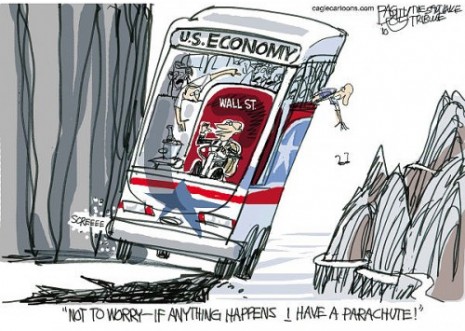
A Parachute for the Economy

The stock market (S&P) is up about 7% year to date. But as we know, the markets doesn’t always reflect the health of the economy. And we have too many wild cards to declare that we are in ‘good times.’

Joe

{ 1 comment }

Your Credit Score

I find the concept of the credit score to be very interesting. It’s a single number which to a degree is an indicator of how good a credit risk you are to a lender.

Yet, in some sense, it tells as little about an individual as a high school grade point average does. I graduated high school with an A average. On a number scale this was 90% or greater. Yet, I barely passed language and social studies. My math and science grades were always mid to high 90’s and that’s what brought up my average. In senior year when I needed just 4 classes to graduate, I took 7, 4 of which were math and science in a calculated effort to get my overall average where I wanted. Gym? The gym teacher had one rule – football players got an A, everyone else got a B if they showed up. In senior year, I wised up, I told the football coach I’d tutor his team in math if he’d recommend me for an A in gym. But I digress.

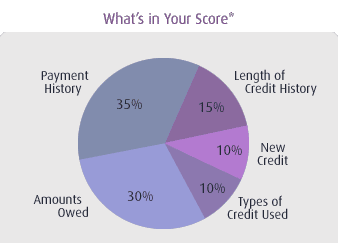
Your Credit Score (otherwise known as FICO score) ranges from 300-850. Let’s take a look at what impacts your score. Payment history, or on-time payment stands to reason. If you have a track record of paying your bills on time, you are more likely to continue doing so. Length of credit history is a tough one. I’ve had credit for 30 years now, yet when I look at my report card as offered by Credit Karma, I find that my average age of open credit lines is only 6 years 4 months. My oldest account is only 13 years 5 months old, and I suspect it’s for my original mortgage on the house we’re in. It was refinanced and 10 years after closing it will fall off the report. This component of the score is the one that has me shaking my head a bit. It would seem that getting rid of old cards you don’t use should be a good thing, it both reduces the risk of a card getting lost or stolen, and it simplifies your finances. If you have multiple cards, more than you think you’ll ever need, it’s a good idea to check your credit score first and cancel them slowly, one by one, to be sure you are not impacting your score too badly.

Amounts owed refers to the percent credit utilization. When I checked mine I found a 6% utilization, but only because I have some pretty high limits. Even though I pay all charges in full every month, if I only had one card and it had a $5000 limit, charging $3000 each month would be a negative. Just like my average high school grades didn’t reflect any one strength, card utilization doesn’t show whether the debt is the same every month or paid in full. With such a low percent used, I’ve nothing to worry about, but I’m curious if I can impact that by paying the bulk of the amount owed just before the bill is cut. If I do that, I’ll update and let my readers know how that worked out. I imagine the card issuers are not reporting real time or mid cycle, but I may be wrong there.

A few points may not impact your cost of borrowing, unless the score is low to begin with and those point bring you over the next threshold. If a loan is in your future, better to take a look at your credit score now and work to improve that score before applying for the loan. Thew lower rate you’ll get will be worth the effort.

Joe

{ 7 comments }