With so many people in the world, it should come as no surprise when an author writes a book on a topic that I’ve been thinking about for some time. It started with a scene in the 1984 Robin Williams film Moscow on the Hudson where he’s in a supermarket and is overwhelmed by the choices of coffee available for purchase. Fortunately, I’ve never passed out in the coffee aisle, but over the years I’ve felt myself a bit paralyzed by the shear number of choices that we have to make on a daily basis, the supermarket among them.
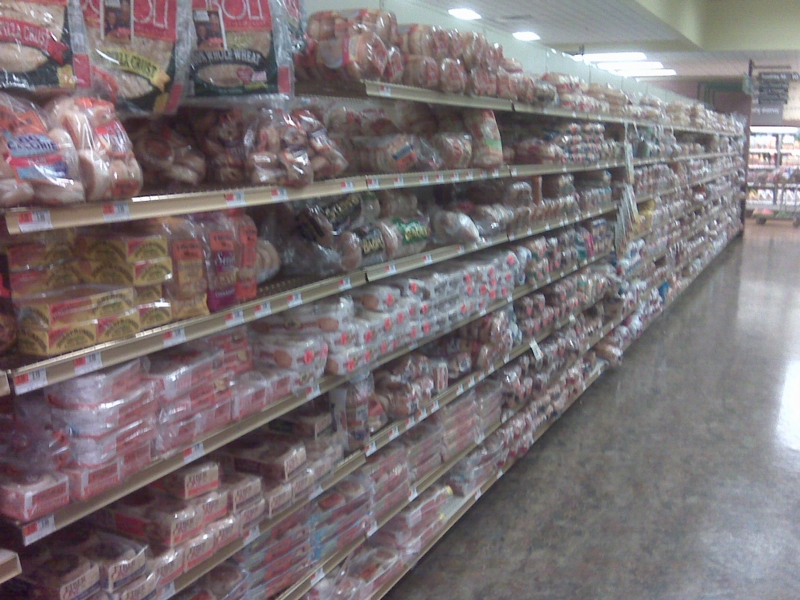
I took this photo a few months back with the thought of writing about this, and then came across The Paradox of Choice by Barry Schwartz which made for an interesting read. The author who I suspect is a bit older than I am (I’m bad at looking at a picture and guessing one’s age, I am 47 by the way) starts with an anecdote about the purchase of a pair of blue jeans. He knows he’s a 32×28 (waist/inseam) but is bombarded with choices, slim fit, easy fit, relaxed, baggy, or extra baggy. Does he like stonewashed, acid washed, or distressed? Zipper or button fly? When I was a teen, I frequented a jeans store that hemmed for $2. So to get it just right, I’d buy the correct waist, but on the long side, wear them and wash them a few times, then go back for my $2 hemming. Barry remarks that what should have been a simple purchase somehow turned into nearly a day long process.
In this country a lack of choice would be unimaginable, yet the number of choices we have with nearly every purchase we make is not liberating but debilitating. We are offered examples of studies that confirmed the phenomenon of too many choices. In a number of different settings, potential customers are offered a few choices of a sample food item, and others, over a dozen. In every case, those offered fewer choices, made a decision and more frequently a purchase than the group that was overwhelmed with items.
I think that Costco hit the jackpot by recognizing this years ago. On my last visit to Costco I found myself chatting with another customer about how cheap the huge shrimp were, and the store manager happened to be within earshot. I asked him if he had heard of this book (he hadn’t) and told he that I now understood Costco’s success. It was the lack of too many choices. Almost no items are available in different sizes, except of course for clothing, and most items aren’t offered by more than 2 or three brands. This fills one’s cart with little in the way of time wasting decisions.
Further along in the book we are introduced to the concept of Maximizer vs Satisficer. The first group tends to try to make sure that every purchase decision is absolutely the best, or as near to the best as possible. The second group, however, will choose something that’s good enough and live with that decision. In my own life, I tend toward being a satisficer. When in my early 40’s, I had the unique situation of buying my first car (having had company issued cars ever since graduating college) I made a very fast decision. It so happened that my best friend and two of my coworkers all had the same make and model car. I asked their opinions and all three were happy with their choice. So, I made the decision to go with that car and spared myself the time and anxiety I hear so many people endure on a car purchase. A few hours on line and I was able to get an idea of dealer cost vs MSRP, to go in and just buy the car.
To be totally honest here, there were times and may still be the occasional time when I tend toward maximizing. In high school I scored a 770 on the math SATs (for those who do not know, this is an exam graded on a scale off 200-800 required by most colleges as part of the admission process) and was very upset not to have a perfect score. My classmates actually sympathized knowing that this was my goal and consoled me, even though it was the highest score in my year. Of course I studied more, actually ‘drilled’ is the right word as I prepped to take it again. The second time I aced it, got the 800.
Years ago, the company I worked for had 4 fund choices, Bond fund, Balanced, Large Cap, company Stock. Of course those choices don’t seem adequate, and the employees spoke out. Three years after bumping the choices to 12, 95% of the total plan value remained in the original 4 funds, and participation in the 401(k) actually fell instead of rising. This situation is repeated in the book as yet another example of more choice really not helping the consumer, only confusing them.
I hope you enjoyed this discussion. It wasn’t a random book I chose to read, as the topic itself had haunted me for years, and I had planned to share my thought on this topic before I was made aware of the book. I enjoyed this book and recommend it if you find the idea interesting.
Joe
 This award was created by Flexo at Consumerism Commentary to recognize the best personal finance products and services, as well as the best blogging in the personal finance category. In case you are curious (I hope you are) about the name Plutus, he is the god of wealth.