≡ Menu

Frugal Friday Week 12

Today, I’d like to focus on the regular use of coupons, and point you to a few web sites to help you along. While the Sunday paper is a great start, some weeks are better than others.

The online sites have been more consistent for me over the last few months. First, I’ll suggest you visit I Heart CVS as er1ca (not a typo) posts adds up to 4 or so weeks in advance for CVS, as well as links to online coupons you can print such as $3off$15, $4off$20 or $5off$25. Combine these pretty large dollar off coupons with the manufacturers coupons and extra bucks (rebates that print on your receipt that are cash for your next trip) and you save quite a bit.

Next, look at Coupons.com. This site posts well over 100 decent coupons each month, as well as some that change a week at a time. Many are .75 and can be doubled if your local grocery store does that for you. If you sign up on the site with your email, they’ll send you a note at the start of the month to remind you to take a peek.

Coupon Dad has a selection, although a number of coupons offered first require a visit to a web site, a bit more effort than I’d like to put into a single coupon.

Retail Me Not offers both coupons for shopping on line as well as those you can print out.

Last, both SmartSource and Valpak have a selection of both printable and online coupons to choose from.

If you are living on a tight budget and need to find even $10 – $20 a week in savings off your grocery bill, this is a great way to spend just a bit of time to reach that goal.

Joe
{ 2 comments }

Money Merge Account Analysis Pt 33

I’ve used the term Innumeracy here to describe the equivalent to numbers what illiteracy is to reading. However, I now seek a stronger word or phrase to describe the egregious claims I’ve run across. I’m leaning toward “numerical blasphemy,” but am open to suggestions.

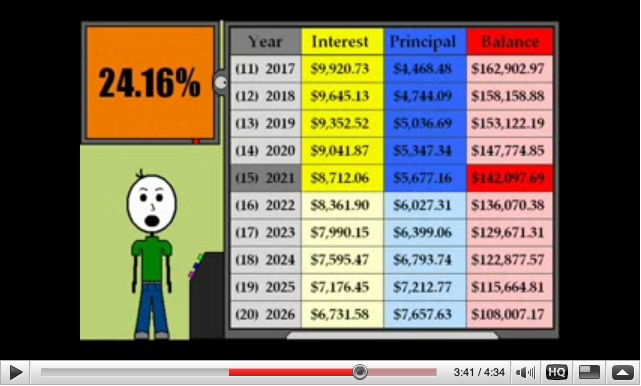
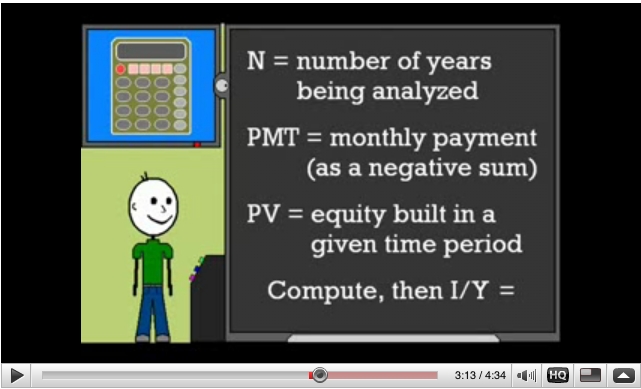
A Money Merge Account agent sent me a link to a You Tube video titled Truth in Lending. The author wanted to illustrate the concept of “front-loaded” interest on a 30 year mortgage. I’ve never seen a post that started with that idea end in anything that made sense, this video was no different. The video itself was well done, nice animation and voice over, but the numbers soon fall apart. I’ll offer two screen shots that show this.

truth1

As this slide came up, it seemed innocent enough,unfortunately it ends incorrectly. When working with a financial calculator you need to be very specific. N is not the number of years but number of payments, in the video’s example, 360. PMT, the payment, can be positive or negative depending on the calculator. Excel looks for it to be negative, a classic TI BA-35 calculator, positive. PV is not the equity built, but the present value of the mortgage, starting at the borrowed amount, and of course, ending with a FV (future value) of zero. He then says Compute, but there are two variable missing, %i (the interest rate) as well as FV. So, while I have no idea what his intention was, he now suggest taking I (the interest rate, I suppose) and dividing by Y (years, but why?) to produce a number which is admittedly large but meaningless.

truth2

Here, you can see that he author suggests that somehow the interest rate over 15 years is over 24%. But, back to a calculator or spreadsheet, we can see that PV = $200K (original loan) i = .5% (monthly rate or 6%/12) N=360 months (30 years) FV = 0 (after 30 years it’s paid to zero. If we enter these numbers we can comput the missing variable, the payment, which is $1199.10. Then it’s simple to set N to 180 (year 15) and compute the new future value, $142,097.69, as he shows above. On the other hand, we can enter PV =$200K, i = .5%, PMT = $1199.10, N=180 and FV = $142,097.69, and ask to calculate the rate, which of course comes back as .005 or 6% per year. By the way, it’s easy to look at the interest column above and divide say, the 2021 interest into the prior year ending balance and see you get under 6%. A couple hundred video views and no one saw how silly this all was?

As far as front loading is concerned, there’s nothing diabolical in how mortgages are calculated, you owe interest on the principal outstanding at any given time. Since you owe far more in the early years, more of your payment is interest. On this example $200K mortgage, in the first month the interest is $1000, but the principal paid is only $199.10. Pay more if you wish, that’s your decision. But don’t fall for an abomination of bad math. What does this have to do with the Money Merge Account? Only that every time I see numbers abused this badly I’m reminded of my friends at UFirst and the MMA.

Joe

{ 10 comments }

IRA Donations

The Emergency Economic Stabilization Act of 2008 renewed the rule allowing one (over 59-1/2) to made a charitable donation of IRA funds without claiming the money as income. If you itemize, you can already take donations off your taxable income so this would have no affect on you. But, if in retirement, your deductions don’t total enough to itemize, this is a way of saving the tax due on the money you’d withdraw from the IRA by donating it directly to the charity.

Also remember, that this year (2009) the requirement to take RMDs is suspended, so if you don’t need the money to spend, start to review your marginal rate and consider a conversion to a Roth IRA. For a Married Couple, filing joint, taxable income up to $67,900 is taxed at 15%, this is a great opportunity to get the tax out of the way while it’s still only 15%. Something to consider.

Joe

{ 0 comments }

Posts from my Fellow PF Bloggers

Fiscal Geek made a Homemade Air Conditioner. Both frugal and practical, it came out of the combination of a heat wave and empty shelves at Home Depot where the air conditioners belong.

Still on the subject of Frugality, Moolanomy posted a list of Best Free Essential Software For Windows. On the list, OpenOffice.org gets my vote for best of the best. This open source (not to be confused with anything illegal or pirated) software is a Microsoft Office look alike, and works on Macs and Linux based computers as well.

Saving for Serenity takes a look at the Serenity Prayer (You know it – God grant me the serenity to accept the things I cannot change; courage to change the things I can; and wisdom to know the difference) and offers a clever spin on the things he can and can’t change in his live regarding finances. I found his post to be more profound than perhaps he even realized, but that’s great. I hope he reads it again in a few weeks gives himself some credit.

Fiscal Geek was on a roll this week, (or maybe I need to get out more) his Debt Bait: 10 Methods to Credit Servitude was great reading, talking about the pitfalls of debt and the many ways to go down that path. I must admit, the first item on the list discussed the “Perk” cards, air miles, rebates, etc, hit a nerve with me. I agree with his conclusion that the banks are betting against me, and I maintain they will lose. But just like Dave Ramsey is speaking to a certain audience, I’ll read that first list item as “in any large enough group of people, most will lose this game, few will come ahead.” To add to his point, I came across a 2007 post on Poorer Than You, Do We Spend More When We Swipe Plastic? and the author, Stephanie concludes the answer is yes.

JD at Get Rich Slowly writes about “What We Wish We Knew When We Were Younger.” I have to give this more thought to come up with my own answers, but a post like this does get you thinking.

I wish you some good reading this coming week.
Joe

{ 2 comments }

Forced Health Insurance?

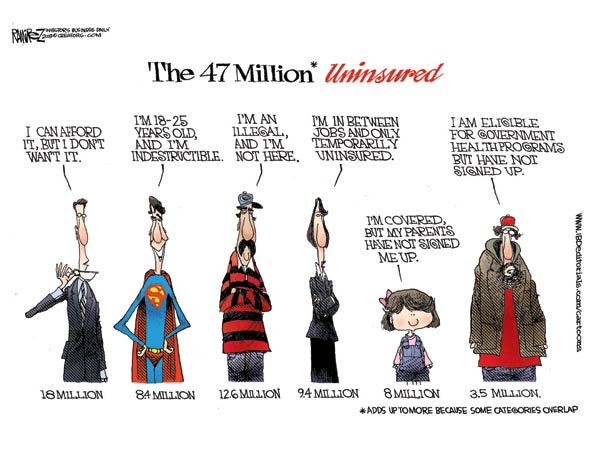
uninsuredHope you’re all enjoying the weekend……

{ 0 comments }