≡ Menu

Frugal Friday Week 7

Subtitled, “The CVS Edition.”

As part of watching your spending, timing purchases according to the sales cycles and using coupons to save even more, consider the deals that CVS offers week after week. A few weeks back, Dove bath soap, normally $8.29 for six bars, was on sale for $7. But CVS had an “extrabucks” (ECB) deal, if you spent $20 or more on this product, you’d get back $10 in ECBs. So, with no extra effort, you’re now at $11 for 18 bars, instead of $24.87. But wait, it gets better. By glancing at Erica’s web site I Heart CVS I was alerted to a $4 off $20 printable coupon. After presenting it, I also had two $1 coupons good off any multi pack of Dove. Final cost was $5, less than you’d pay for generic soap. The I Heart CVS site also offers a glance at the weekly flier up to a month or so out. Erica frequently posts her hauls on line so you can see her strategy and how she consistently is able to save 75% or more on these purchases. Take a look at there and see how you can turn just a few minutes of your time into a savings of $20 or more. Remember a dollar saved is not a dollar earned. It’s more like $1.50 or more that you’d need to earn to clear that $1 after taxes.

On a visit planned for the week of July 12, I plan to get Zaditor eye drops ($14.99 with $3ECB) three packs of pens ($0.99 with $0.99ECB on ea, two pair scissors ($2.99 with $2.99 ECB on ea) and two glues ($0.99 with $0.99 on each). Total bill, $25.92. I have a $5 ECB, a CVS coupon for $5 off the Zaditor and a $2 manufacturer coupon on the Zaditor, net register bill $13.92. But I also leave with $11.95 in ECBs or $6.95 more than I handed in. A net cost of $6.97 for a $15 necessity and a head start on a few school items.

As they say, your mileage may vary. Some weeks are better than others, but I find that with very little effort the savings make the planning worth it.

Joe

{ 0 comments }

College Financial Aid

We all know the drill: The month before your baby is due, while the paint in the baby’s room is drying, you go to your broker’s office and get the paperwork to set up a college savings account of one type or another. This post was originally titled “Saving for College,” but as I learned more, I decided to focus on the Financial Aid aspect instead.

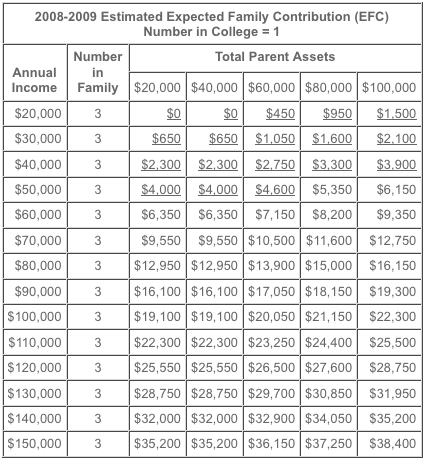
The financial aid process comes with its own acronyms, the first I ran into was FAFSA, (Free Application for Federal Student Aid, only use the Dot Gov site, other sites charge a fee). Next came EFC, the Expected Family Contribution. This chart, generated from the site FinAid is a great start to understanding the process:
collegeEFC

This chart is based on parents’ income and assets. You can see that as income rises, the percent expected to be paid toward college rises from about 17% at $40K to over 30% right after $70K income level. Assets are not treated so harshly, rising from 2% to 4% as income increases. Equity in one’s home isn’t counted at all.

On the other hand, 50% of student income is expected to pay for college (ouch!) and 35% of student assets.

Parents’ retirement accounts are not considered in the equation, and a 529 account is considered a parent’s asset, not the student’s.

Before I discuss a few strategies to maximize the aid your child would receive let me observe that the average cost for a private four year school was $25,143 for the 2008-9 school year and the public four year cost averaged $6,585 (it was just announced that these numbers rose by 4.3% for 2009-10). Looking at the chart above you can see that for a public school an income above $60,000 will make aid hard to come by, as an income above $120,000 will support the full cost of private school.

A number of strategies that can make a difference in your EFC:

Fund your 401(k) until it’s max’ed. If you reduce your income from $60,000 to $50,000, you will save $2,350 in the EFC hit as well as $1500 in federal tax for a total $3,850. (See Fairmark to better understand your tax bracket.) After graduation, if you must withdraw the $10,000 you will only be hit with $2,500 in both tax and penalty. (Just making a point, save it till you retire.)

If you are sitting on an investment (non-retirement account) portfolio, and still have a mortgage, pay it in full. $100,000 in assets will be “taxed” at $3,000 per year at the $60,000 income level and $3,200 at higher incomes. If your mortgage is 5%, this translates to over an 8% return on the money each year for the four years of college.

Given the 35% of student assets expected to be used for college, I now understand why so many freshmen are driving expensive cars. Consider, $50,000 in the student’s name will be spent down to $8925 over four years, $41,074 expected to be used for college. In another case of “unintended consequences,” it actually makes sense to go buy a car and blow the money. A better choice would be to take advantage of tax sheltered retirement accounts, 401(k) if the student works a regular job while in high school, Roth IRA if working for a company with no retirement account. The IRA limit is $5000 this year. One can deposit up to 100% of their earned income into an IRA up to that $5000 maximum.

Other advice I’ve run across suggests having your children close together as the aid formula is kind to those with two or more students in college at the same time. If your two children are a year apart, perhaps the older one wants to take a year off before returning to school. These two suggestions are a bit extreme, but will increase your potential aid nonetheless.

Suggest to any helpful friends or relatives who with to help with the cost that they wait until graduation and apply that gift to any loans, but not gift it to the student while in school.

If you are well above the income levels that will qualify you for aid, congratulations, you’ll be paying your student’s way, but if you are in that middle, I hope these strategies help you. For more on this topic, see the article When Saving Means Losing.

Joe

{ 7 comments }

Good Bye Bernie

madoff

I heard today that you are sentenced to serve 150 years. It would be ironic if medical breakthroughs over the years let you serve half that time behind bars. Either way, you got what you deserved. How many lives did you ruin? How many retirees will need to return to work after thinking they had don’t the right thing investing with someone of you caliber?

And yet, too many questions remain. Why did you do it? How could those around you not have known? How did the SEC miss this, twenty years of your Ponzi scheme, no trades, who’s minding the store?

And yet, in a different view of this tragedy, Joe Nocera suggests “Madoff Victims, Get Over It” claiming that his investors were greedy, chasing the promise of higher returns in an elite investing club. With greater returns comes greater risk. The returns Bernie Madoff claimed were beyond reasonable and that should have set off some red flags. But this is hindsight.

Tomorrow, College Financial Aid.

Joe

{ 2 comments }

This week’s blog reading

First was Jeff Rose’s 12 Common IRA Mistakes To Avoid, a great list of mistakes, many of which I’ve discussed in various posts on my own blog. Maybe it’s the list format that attracts me, or maybe it’s just that the first few are the issues that we know about, so when an author digs deep enough, 12 here, he comes up with gems that aren’t commonly discussed. Take a look at Jeff’s list, I promise you, you will find at least 3 things that didn’t occur to you.

Mike at Four Pillars wrote, Is Dave Ramsey A ‘Financial Expert’, and I’ll not ruin the punchline for you. I did write to Mike sharing my agreement with his conclusion and mentioned I had a Dave Ramsey post of my own on the drawing board.

I also found that J.D. updated his reading list with “25 Essential Books About Money: Financial Wisdom from Your Public Library.”I’ve maintained my own suggested reading, but J.D. has gone one step further, offering a mini-review for each book and nicely grouping them into topics: Debt Reduction, Everyday Personal Finance, Investing, Financial Independence, Psychology of Money, Kids and Money, and Financial Journalism. I consider myself pretty well read, but J.D.’s list will be the source for my library requests for the next few months.

I also took some more time to read Sherri’s serene journey, last week her recent post was my find, but reading her site some more let me to her series on Eliminating Clutter. She start the first of three posts offering how clutter costs (thus the tie-in to my financial focus) in Time, Money, and Health. The series does a great job to offer ideas of clutter’s source and how to get it under control. Her blogroll includes Unclutterer which offers daily tips on how to organize your home and office.

Joe

{ 1 comment }

Teachers Can Save The Economy

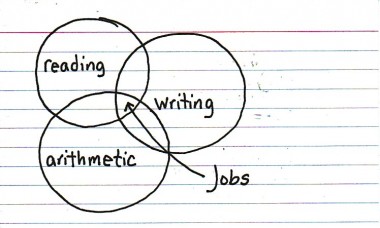
From the web site Indexed:indexedteacher

I am a frequent reader (viewer?) of Jessica Hagy’s site Indexed where she offers a daily view of life with a chart or venn diagram. The above struck me as interesting as I’ve always had a soft spot for teachers.

Joe

{ 0 comments }