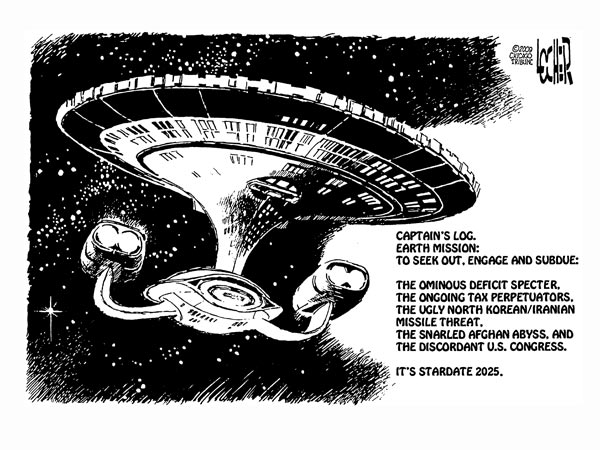
I’d not miss a chance to pass along a Trek related political cartoon.
Enjoy the weekend,
Joe
I’d not miss a chance to pass along a Trek related political cartoon.
Enjoy the weekend,
Joe
Last week’s assignment was to track your expenses, to the penny. I’ll revisit that next week. Today, I’d like to talk about finding some quick savings if you carry a balance on your credit card. It’s very simple, call each lender and ask them to lower your rate. With the average card holder carrying nearly $10,000 in credit card debt, each percent you are able to save is $100 in your pocket. If you have any recent card offers in the mail, having one handy may help. Use it to tell the old bank that you have the offer in hand but would rather just stay with them. The worst case is the bank might say no, but the chance at saving as much as $500 per year should be enough to spend the 20 minutes or so on the phone. Good luck, let me know how it goes.
Joe
After Tuesday’s Credit Card Reform post, I received a number of emails asking how to get one’s credit score for free. I had written about this over a year ago, telling my readers how a WAMU (Washington Mutual) credit card offered free access to your credit score as a benefit. Sure enough, WAMU was taken over by Chase Bank, and that little perk was canceled. Now, another company offering free access to one’s score is Credit Karma. This is currently the only free credit score (with no 30 day trial to some monitoring service) that I’m aware of. A credit score doesn’t tell the whole story, but as in can have an impact on the rate you’ll pay for a mortgage, car loan, or credit card, it’s a good idea to know your score and maybe heko inch it up a bit before applying for new credit.
This would also be a good time to recap how your credit score is calculated:

By the way, the above is from a PBS special, “Secret History of the Credit Card.”
FICO formulas are still a bit of a secret, but the above is a good start. As I’ve read more about each of these criteria, I understand that ‘amounts owed’ are a ‘percent available credit used’ more than total dollars. So accepting a new card and instantly using the entire line may have a bit of an impact, but this is where unused credit on other cards actually helps bring down the total percent used. Of course, applying for too many cards in a short timespan also will impact your score. Canceling cards can hurt you in two ways, raising the ‘percent credit used’, and reducing average age of accounts, so you are correct, these are concerns.
I’d also suggest an article “Five Mistakes That Hurt Your Credit Score” by Jeffrey Strain of TheStreet.com which adds to the thoughts I presented here.
Last, you can go to annualcreditreport.com and request to view your credit report from each of the three nationwide consumer credit reporting companies: Equifax, Experian and TransUnion. Since each one permits you you view your report annually, you are able to view a different one every four months. I’ve not seen the value in paying for credit protection since your credit cards’ liability limits you to $50 so long as you repost a card stolen soon after you are aware it’s missing. Keep in mind – Credit Report is a list of all your current debts, including open accounts along with their available credit as well as recently closed accounts, Credit Score is one number ranging from 300-850. Neither shows your income but only reflects how you’ve handled the credit you have. The credit report will show late payments and that will impact your credit score. I believe the changes in our banks’ behavior will impact all of us, and result in undeserved lower scores.
JOE
President Obama signed the Credit Card Reform act (officially called the Credit Card Accountability, Responsibility, and Disclosure (CARD) Act of 2009) last week and I’d like to offer my thoughts. First, let’s review the rules that will be put into place under this legislation:
These are the major points contained in the 269 page pdf, available from the treasury web site (Note – The document may not open in some vbrowsers, right-click if you wish to download and read it). Now, let’s look at what isn’t addressed and the unintended consequences of this legislation:
This is one story I am certainly going to follow, as we all have an interest (pun intended) in its outcome.
Joe
On our family trip two weeks back to California to see our friend graduate, we spent an afternoon on the boardwalk on Venice Beach. A couple dozen yards or so away I saw a man holding something up with one hand and holding his his other hand out as people just passed him by. I’m in the habit of handing a dollar or two to people who appear to be homeless, and I reached down to see that I had some singles at the ready. As he came near me, I saw he was wearing dog tags, and the thing he was holding up was some kind of veteran’s ID card. He asked for $2, telling me that it was all he needed to go buy lunch, and said that he was a Vietnam vet. Almost at a loss for words, I handed him the $2, and said, “thanks for serving.” He kindly responded, “you’re the first person ever to say that to me.” This seemed an appropriate story to share with you today.
Joe