Just thought I’d take a look back and share some fellow bloggers’ posts that caught my attention this week:
From Moolanomy’s Personal Finance, an article titled 40+ Alternative Income Ideas and Resources. Actually, he’s up to 50 as I write this, he’s added a few more since the original posting. Here, the author shares his list of ways to make extra money, running the full range of the very simple, such as selling your old stuff on eBay, to the second career level of commitment, such as “get a second job.” This isn’t just a list (lest you think “get a second job? d’uh?) but nearly every item on his idea list offers a further link for more details and to start your research if that idea appeals to you.
Flexo at Consumerism Commentary alerts his readers that Schwab Brokerage Lowers Expense Ratios, Beats Vanguard. This bit of news didn’t get the press I’d have expected. Funny, I am a Schwab customer, and I’d not have seen this news if it weren’t from Flexo, the blog author. My experience investing tells me that over time, the difference between excellent results and results that simply fail to please, is expenses. Something to consider.
At Five Cent Nickel is Risk Tolerance vs Risk Capacity. An excellent piece describing the difference between Tolerance (one’s attitude) vs Capacity (goal based risk required for one’s situation). A further link offers a quiz to show you a number to determine your level for each.
One last one I’ll share today, a personal post from Mrs. Micah, is What I’d like to Give my Mom for Mother’s Day. As we get bogged down in the day to day grind, it’s posts like this that make you stop and think, about people and not things. About those whom you love, and not the stupid issue you had at work this past week.
Happy Mothers Day, everyone.
Joe
{ }

As a lifelong fan of Star Trek, I’d not miss a chance to reprint a political cartoon that references the franchise. Out of respect for Matthew Shepard and his family no comments will be accepted for this post. Please visit the Matthew Shepard Foundation web site to offer your support and to understand why I’m proud as a Trekkie that the artist of this cartoon chose the Starfleet emblem to represent a message of “erase hate.”
Joe
{ }
Yet another financial term in the news these past few months.
A couple weeks ago, MSN money printed an article “10 companies that could go bankrupt” in which they disclose that the criteria to be chosen for the list was the value of the credit default swaps on the companies’ 5 year bonds.
So let’s look a bit at what this means. When an institutional buyer of say $1M face value in a company’s bonds want to protect itself from the risk the company will default, it may enter into an agreement with a third party and pay an annual premium similar to an insurance policy. If the company pays 8% (or $80,000 on that million face value), the buyer may pay $20,000 to the third party for insurance against default, otherwise known as a credit default swap (CDS). Simple enough, right? Well, not so fast. One may buy the CDS without having the bond it’s insuring against. Consider this – An insurance company will not sell a life insurance policy on me to a stranger. Nor will it sell me an inappropriate amount of insurance, say 100 times my annual income. (Imagine the macabre possibilities if a stranger could buy any size policy on your life, the making of a horror film.) No such regulations apply to CDSs. So there’s a fine line between a CDS functioning as proper hedge against risk and one which is part of a speculation running counter to the good of the system.
As the subprime market started to fail many bonds dropped in value causing distortions in the CDSs traded on those bonds. Many of the companies on the MSN list have positive cash flow, servicing their debt, and buying it back at depressed prices. Will some of them fail? No doubt. The article itself was based in poor research which was not adequately described for the reader’s benefit. The equivalent of throwing gas on a fire.
Joe
{ }
The CDC stated in 2003, “Using new and improved statistical models, CDC scientists estimate that an average of 36,000 people (up from 20,000 in previous estimates) die from influenza-related complications each year in the United States.”
Since the flu is somewhat seasonal, this implies a peak death rate of well over 100 per day.
From a press briefing yesterday: “The World’s Health Organization earlier today was reporting 898 cases in 18 countries. I like to each day put this in context with seasonal flu. With seasonal flu, we see in the United States over 30 million cases. We see 200,000 hospitalizations and, on average, 36,000 deaths.”
There’s no evidence that this strain is any more contagious than normal. It seems to me the only thing that differs is that this strain has gotten a strange name. Would it be so frightening if it were never named, just left with the H1N1 designation? I refer to this as the bull flu because it hit the press just as the market appeared to be gaining a bit of upward momentum. Months from now, it will have been yet another panic over nothing. Remember Y2K?
Joe
{ }
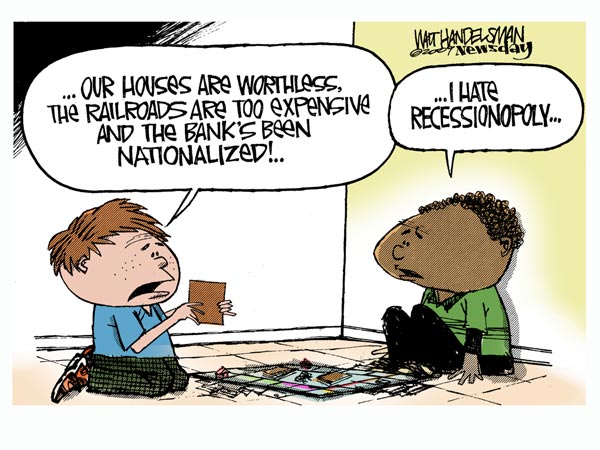
Let’s hope this isn’t the version our kids will be playing. Enjoy the weekend.
Joe
{ }