This week the tax on cigarettes went up to $1.01 from 39 cents per pack.
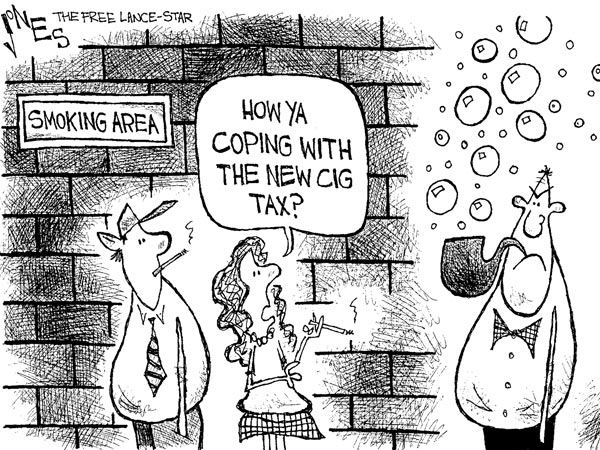
Have a smoke-free weekend!
Joe
This week the tax on cigarettes went up to $1.01 from 39 cents per pack.
Have a smoke-free weekend!
Joe
Today, the Financial Accounting Standards Board (FASB) met to consider adjustments to its mark to market rules:
FASB agrees the objective of mark-to-market accounting is still what would be received in an orderly transaction in the current inactive market.
FASB says an ‘orderly’ transaction does not include forced liquidation or distressed sale.
FASB agrees to remove presumption in mark-to-market accounting rule that all transactions in an inactive market are distressed unless proven otherwise.
What does this mean? It means that when an asset such as a mortgage security, has no market, no willing buyers, that the banks which own such assets do not need to price them at firesale prices. This gives banks more flexibility in valuing the assets on their books and for what it’s worth the market reacted positively on hearing the news.
Joe
I’d like address two related topics today. First is Affinity Fraud. (<< If you haven’t caught on by now, the underlined words are a link to an article) From the SEC site I linked to; “Affinity fraud refers to investment scams that prey upon members of identifiable groups, such as religious or ethnic communities, the elderly, or professional groups.” Why do I bring this up in my MMA series? Simple – because, due to the nature of MLM (multilevel marketing) sales, most sales tend to be made to a friend, relative or co-worker. No, I don’t have precise data on this, the evidence for me is intuitive. Every single agent that has written about happy customers of MMA refers to his/her parent, sibling, friend, co-worker, etc. purchasing the system and liking it. Making a sale of this nature cannot be easy, thus the claimed 100,000 sales made by a total of 50,000 agents. This implies an average sale of “one” as each agent is also a user, and first sale of another agent. On one hand you can suggest it natural that one would try to sell such a product to the people they do, but this is exactly how frauds (such as the recent Madoff Ponzi scheme) was perpetrated. For now, that ‘s my brief though on this topic.
Next, I’d like to offer what I find to be a very strange mix of God and MMA. I recently had a dialog with a woman on Bargaineering.com and the conversation quickly took a strange turn. She offered “Go look up Jesus Christ on the internet and see what ‘Experts’ say about him. So many people and so called experts will say he is not the Son of God and will really say some really ugly untruths about him, but we all know the Truth. So I don’t care what Kiplingers says, just like I would not base me continuing or deciding to be a Christian on if people on the internet (Same as reading junk on a bathroom wall of people’s opinions) and magazines and experts said there is no God or Jesus Christ was only a teacher and not the Savior.” Well, first, religion is a very private thing, and I shy away from trying to convince anyone of my views. I do know that many religions rely on faith to accept things that cannot be proven. On the other hand, the concept of a “Faith Based Mortgage Accelerator” seems a bit strange to me. The woman I dialogged with asks me “Did God anoint you to build a mission based company like UFF? No, he did not. He choose someone else.. Does that bother you? If it does then all you need to do is submit your plans for creating a better solution that will help America get out of the bondage of debt.” Wow, I’m sorry, it’s tough to criticize someone anointed by the Big Guy Himself.
So for my religious readers, I’d have to ask how to reconcile “judge not, lest ye be judged” with “love thy neighbor as thyself.” Am I guilty of judging when outing what I know (not believe, but know) to be a scam, or is it my obligation to use my knowledge to protect my neighbor from such scams. In all of my writings, I’ve done my best to avoid ad hominem (personal) attacks, although I’m sure I’ve slipped now and again. I’ve also tried to stay away from the ridiculous lists of references, those who approve or disapprove the program, trying to let the numbers speak for themselves.
In another post to me she writes “The real scam I believe in America is the 30 yr fixed mortgage with all front loaded interest for the 1st 10 yrs or more and people like you and your sources are probably in one and going to be in the bondage of debt and servant to the lender until they die.” Front-loaded? Interest is charged on the balance outstanding, and that’s just how it works, there’s no deal with the devil here, just math, and the time value of money. “Bondage of debt”? My mortgage payment is about 15% of my gross income, it’s a bill to pay, right there with property tax, gas, electric, summer camp, etc. In biblical days (and pardon my ignorance, I think today the Amish, too) a group would gather and raise a new house in a few days for the newly married couple. Today, with homes costing multiples of one’s annual income, the mortgage is needed, a necessary evil.
Joe
I recently heard that iTunes was planning to raise the price of some popular songs from $0.99 to $1.29, and at the same time, some less popular songs would be reduced to $0.69. Makes sense to me. But from techdirt, “Oddly, the LA Times article claims that the new pricing scheme is “true to supply-and-demand economics,” but, as Gizmodo notes, that’s not true at all. The supply is infinite. So if it were true to supply-and-demand economics, the price would be free. The actual price is based on an artificially limited supply and a made up demand.” Huh? Let’s look at a supply demand graph;
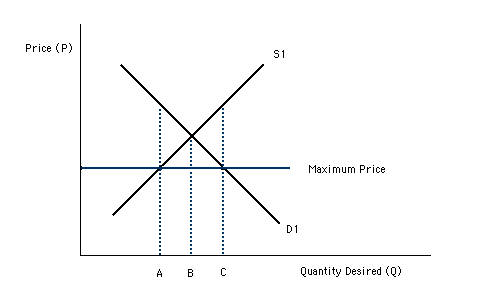
Supply only goes up if the price is maintained, at a price of zero, the supply drops to zero as well (in theory). The Gizmodo quote confuses the medium (the bit going across the internet) with the product itself (the song). The supply of good music is certainly not infinite, you’d not listen to any and every bank or piece of music that came along. Just as their are bands whose concert tickets are scalped for many hundreds of dollars, their are also bands who don’t sell out their concerts. There is nothing that’s infinite, even clean water is not plentiful everywhere on earth.
I’ve heard of soda machines which contain temperature sensors. These machines are programmed to bump the price based on the temperature, rate of sales, and level the machine is full. iTunes seems to be the perfect venue for little known bands to offer their songs for a lesser amount, even free for a time, and for superbands to get a bit more money. But lets not kid ourselves, supply/demand is far from dead.
Joe
On my feature article blog, I’ve shared my feelings on variable annuities, and ended one of the posts with the note that Jefferson National offered a VA with costs so low, that for those who might benefit from such a product, I felt it worth considering. I was recently contacted by Jefferson and asked if I’d consider a guest post, and I agreed. I offer this disclaimer: I have not asked for nor was I offered any compensation for this post, my motivation is to bring to my reader’s attention financial information that may benefit them. After my rants regarding expensive VAs, sharing this with you seemed appropriate. The following appears unedited.
Refinancing Retirement: Trade-Up to a Flat-Insurance Fee VA through a Tax-Free 1035 Exchange
By Laurence Greenberg
Variable Annuities are Ripe for Exchange
In the ’90s bull market, consumers purchased variable annuities (VAs), thinking they would drive greater tax-deferred growth and earn more on retirement savings. But with high asset-based insurance fees and a limited selection of investment option, many of those annuities haven’t delivered.
“Many people bought variable annuities and neglected them”, says Aaron Grey of the fee-based advisory firm Denver Money Manager. “Now, years later, these VAs have consistently underperformed investor’s expectations”. Even worse, investors are often locked into their underperforming VAs due to high surrender charges, which penalize withdrawals made in the first five to seven years.
Today, Morningstar estimates that there is more than $1 trillion in retirement savings tied up in variable annuities.1 With asset based insurance fees averaging 1.35% of invested assets per year2, that means consumers are spending roughly $14 Billion each year on asset-based insurance fees alone.
The Solution: A New Category of Flat-Insurance Fee VAs
Fortunately, a tax-free 1035 exchange can allow you to take advantage of cost-saving innovations, such as no-load, no-surrender charge, flat-insurance fee VAs. Just as you might choose to save more of your hard-earned money by refinancing a high cost mortgage, loan or credit card, a tax-free 1035 exchange may allow you to save considerably more each year on your variable annuity.3
Faced with longer life spans and a failing retirement safety net, consumers need to save more. Once employer-sponsored plans and IRAs are maxed out, VAs are a powerful alternative for long-term tax-deferred investing. But, if traditional ‘old school’ variable annuities aren’t performing, a new flat-insurance fee VA might help you increase the power of tax-deferral so you can accumulate more and reach your savings goals faster.
The variable annuity Grey recommends most often has a flat-insurance fee of $20 per month, no matter how much you invest.4 On a $100,000 contract, that’s the difference between paying an average of $1,350 per year on a traditional variable annuity versus just $240 per year with a new Flat-Insurance-Fee VA. And this new model offers 5x more funds than the typical VA2, to help you better manage risk, adjust to business trends and market cycles to improve the performance potential of your retirement portfolio.
More Money for You – Not Your Insurance Company
By eliminating excess fees, these new Flat-Insurance Fee VAs have the potential to ‘buy back’ a lot of performance according to Grey. Rather than giving up 1.35% or more every year to the annuity company, that’s money you can re-invest into your account, giving you significantly more assets to compound and grow for retirement. “This is especially important in today’s low-return environment,” says Grey.
The way he sees it, a 1035 exchange simply makes sense for investors with underperforming VAs or anyone who’s currently in a variable annuity and paying too much.
.
Laurence P. Greenberg is President and CEO of Jefferson National, which developed Monument Advisor, the first flat insurance fee variable annuity. See the impact fees and charges may actually have on your savings by taking the challenge at www.AnnuityRescueCenter.com. For more information or to receive a prospectus, visit www.jeffnat.com or call 1-866-WHY-FLAT (866-949-3528).
1 National Association of Variable Annuities (NAVA) and Morningstar quarterly data reported as of 12/31/2007.
2 Morningstar data as of 12/31/2007.
3 Before exchanging, please review the policy and prospectus to identify any penalties, surrender charges or loss of benefits that may pertain to your existing variable annuity contract. Please consult with a tax advisor for any potential tax consequences of switching from one variable annuity to another. Please note this is not an endorsement to switch from your current variable annuity. You should review your particular situation to determine which variable annuity is appropriate for your needs
4 Jefferson National’s Monument Advisor has a $20 flat insurance fee on more than 97% of our underlying funds. Certain funds also have a transaction fee ranging from $19.99 to $49.99 per transaction, depending on the number of transactions per year. See the prospectus for details. Like other variable annuities, the customer pays fees of the underlying funds selected plus the fees of any advisor hired.