by Joe
on November 21, 2008
In 2006 and 2007, there was a tax law allowing someone over 70-1/2 to make a donation from their IRA, even if this was part of their RMD. This had a very narrow audience of interest, one would have to find herself a combination of 70-1/2 or older, therefore taking IRA RMDs, making donations worth the effort to do the extra paperwork, and not an itemizer. The benefit for this situation is that the donor is making the donation directly from IRA to charity, and therefore avoids the tax due on that portion of her distribution.
Given the limited discussion of this topic, I expected it to expire as 2007 closed, and not get revisited. I was mistaken, the Emergency Economic Stabilization Act of 2008 renewed this law for both 2008 and 2009.
Joe
{ }
by Joe
on November 20, 2008
When I was discussing Mortgage interest, I received a few emails asking to to spell out a bit more clearly how regular mortgages calculate interest vs how home equity lines of credit (HELOCs) calculate. Fair enough.
One disclaimer; before you act on my explanation here, confirm with your bank that your mortgage is as I describe. I share here my understanding and experience, but it’s certainly possible that your bank follows different rules.
A standard fixed mortgage with a due date of the first of each month will often have a grace period allowing payments up to the 10th or even the 15th of the month with no late fee and no extra interest accrued to the account. On a monthly payment of $1200, this extra 15 days float is worth about $36 assuming a 6% mortgage. You see, it’s money available 15 days per month or half the time, so half of $72 is $36. Not a huge sum, but if your bank has a grace period this generous, you can save a bit by taking advantage. Just as the bank may have a grace period, they will not offer you any savings by paying a week, two weeks, or even a full month early unless you specifically note the extra funds are to go to principal. In that case the next regular payment is still due on the upcoming first of the month.
A HELOC, on the other hand, charges interest to your account based on average daily balance. I know of no bank that will lend you money from the 1st to the 29th but if your balance is $0 on the 30th will charge you no interest. That suggestion is absurd, and repeated by people who are either very confused, or those trying to perpetuate a lie. Just because someone in the mortgage business believes he “borrowed the bank’s money interest free” doesn’t make it so. In fact, it undermines his credibility as well as the agent who uses such nonsense as “proof” and a testimonial. To be clear, whatever the rate is on your HELOC is multiplied by your balance at each day’s end and accumulated over the course of the month. If you borrow money on the 1st and pay it in full on the 3rd, that’s 2 days interest. If you run a small balance, this may just amount to pennies, but you are still being charged this interest each day.
MMA agents will confuse you with this even more easily than they confused this mortgage broker. They will suggest that there’s some magic to the the way HELOCs calculate interest vs how the standard mortgage calculates. There may very well be a few dollars savings to be captured, but that’s nothing compared to the $1000 you are prompted to pay each month from your own money. Don’t be confused into believing the software creates this savings. In fact, when you ask an agent to run an analysis using as little discretionary income as possible, you’ll find they offer you numbers that easily show the lack of value of this software. I’ll discuss their analysis further in a couple weeks.
Joe
{ }
by Joe
on November 19, 2008
My server was down and I had not set anything up in advance. By the time today came, I’ve been editing and finishing the next few day’s topics. So today turned into a ‘gone fishing’ day, which I will keep to a minimum. To those who tried to log in most of last night, my apologies. All in all, I’ve ben satisfied with the hosting company I use.
Joe
{ }
by Joe
on November 17, 2008
I’ve remarked that by February/March when many of us are running to our tax man (queue up the Beetles’ song by that title) it’s already too late for certain things it may be wise to do before year end.
Selling stock at a loss may be something to consider. First, if you have any stock gains during the year, losses will offset or completely cancel those gain. If the losses are greater than your gains, up to $3000 may be taken again ordinary income producing a tax savings.
One reason I bring this up today and not mid-December is that you may feel that the stock you hold have good fundamentals and you expect them to rebound, i.e. you wish to hold them for the long term. You are not permitted to sell stock at a loss and buy back the same stock in fewer than 30 days. This is called a wash sale, and the loss is not allowed, it simply reduces the cost basis of the repurchased shares. You are, however, permitted to buy shares, wait 31 days and sell the losing shares (identifying those shares to your broker as the shares you wish to sell) and not run afoul of the wash sale rules.
As always, I warn that you should not let the tax tail wag the investing dog. And you should always know why your portfolio is invested the way it is, whether it be in individual stocks, ETFs, or mutual funds.
Joe
{ }
by Joe
on November 15, 2008
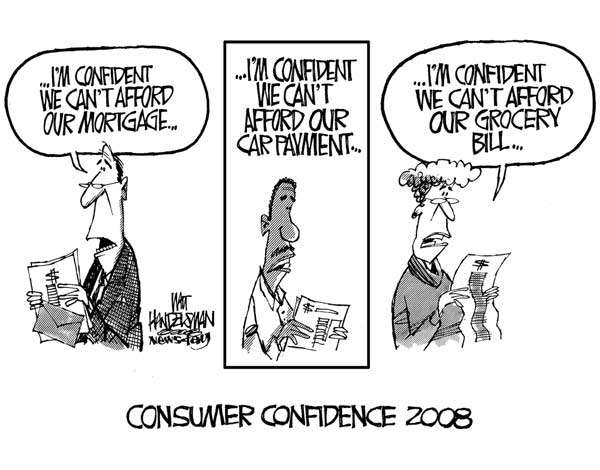
Enjoy the weekend.
Joe
{ }