
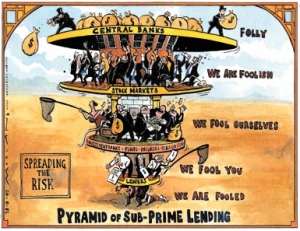
This looks like one from way back when, another classic.
Joe
And confiscate his ill-gotten gains along with the gains of the other CEOs who led this country to the brink of financial ruin. Shortly after the implosions of Worldcom and Enron, the Sarbanes-Oxley Act (SOX) was passed. This act created a sweeping set of rules regarding accountability, forcing a clean set of accounting books, under penalty of law. The act is 11 sections law, number 10 reading “the Chief Executive Officer should sign the company tax return.” This is to provide some level of accountability and “the buck stops here” approach. SOX was not optional, but mandatory for all US based public companies.
In June of this year New York Magazine printed an article The Confidence Man about David Einhorn of Greenlight Capital, a hedge fund, and how he started to see problems with Lehman’s accounting back in May. He make this observation from reading the Lehman financial report and comparing it to remarks made by the CFO on a conference call. It took a few months but he was proven to be right on track.
Now it would seem that Dick Fuld’s claim of ignorance is immaterial, as he signed off on Lehman’s filings. The whole point of SOX is accountability, and it’s his signature on the return. A half billion (his last five year’s compensation) here, a half billion there, pretty soon you’re talking real money. Take it back. Take it all back.
Joe
If you have not yet done so, please read part 1, part 2, part 3, part 4, part 5, and part 6 of this series first, then read on.
Whose money is it? By that I mean if you take $1000 and the MMA software tells you you just ‘canceled’ $4934 in interest off the back end of the mortgage, representing 5 months worth of payments, do you pat yourself on the back for prepaying your mortgage, or do you let someone convince you the savings was from ‘sophisticated algorithms’? Let me offer you an example from The Jubilee Project, (this site is has been canceled, I believe Jubilee has moved on to other things) this is from a letter a satisfied client wrote;
We invested in the Money Merge Account May of 2007 without completely understanding how our 30 year fixed mortgage and other debts were going to be paid in full in less than 7 years.
Well, without getting too pedantic, this is simply not an investment, but that’s a tangent I’ll skip. One should never go down a path such as this without a complete understanding of what they are getting for their money. The claim that this guy’s mortgage would be reduced to 1/4 of its duration should have him curious as heck how exactly this will happen.
We began the month of June with a zero balance on our HELOC. Following the cues of our Money Merge Account we chose to withdraw $ 28,538.81 of the banks money from our HELOC and send it to our 1st mortgage as a principle reduction. We then deposited $ 20,687.17 that had been sitting for 15+ years in a low interest bearing savings account. You will see that our ending balance was $ 7,851.64 at an interest expense of $ 7.79. That interest expense of $ 7.79 was calculated off of our Average Daily Balance of
$ 1,266.39. For the month of June we had the use of $ 6,585.25 of the banks money interest free! We found that ‘A – B = free money’ formula to be both counterintuitive and bazaar (sic)! Essentially, we leveraged the banks money through the HELOC resulting in what could be called a To-Good-To-Be-True interest savings for us on BOTH our 1st and 2nd mortgages. This simple math edified for us how we will be mortgage/debt free in less than 7 years!
1. HELOC: $ 6,585.25 (leverage & float the banks money with no interest charged)
2. 1st Mortgage: $ 74,073.23 (canceled interest = 10 years of canceled mortgage payments)
3. Total Interest Saved: $ 6,585.25 + $ 74,073.23 = $ 80,658.48
Now, you can also view that client’s HELOC statement, (same site, also down) and you’ll see two things. First, he draws a HELOC advance but takes his cash savings and pays it back the same day. Not really an issue, but $20,687 came from that client, and $7,851 from the HELOC. Second, he seems to be so fascinated by the minor interest charge for this shuffle, but it’s nothing remarkable at all. The money is drawn on 5/29 and a statement is cut on 6/2. It’s 4 days interest, not rocket science. And this client works for a mortgage company? To take this to an absurd extreme, if one borrows $50,000 off their HELOC just before the statement is cut, they may very well see no interest charge at all as none has accrued. But to suggest that it was borrowed at ‘no interest’ is simply wrong, and again, will be clear after a full month has passed. If he (and his wife) are comfortable to deplete their savings, preferring instead to use those funds to reduce their mortgage term, that’s fine by me. He may have other assets to tap, or is comfortable relying on his HELOC if he has a short term need for funds. But don’t let the smoke confuse you, he sent his savings to pay down his mortgage.
As far as his note (1) above is concerned, that $6585 is meaningless. He really owes $7851 on the HELOC and it’s accruing interest at 7.24%, so unless he pays it down from income, it will be $47.37 in interest for the (full) month. Not to be too unkind regarding this, the calculation of interest is an important thing to understand. Ending balance ($7851) and average balance ($1266) cannot be subtracted or added, the numbers simply reflect the number of days that loan was outstanding. The only time the client wasn’t charged interest was when he had no loan, prior to 5/29. He never borrowed money at zero interest. In (3) his statement that the difference of $6585 was saved interest is nonsense, it’s actually the average amount not borrowed though the month. Projecting out (3) that he just saved $74,073 due to the prepayment is something I won’t dispute, but that was a choice he (or any client) had the day before signing up for MMA. Next month when his furnace breaks down, or transmission goes, or any other unexpected expense rears its head, he will have no savings to draw on, but he will have to tap his HELOC further at the 7.24% rate. I don’t imagine the agents selling this software are too eager to discuss this twist.
I also note that since this client is in the business, one would think he’d be refinancing his mortgage to a lower rate, not using a higher interest (which should have dropped over the last year) HELOC to float that debt. The owners of Jubilee find this client’s letter to be proof of MMA success? I think this proves nothing, except how easily people are confused, and even the so-called experts do not understand how mortgages work.
The client goes on to offer:
The interest canceled for our $ 3,500.00 investment in the Money Merge Account for the month of June ’07 was $ 80,658.48.
Ok, let’s think on this. I don’t know what his mortgage balance was, or its rate. But I do know that his reference to the $6585 is misguided at best. He saved $74,073 but this just reflects the time value of money. Where does he account for the $3500 fee? Anyone can take their saving and throw it against the mortgage, can’t they? And what of the $7851 HELOC balance? It’s now costing him more interest than his mortgage was, as it has a higher rate. It’s really easy to look at a spreadsheet or calculator and see that at the beginning of a 30 yr mortgage, if you make a lump sum payment of say, $10,000, you just reduced your balance by $53,624. If it’s from your savings, you just got a return on those funds equal to your mortgage rate, nothing wrong with that. But if you borrowed it off your HELOC, at or above the rate you pay on your mortgage, you’ve accomplished nothing, and are worse off.
Next week, I take a step back and discuss the ‘rule of 72’ and how mortgages work.
Joe
In August, I posted an article to point readers to a public radio show This American Life where they had aired a program titled “The Giant Pool of Money,” focusing on the subprime meltdown.

Recently, they aired Another Frightening Show About the Economy which goes into even more detail, this time focusing on the commercial paper market and credit default swaps. I offer this as a sample of the explanations out there that are actually understandable by the average Joe, in this case from a radio show I’ve enjoyed for years.
Joe
Note: as the comments here are not seen without the extra click, this one was worth adding right to the post, a note from one of my regular readers (thanks, JAL!):
If you enjoyed the economic related episodes on NPR’s This American Life, you’ll probably also like NPR’s Planet Money daily podcast. In the same style as This American Life, it features discussions and interviews about the current economic situation in a plain easy-to-understand form. Check it out:
http://www.npr.org/rss/podcast/podcast_detail.php?siteId=94411890
Best regards,
JAL
This is another classic email making the rounds;
If you had purchased $1000.00 of Nortel stock one year ago, it would now be worth $49.00. With Enron, you would have $16.50 left of the original $1000. With WorldCom, you would have less than $5.00 left. If you had purchased $1000.00 of Delta Air Lines stock you would have $49.00 left. If you had purchased United Airlines, you would have nothing left. But, if you had purchased $1000.00 worth of beer one year ago, drank all the beer, and then turned in the cans for recycling, you would have $214.00. Based on the above, the best current investment advice is to drink heavily and recycle. This is called the 401-Keg Plan.
It’s getting a bit old, as it started right after the netcom bubble, but it was wrong even then. Here’s the math for you. Even if the deposits were in addition to that $1000, this works out to 23 cents per can or $5.60 per case of beer. Is any beer under $12 a case? Does anyone read this and just say “enough, the math doesn’t work.”?