by Joe
on September 24, 2008
I frequently field questions from people asking me to compare the use of a 401(k) account to an IRA, and I’ll discuss this a bit today.
401(k)
- No income limits to make deposits
- Company may offer matching up to some level
- (Usually) limited choice of investments
- Fees may be excessive
- $15,500 deposit limit ($20,500 if 50 in 2008)
- Loans permitted at reasonable rates
Traditional IRA
- Income restrictions (single $53K-63K, joint $83K-$103K)
- No company match
- Unlimited investment choices, mostly
- Fees can be controlled, kept to a minimum
- $5000 deposit limit ($6,000 if 50 in 2008)
For those whose company matches some of their 401(k) deposit, I suggest depositing up to the match. Often, this means that for the first 5-6% of your income, you are matched 50-100%. This is worth doing almost without regard to the rest of your financial situation. Next, unless the 401(k) has truly superior choices (my company offers an S&P index fund for .05% per year. On $100,000, this is a $50/year overhead) I’d suggest going to the IRA and topping it off. As I published some time ago in my 401(k) Ripoff article, some 401(k0 custodians are charging as much as 1.4%/yr for the accounts of small employers. This expense negates much of the benefit of saving tax deferred. Unless you plan to leave an employer with such a high expense 401(k) after a brief time, I’d not deposit more than what it takes to capture the match.
One lesser known benefit of a 401(k) is that if you retire and are 55 or older on your retirement, you may take withdrawal from the account without penalty. This suggests that as you approach retirement, you might decide to pull your IRA money into that final 401(k) account to take advantage of this. Of course it depends on the balances of your various retirement accounts.
After 59-1/2, I favor moving the 401(k) accounts into an IRA as the management becomes easier. Withdrawals may be done on line, the funds moved from the IRA to your cash account, and you can write a check the same day. The choice to convert to Roth is easier, done quickly and with minimal effort. Lastly, I suggest you pay close attention to the beneficiaries on your retirement accounts. It’s too easy to forget that a first spouse is still listed, or that the current beneficiary may have predeceased you. The rules regarding IRA beneficiaries are pretty specific, and must be listed on the account. IRAs do not pass via will. Please read my April 28 post “On my Death, Please Take a Breath“. It’s a sad anecdote about what not to do when inheriting an IRA or other pre-tax retirement account.
As always, please submit a comment if you have any questions on this topic.
Joe
{ }
by Joe
on September 22, 2008
In a post on April 21, “DVY – The iShares Dow Jones Select Dividend Index” (another of my eye-catching post titles), I offered that this ETF provided a nice dividend, 4.29% when I posted, a bit less after the recent rally. I suggested that for those who are investing for the long term, this ETF might provide a good selection. The dividend is taxed at favorable rates, 0% if you are in the 15% bracket or lower. Below is a chart comparing DVY to the S&P 500 index since I made the recommendation. *
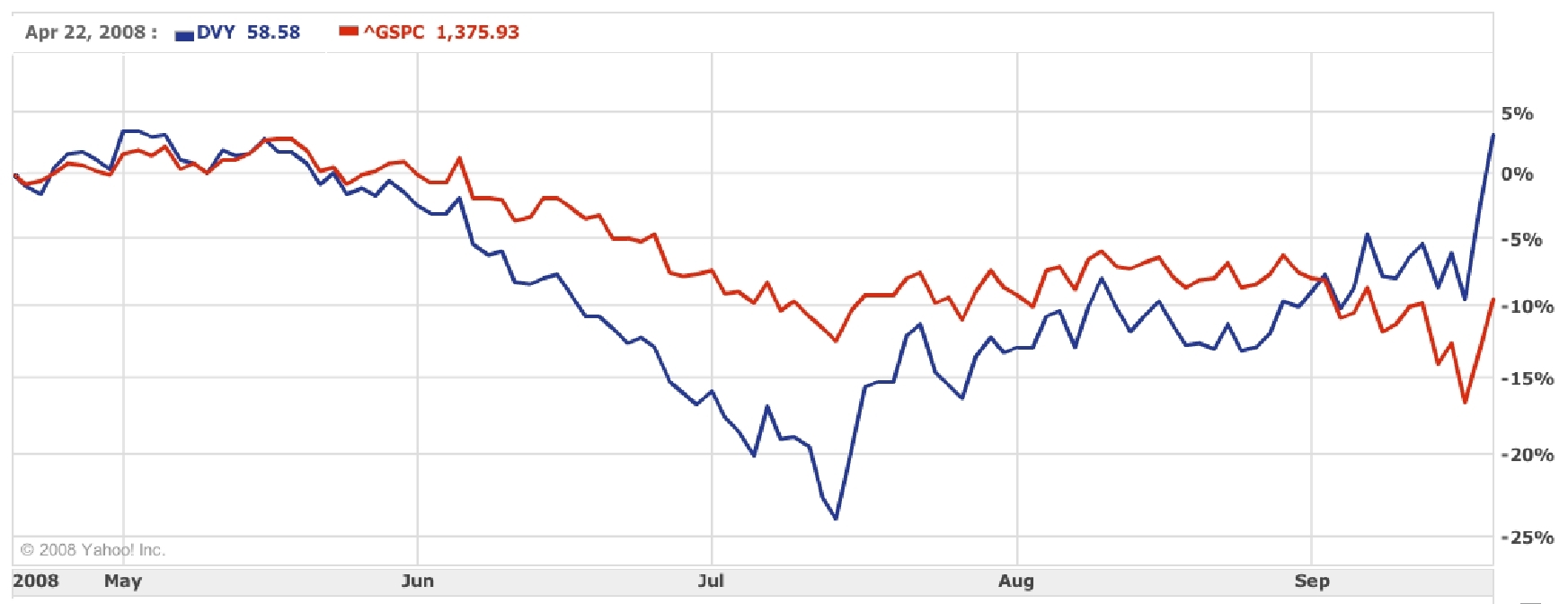
I acknowledge that there was a time, around July 15th when this appeared to be a bad idea, with DVY lagging the S&P by more than 10%. Of course, in hindsight that was the time to buy more, as DVY recovered and since my April post, the DVY is up 2.5% vs the S&P, down nearly 10%.
I’ll repeat, this ETF is a mix of stocks with the risk the market brings, but the long term, a five year period or longer should reward patience.
Joe
*My standard disclaimers apply.
{ }
by Joe
on September 20, 2008
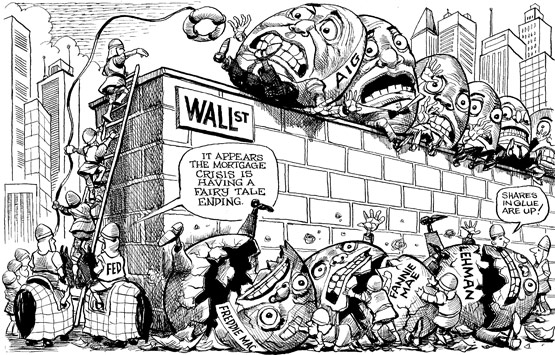
From “The Economist” Magazine.
Have a great weekend,
Joe
{ }
by Joe
on September 19, 2008
I saw the commercials for Bank of America’s “Keep the Change” program, and have to say, “No, thanks.” Every time you spend money on your debit card they round it up, and move that money into a savings account. So in their example, if you spend $3.43 they debit your checking account $4.00 and put 57 cent toward savings. For the first three months, they will match it, so on a $25.01 purchase, they will match you 99 cents. But on a $100.99 purchase you are matched 1 cent. I’d guess the average match will be 50 cents or so, but once that full match ends and they match your round up by 5%, that means the match drops to 2 cents. Why bother? A good credit card will match 1-5% depending on the type of purchase you make. As far as I am concerned, debit cards make no sense. I understand how they work, I just don’t see why one would choose a debit card over a credit card.
Joe
{ }
by Joe
on September 18, 2008
If you have not yet done so, please read part 1 of this series first, then read on.
Last week I offered some discussion as to whether or not one would have any reason to pay their mortgage off early. This week I’ll briefly focus on one aspect of this decision – the after tax cost of your mortgage vs what you’d expect to earn elsewhere.
Most of the MMA examples offered start with a 6%, 30 yr, fixed mortgage. Now, if one is in the 28% tax bracket, their after tax interest cost is 4.32%. In my state, (Massachusetts) the tax exempt fund now yields 4.2%. From the chart of Fed Funds Rate below,
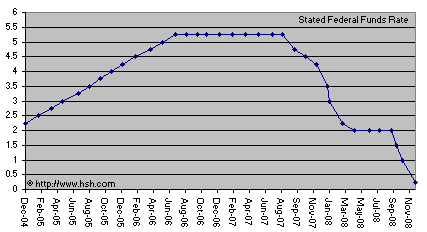
does it look like rates can continue to fall? As rates creep back up, and you can earn more than your mortgage costs you, after tax, why would you choose to pay down the mortgage? If you lost your job, and the banks freeze further loans from your HELOC, would you rather have a paid off house or two hundred grand sitting in tax exempt muni bonds?
I also suggest you look at the Money Chimp site, and note that in the 10 year period 1998-2007 the average return of the S&P was 6.7%. Had you invested in a low cost (.1%/yr) index fund, you would have seen 6.6% during that period which contained the crash associated with the bursting dotcom bubble. If you are disciplined enough to send all of your disposable income to your mortgage (through the HELOC account) then I believe you are disciplined enough to use those same deposits into an S&P index and dollar cost average into the market for the long term.
Next week – the process of using an MMA account
Joe
{ }