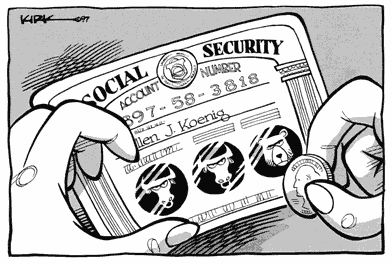
Not much I can say about this one, a picture’s worth 1000 words….. enjoy the weekend!
Joe
Not much I can say about this one, a picture’s worth 1000 words….. enjoy the weekend!
Joe
As I hear more people talk on this topic, I grow more hopeful that the pain we are feeling in our wallets at the gas pump will pave the way toward a better future.
In an interview with the former mayor of New York, Ed Koch, I heard him call for a “Manhattan Project” for alternative energy. Let’s hope other politicians share his view. Al Gore seems to be on a similar path, he calls for a ten year plan to produce 100% of our energy needs from renewable resources within the next 10 years. T Boone Pickens (whose site I added to my link list, right) also proposes a plan for renewable energy. His plan differs slightly from Gore’s in that he feels it would be faster to introduce the widespread use of natural gas powered vehicles as an interim step to the electric car.
In the end, I look forward to a world where our children breathe cleaner air and see a clearer sky. More to come.
Joe
From Innumeracy.com:
Innumeracy: A term meant to convey a person’s inability to make sense of the numbers that run their lives. Innumeracy was coined by cognitive scientist Douglas R Hofstadter in one of his Metamagical Thema columns for Scientific American in the early nineteen eighties. Later that decade mathematician John Allen Paulos published the book Innumeracy. In it he includes the notion of chance as well to that of numbers.
From “Money Merge Advantage”, (please note, this blog was suspended by WordPress for TOS violations) an MMA agent’s blog:
“In FACT, The software alone could still beat the 2nd scenario (putting the $300 discretionary to the mortgage each month) WITHOUT using that discretionary income AT ALL. Yes, SERIOUSLY!”
If you have no idea what Money Merge Accounts are, or what I am talking about, please see my Money Merge Links page for references and then read on. In the blog I reference, the example starts with $250K, 30 yr, 6.5% mortgage. Then we are told a bi-weekly will provide some $75,800 worth of interest savings. No problem there, a bi-weekly is like paying 8% higher than the required monthly payment, usually in the form of a 13th payment snuck in once a year. The examples then offer that $300 more each month will cut the mortgage down to 19 yrs 8 months, which I still follow. But then the blog writer claims that with no extra money, beyond the $300, MMA will cut the mortgage to 14 yrs 4 months! This is beyond the wildest claims I’ve seen so far, and completely beyond reason.
Lastly, came the quote above, suggesting that with no extra funds available, the HELOC shuffle alone can produce savings greater than a $300 monthly principal payment would achieve. This raises new and troubling questions. The couple in the example have a net income of $3800/mo. If their HELOC were 0%, and they borrowed this $3800 at the beginning of each month, and paid it back at month’s end, it would gain them just under $21 per month, nowhere near $300. And no HELOC offers a 0% interest rate. At best, the HELOC is a percent or two under the fixed rate mortgage. This is simple math, folks, and no “sophisticated algorithms” are going to change the fact that 1+1=2 or that the best one might squeeze out of their HELOC shuffle efforts is $20-$30 per month, certainly not $300.
Joe
A couple weeks back in a post titled Money Merge Hyperbole, I discussed the Money Merge product offered by UFF, and focused on the fact that in their published example, it’s clear that the use of a HELOC doesn’t provide any incremental savings. A kind reader points out on his web site, My Debt Elimination Calculator (Edit – Greg has since stopped selling this software), that HELOC can provide some savings depending on a number of factors. Among them, the time of the month that income comes in, when bills are due, and the relative differences in HELOC interest rate, mortgage rate, and checking account interest. I agree with this. I’m from the “numbers don’t lie” camp and Greg offers numbers to back up his comments on that post. In his examples, the HELOC system saves $2550 more than the prepaying method on a $100K mortgage. (This is for the more realistic example where the borrower doesn’t have the (unrealistic) extra $1000/mo, but a more reasonable amount which will reduce the mortgage to 24 years from 30. In this case, Greg’s software is capturing over $100/yr in extra savings by using the HELOC. I certainly can’t knock a system that beats what I saw on official MMA sites but only costs $30. Take a look through the link above.
One point I must concede is this: It’s easier to make a purchase (waste money) when it’s from cash in the bank than when you are taking that money as a HELOC withdrawal. Maybe that’s what the MMA people are trying to say, but that message is lost to me among all the hyperbole.
I will close with this question and thought. If UFF, with the chance to put their product in the best light, cannot provide an example with real numbers which shows any savings beyond that of the prepaying (which I can illustrate with a free spreadsheet) yet create this illusion of ‘sophisticated algorithms’ taking millions of dollars to develop, how do they justify a $3500 price tag? On the flip side, you have been introduced to Greg, (whom I just met via my blog) a Computer Scientist who was able to write code providing a solution that actually impressed me looking at his example. I’m sure this debate isn’t over.
Joe
I continue to be amused by the debate over whether the ‘Debt Snowball‘ that Dave Ramsey suggests is the best method for fast debt reduction. I wrote about this some time ago on my Feature Web Site, and got quite a bit of email telling me how I ignored the emotional side. They quoted Dave Ramsey, “personal finance is 20% head knowledge, 80% behavior”.
Today I came across the web site “Consumerism Commentary”, which had a nice spin on paying the highest interest debts first (as I suggest), but calling this method “The Debt Avalanche“. Sounds good to me. Nice article.
Joe