On Feb 13th I posted Unintended Consequences III and talked about the conflict between crops used for food vs biofuels.
I just found a New York Times article “A New, Global Oil Quandary: Costly Fuel Means Costly Calories” which discusses this topic and confirms my fears.
Joe
{ }
In my recent posts where I share my excitement regarding the future of solar power, I talk about the potential cross over point where the cost of electricity, specifically from solar, is lower than the cost of gas. Well, a bit more googling, and I have some more numbers. From ‘Life after the oil crash’, I find that a gallon of gasoline contains energy equal to about 37 KWH. With gas at about $3 per gallon right now, this is about 8.1 cents per KWH versus a US average cost per KWH of 10.69 cents. As we approach $4 gas, the cost of gasoline will exceed the cost of electricity BTU for BTU.
The latest prices I see for solar show about $6000-$8000 for a 1KW installation. Assuming a 5%/yr return, that’s about $400/yr. If the system is running full power for 2000 hours per year, we are at a 20 cent per KWH cost for solar. Still more than what we’d pay our electric company, but prices are still falling. We may be a few years away, but the current oil crisis will only help the cause (for solar).
Joe
{ }
It was September that I last wrote about this. Yesterday, we were up 3.71% on the S&P 500, as you can see, 1320.65, up 47.28, the largest single day gain in nearly 5 years. I could go on a bit to talk about yesterday and the markets of today and next week, but instead, let’s look at 1986-96. Why? Because it contained both the crash of ’87 and the recession of 1990-91.
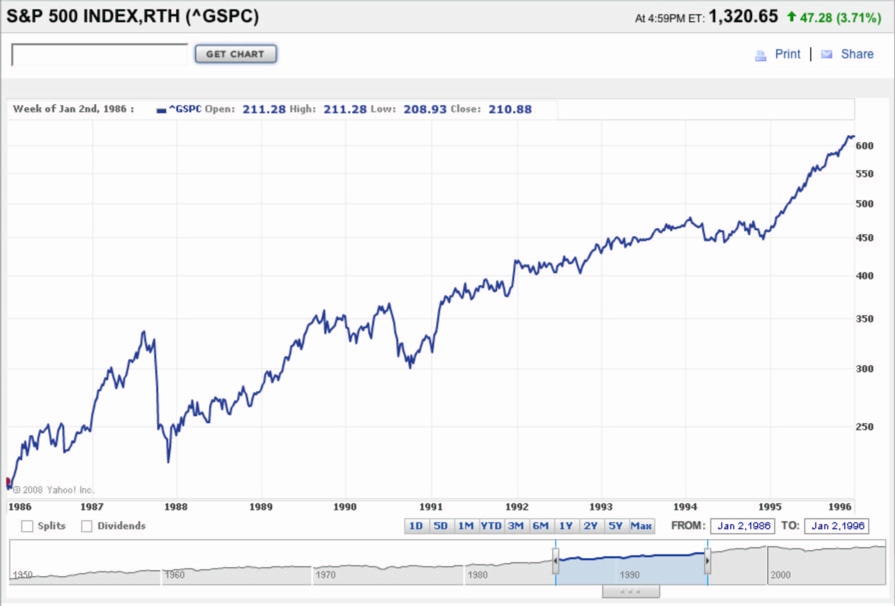
During this period, the market still managed to more than triple. I’m sure there were those who were scared out of stocks in 1987, but let’s remember one thing about 1987; the S&P 500 returned 5.7% that year. I recall a conversation I had with a friend on Aug 25, 1987 (I remember because it was the day after his birthday and I took him to lunch). The market had gone up quite a bit and he asked me what I thought. I told him that in the short term anything could happen, but if he sold then who knew when would be the right time to get back in? Those who averaged in over the prior five or so years were still well ahead, even after the crash. By focusing on the long term and not getting into the habit of buying high and selling low, you can achieve your goals and sleep at night.
And at SmartMoney – “Bull Markets Return When You Least Expect” by James Stewart
JOE
{ }
- Dollar Value vs Foreign Currencies
- Trade Surplus / Deficit
- Interest Rates
- Tax Rates
- Unemployment Rate
- Inflation
Did I miss anything? I don’t know if there’s a ‘general happiness’ index available, but if there were, I’d add it to the list. What is this list? It’s the data we follow and hear comments in the business news. There are ideal numbers for each, right? For trade, we want a surplus, we want to sell the goods we make in the good old USA. But we want a strong dollar, and today, the dollar is low compared to say, the Euro, or the Yen. I look at Yahoo and see that in the last few years, the Yen was as low as 123 to the dollar and recently is about 102. I remember in the early 90’s getting 240 Yen for my buck. But at 240, I could buy twice the Japanese goods I can today, so the trade balance was an issue. See where I’m going? And I’ve only looked at two variables so far.
What is the ideal unemployment level? Who was it that said “If you lose your job, it’s a recession. If I lose my job, it’s a depression.” (Some say this was Truman.) I would like to stay employed, so 0% works for me, but as unemployment drops ‘too low’ wages tend to get inflated as people are offered more money to lure them over from another company.
We had a similar issue a few year ago with inflation. As we approached 1% and less, people started to discuss the risk of deflation, as if that risk were real. At that time the budget deficit was no longer, we ran a surplus. The fear turned to ‘where will Social Security funds get invested?” and worse, “how will the Fed implement monetary policy if the purchase and sale of bonds is no longer available?” Well these fears were short-lived, but you get the idea.
I have no answers, just observations on this topic.
Joe
{ }
I know, I am going to run out of Sun related puns and allusions pretty soon, but until then, I remain excited about the prospects of a solar powered world, and will continue to follow what I believe to be the most exciting innovation that we are continuing to ignore.
The New York Times recently published an article, “Silicon Valley Starts to Turn Its Face to the Sun” in which they reference Moore’s Law and how since solar panels are made of silicon, we may continue to see Moore type leap in efficiency. I remarked last week that the recent run up in oil prices will only serve to push the demand for solar. The one concern I had on solar as a power source is that by definition, it’s not available 24 hours per day in every area. I was looking for a sign that storage (batteries) that would bridge the gaps (nighttime) in availability. A story just crossed the wire titled “Sharp to make solar power storage batteries” and that helped to boost my optimism that as the cost of solar continues to drop, we will have a new storage technology available.
I dream of the electric car that when charged has a range of 240 miles. I dream of charging stations at every rest area and gas station, with a simple metered system to draw power and bill your credit card. A half hour fast charge to get that 240 mile range would be ideal. Even the 240 range would cover 90% of people’s regular daily use, and would have enough range for an ideal second family car. The lower emissions would only be an extra perk in this scenario.
JOE
{ }