
A report on Solar Power states that the cost of solar panels (photovoltaic) had come down to $4 per watt by 2005. So, a $4000 panel will produce a kilowatt of power. I’ve read that, while it varies by region, 1600 hours of good sun is an average annual number to use. In my area (outside of Boston), electricity cost is about 17 cents per kilowatt-hour. This is a value of $272 of electricity for our $4000 panel or 6.8%/yr. No need to do too much further analysis here, it would seem obvious that with the cost of electricity going up with inflation, and the cost of Solar Panels coming down in cost per unit of power, we will soon approach the tipping point where the return on one’s investment is “an offer you can’t refuse.” What is the return required for this to happen? 10%? 15%? I do not know. But with the production cost coming down at a fast pace, that point is likely no longer than 5-10 years. We will then see a cycle where this new demand helps to bring down production costs down even further as economies of scale kick in. All this thinking about low cost electricity gives me one thought: “I want my electric car.”
JOE
A few days ago, in You Are Rich, I observe the median income of all the people in world is about $850. Now, that thought led a Forbes author to go one step further, in the Forbes 400 issue, writing an article The Forbes One Billion, in which he notes the combined wealth of tho top 400 people in the US is $3.5 trillion. On this, you’d expect an annual gain of $350 billion or so. He then states that the bottom One Billion people average $350 per year in income. The $350 billion dollars of annual gain of our top 400 fellow Americans can double the income of One Billion of the world’s poor. I don’t have more to say on this, to me, it’s something to ponder.
JOE
A friend posted on usenet group misc.invest.financial-plan;
DEMAND (for Gold)
71% 2950 Jewelry (mostly US, China, India)
7% 300 Central banks & industry
6% 250 Hoarding
7% 300 ETFs
3% 130 Coins
5% 200 Hedging reductions
4130 Total Demand
SUPPLY
2500 Production
850 Scrap
500 Official sales
3850
(-280) Surplus (deficit)
To which I added:
Two thoughts, perhaps obvious, but bear with me.
One poster mentioned the substitution effect. Yes gold is used in electronics, but the amount in any system is so small that gold can rise to $2000, and there would be little reason to seek an alternative. I can find gold leaf selling for a few cents per square inch. Likely the gold content of a $500 computer is measured in cents. So no issue there.
Second, as the price rises, two thing happen. People find old gold jewelry they are not so attached to, as well as coins whose gold content (value) now exceeds any numismatic value. So the supply rises that way. Also, mines tend to have supplies that vary with cost. Huh? Well, there’s a cost to mining that has two large factors, yield (oz AU/ton ore) and depth (cost to dig). So if I hit an area that yields 1 oz/ton, and it costs me $800 to process, that area is noted and left unmined. At $1000, it’s reopened. This is oversimplifying, but not by much, it goes back to supply/demand, explaining how supply literally increases when the price is higher.
JOE
The Law of Unintended Consequences will sprout up in most changes implemented in our financial system. I’d think the guys at Freakonomics would appreciate some of the times this becomes obvious. In Barrack Obama’s tax plan he offers:
“The IRS would send prefilled tax forms to 40 million workers who take the standard deduction and have a bank account. They would simply have to sign and return it, which Obama estimates would save more than $2 billion in tax preparer fees, 200 million hours of work and “an incalculable amount of headache and heartburn.”
Now, I’m all in favor of simplifying our tax code, but looking at these numbers, the math says the average return costs $50 (can that be right?). So these certainly aren’t being done by CPAs, more like H&R Block storefronts with seasonal help. If these people make $25 an hour, that’s 40,000 people (assuming a seasonal job that runs just 1000 hours a year) out of a job. Simplify the return, put 40,000 part time workers on the unemployment line. There’s a trade off, I’d say. This is one topic, The Law of Unintended Consequences, which, among others, I plan to revisit. It’s easy to find if you just look.
JOE
I enjoy the copy of some of the advertising promoting gold:
“in 1920 a man could buy a suit with a $20 bill or $20 gold coin. But in 2006, $20 won’t buy a shirt, and a gold coin, now worth over $500 will buy a suit.”
So what? At 12% (the S&P return during this time according to the MoneyChimp) , your money will double every 6 years. Over 86 years, that’s more than 14 doublings, or over 17,000 times your investment, $340,000 for your $20 bill.
Someone tell me how an ad can make an ‘investment’ that will grow from $20 to $500 in 86 years, an annual return of 3.8%, look good when the alternative (the S&P) would return 680X as much.
From the 1980 peak, gold would have to exceed $4800 to outperform stocks over the same period. I look at the 35 year chart:
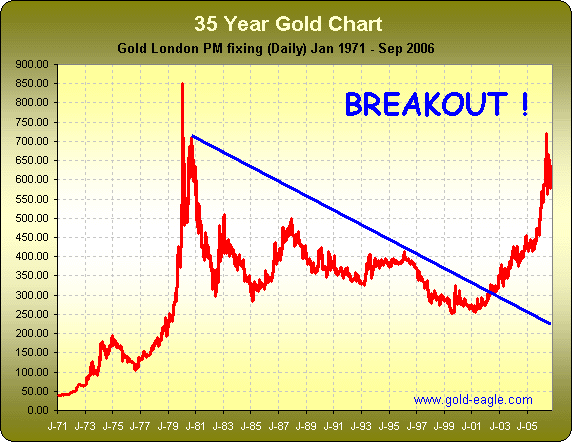
and I’m no technician, but ‘down’ looks far more likely than up. Within my market timing article, I discuss how buy and hold will profit if you are patient. Even buying at the market high reached in August of 1987, right before the crash would be profitable if you held long term, returning nearly 8%/yr up to the market bottom of 2003. Now, if you bought gold at $850, in 1980, and were patient, reinvesting dividends* along the way, by now, er, nearly 28 years later, you’d still be short of breaking even.
(*Gold offers no dividend of course. How could it?)
JOE