
You can go to annualcreditreport.com and request to view your credit report from each of the three nationwide consumer credit reporting companies: Equifax, Experian and TransUnion. Since each one permits you you view your report annually, you are able to view a different one every four months. I’ve not seen the value in paying for ‘credit protection’ since your credit cards’ liability limits you to $50 so long as you repost a card stolen soon after you are aware it’s missing. Even those protection services cannot save you the time it will take to get your life in order if you are the victim of true identity theft.
JOE
I received an offer for a credit card with zero interest on purchases or balance transfers for the first six months, and for the first time, took the lender up on the offer. I found myself with a card having a $20,000 credit line and a blank check for a balance transfer. The fine print showed the transfer was subject to a 3% fee, but capped at $50, so I wrote a check to my brokerage account and deposited $19,950 into a money market fund earning 5%. For the effort of writing that check and making the payment back in 6 months, I’m ahead $450. I’ve read there are people that manage to find offers such as this one on a regular basis, making a few thousand dollars a year just by shifting this money around. I’d think there are only so many banks making such offers, and at some point too much available credit will impact one’s credit rating, but for now, I’ll take the $450, and be sure to make the payment in full when this becomes due.
JOE
Time has a way of ticking by, and it’s not too early to think about the financial moves you want to make before the end of the year.
First, do you have an RMD (required minimum distribution) for your IRA? If you do, and if you make charitable contributions toward the end of the year, but you don’t itemize deductions on your taxes, then consider donating some of your RMD. This is part of the pension protection act passed last year, and this rule regarding RMDs is in effect for only 2006 and 2007. Too bad. If you fall into the small group that would benefit from this, it’s the financial equivalent of taking the tax deduction.
Also, if you are retired, it may be time to consider converting some of your IRA to a Roth. The reasons for this may not seem so simple, but the general goal is. You wish to avoid having your growing RMDs force you into another tax bracket, and/or to avoid having this income subject to the bizarre Social Security tax trap. For example, a married couple finds their taxable income is $40,000, and according to the chart at Fairmark, they are in the 15% tax bracket (i.e. the next dollar taken is taxed at 15%). They may be able to convert $23,000 from the traditional IRA to a Roth, still paying 15%, and that money will grow tax free, with no forced withdrawals. Since RMDs continue to rise as one gets older, this strategy will keep the IRA balance from rising to the point where withdrawals force the couple into the 25% bracket. This example ignores the Social Security tax trap mentioned, and linked, above. More year end ideas to come soon.
JOE
I recently posted that you should not panic, nor should you fall prey to those who will sell you on the belief that they can time the market. What should you do? Decide on the proper asset allocation and rebalance as appropriate. Say you had $100K in early 2004, and to keep it very simple, you had 60% in stocks, 40% in cash. Like this:
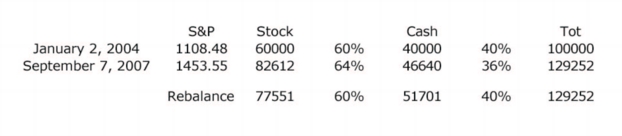
Now, you’ve ignored the account, and look now to find the stocks have grown (there were some dividends, so that $82,612 includes reinvested dividends) so instead of your mix being 60/40, you’re pushing 64/36. Very simple. It’s time to sell just a bit over $5000 of your stock index fund or ETF to bring the account back into balance. Your stocks will likely be in more than one fund, to include foreign stocks, and to add the stocks not in the S&P (small and mid-cap stocks), and the cash portion may be mixed in bond funds as well as cash for shorter term needs, but the concept is the same. A periodic review to be sure your allocation targets remain in place. Some people choose to reallocate on an annual basis, maybe at year end as they do their year end tax planning, others will reallocate as the percentages vary from target by more than some percent, perhaps 5. So in my example above, you may choose to wait to reallocate until stocks are above 65% or below 55%.
See the links at my friend Elle’s site for tools to help you decide on the asset allocation that’s right for you.
JOE
I’m more and more convinced the recent housing disaster is more a result of ARMs adjusting combined with the so-called sub-prime mortgages which were written without proper income verification and, in many cases, untruthful appraisals. I pulled data on income, housing prices, and mortgage rates to produce the following:
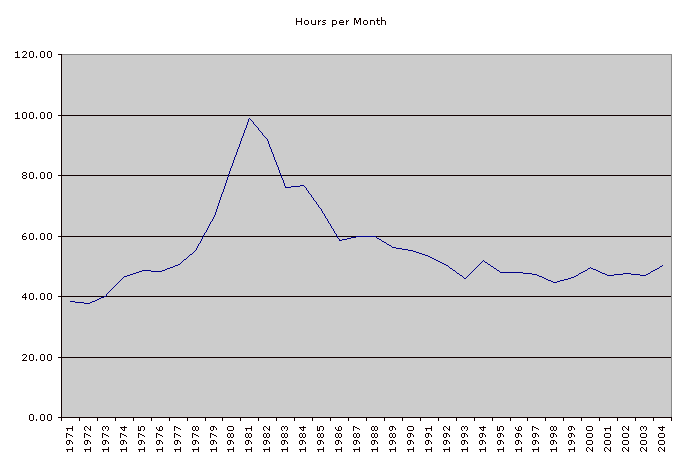
It would seem that even though median housing costs rose four fold from 1981 to 2005, that wages (required to afford the payment), normalized to hours, actually decreased, in fact, by nearly half.
JOE