
I was thinking more about the outrage regarding gasoline prices, and it occurred to me. No outrage on coffee. When you buy a gasoline contract, today you’d pay about $1.83/gal. And I just paid $2.65 for a gallon of gas at the pump. So, along the way, there’s a 45 percent markup from the refiner to the pump price. Now, you can also see that coffee goes for $1654/ton, or 82 cents per pound. A pot of coffee takes 3 oz max, call it 25 cents worth. 4 cups to that pot, and we’re at less than 10 cents for the coffee we pay at least $2 a cup for.
Where is the outrage and cries of gouging? The markup isn’t 50% or 100%, but near 2000%! Same deal with sweets. A pound of sugar, just over 10 cents. A pound of jelly beans, $15. Is it that we view the gas as a necessity? Or that $2 a cup for coffee isn’t the impact of the $40 for that tank of gas? I don’t know the answers, I’m just thinking.
JOE
I updated my Don’t Panic post to show a chart of volatility going back 15 years. While we are currently in interesting times, this type of market is not unique. Enjoy the weekend, Monday will come soon enough.
JOE
Well, it may help the environment, but does it really save you any money? Charts of MPG vs Speed are tough to come by, but here’s one from 1997;
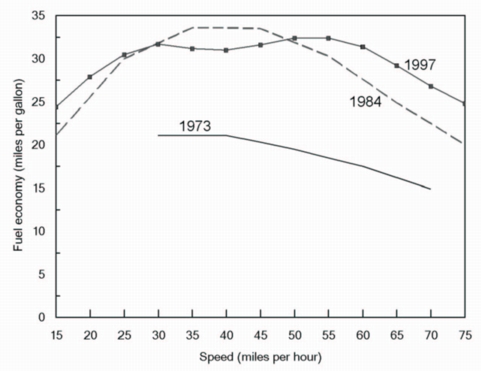
Now, I know things may have shifted, but I doubt the curve has steepened much from here. At 55 MPH, we are looking at 32 miles per gallon. At 65 MPH that drops to about 27. The math from here should be simple. At 55 MPH you would go 55 miles (in exactly an hour of course) and use 1.57 gallons of gas. At 65 MPH, you go 55 miles in just under 51 minutes, and use 2.04 gallons of gas. So you’ve traded 9 minutes for .47 gallons of gas saved. With gas about $2.75 per gallon, that’s $1.28 saved. This computes to $8.56 per hour. There’s often a trade off between time and money. Of course driving an hour round trip to save $1 on a grocery item doesn’t make sense, but these are the choices people sometimes make without much thought. If your highway miles are minimal, no big deal, but the difference between 55 and 70 when one drives 12,000 highway miles per year is 47 hours. I’m sure we’d all like to grab that time back just when vacation time has run out.
JOE
A near daily post lets me address topics that I’d not think worthy of my monthly articles, either due to general interest, space, or some other reason. This is one such topic.
When gasoline started its recent climb, I soon heard of some congress people who missed much of their economics 101 class. They called for anti-gouging rules which to me sounded a bit like price controls which we know do not work. Let’s go back to the lecture on supply/demand for a moment. There is a supply curve (here shown as a line), showing that the manufacturer will be willing to supply ever increasing quantities of a product as the price offered rises. That actually stands to reason, doesn’t it? On the other side, we have the demand curve. The consumers, taken in aggregate, will want ever increasing quantities of a product as the price falls. Of course, there are limits at the endpoints, if milk were cheaper, it might reduce juice consumption (a phenomonon called cross elasticity of demand) , but at some point, even free milk could only generate so much demand. We are looking not at these extremes, but at the current point where the market clears.
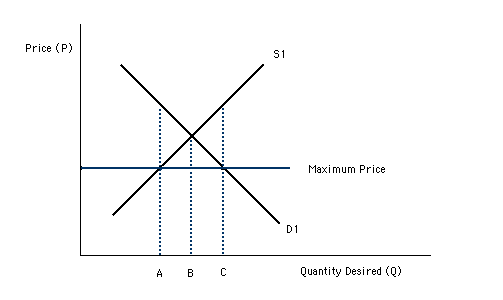
In the case of any product, the natural clearing price is at B, where the supply and demand lines intersect. Now, what would happen if prices were capped by the government? At the artificial government maximum, there is a demand (C) and supply (A) which do not match. At best, that sounds like long lines for gas, but worse, it sounds like gas stations shutting down for a long vacation. Just my overdue thought on this. Shortly after this all occurred to me, Gene Epstein (of Barron’s) wrote with similar thoughts.
JOE
My Mastercard bill is due on September 3. That wouldn’t be an issue except that September 3 is a holiday in the US, and both the post office and banks are closed. Labor Day also happens to fall on a Monday, in fact, it’s always on the first Monday of September. That means my check will not be delivered on the Monday, or the day prior, or the day before that. Actually, if I don’t get the check out say the bank receives it by August 31, it will be late, and I’ll be charged interest and a late fee. I happen to pay my bills on line, and fortunately, my bank’s system will automatically warn me of the days banks are closed and suggest I make the payment earlier. These are the small things that I think about, but try not to sweat.
Update – my Amex bill just came in, and it’s due on Sept 4. I’ll keep an eye out to see if it’s ever due over a weekend or holiday, now I’m curious.
JOE