≡ Menu

Frugal Friday Week 44

This is the accurate-pricing law of my state, your state may have a similar law –

COMMONWEALTH OF MASSACHUSETTS OFFICE OF CONSUMER AFFAIRS AND BUSINESS REGULATION DIVISION OF STANDARDS IMPORTANT CONSUMER PRICING NOTICE PRICE ACCURACY GUARANTEE

As required in 202 CMR 7.07 if there is a discrepancy between the advertised price, sticker price, scanner price, display price and checkout price on any grocery item the consumer pays the lowest price. In the case of food stores or food departments, if the checkout price or scanner price is not the lowest price or does not reflect a qualifying discount: the consumer:
a.) Shall not be charged for one unit of the grocery item, if the price is $10 or less;
b.) if the lowest price is more than $10 the consumer shall be charged the lowest price less $10 for one unit of the grocery item,
c.) and shall be charged the lowest price for any additional units of the same grocery item purchased.

There’s one grocery store I frequent where I’ve discovered more and more errors in pricing at the register. Sometimes I catch it right then, sometimes not till I get home, and then it’s usually forgotten. A couple weeks back, I went to buy a bag of popcorn. (Did you know you can make a homemade snack similar to Cracker Jack at a fraction of the price? And if you or a family member has a peanut allergy,  just leave the nuts out. But, I digress.) This was an item I saw I was charged 40 cents too much on the last purchase. So instead of going to the register, I stop at customer service. I figure that when they price-check it for me and it rings up wrong, they’ll at least thank me and say they’ll fix the pricing in the computer. Nope. They tell me to just let the cashier know and she’ll adjust the price. Which she did. You see what’s missing. My free popcorn. Sometimes I’m too easygoing, I suppose. If the cashiers don’t already know this, and it seems the customer service booth people don’t, either, then it’s really something the store management needs to be aware of.  I ask myself if I really want to be the guy to print the document from our state government site to bring to his attention.

The law goes on to state that the above excerpt is required to be posted at every register. My local Trader Joe’s locations all have it taped to the side of the register, but not the other local supermarkets.

What would you do? Would you be comfortable bringing this to the store manager’s attention?
{ 2 comments }

Mortgage Rates are Heading Up

You knew that, of course. If you’ve searched for personal loans at sites such as http://www.cbonline.co.uk/personal/loans  you’ll discover competitive rates, but if you own a home in the US and have a mortgage, hopefully you’ve looked at the rates as they dropped and acted by refinancing to a lower rate. But, as I expected, the low rates were not going to last forever and we’ve recently seen the move back up.

RateHistory

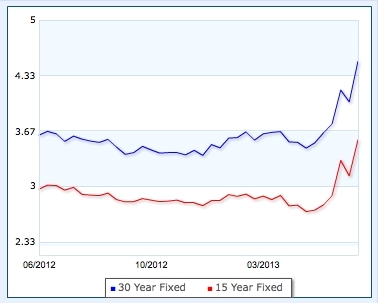
This chart only goes back a year. If we went back 5 years, we’d see rates at 6%. Go back to the 80’s and the 30 year fixed rate was 18%. But I digress. The 30 year rate recently hugged 3.4% for a time, and has now risen nearly a full percent from that low.

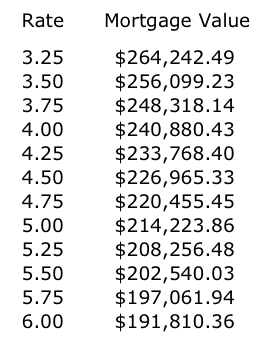
mortratesHave I mentioned my love of spreadsheets? You know how there are rules of thumb that suggest you can afford X times you income on your house purchase? Those rules are tied to the interest rate, because as rates change, the payment you can afford gets lower as rates rise. I wanted to look at this with numbers that are reasonable to my readers, so I started with a $60K per year income. This is a bit over median income, and offered just as an example. A well qualified mortgage will permit you to use 28% of your monthly income for the mortgage, property tax and insurance, so I use 23% for the mortgage payment only, that’s $1150 per month. Strictly from an affordability perspective, you can see that at 3.5%, an earner just over median family income would be able to pay for a $256K mortgage. Since this is an 80% loan to value, the home price is $320K, twice the median home price. It was actually a great time to be a buyer. Now that rates are nearly a percent higher, we are close to 4.5%, with that same payment of $1150 only supporting a mortgage of $227, nearly $30K less just a few months ago. This chart gives you a good look at how the borrow power of that payment drops as rates rise. The real question is whether this will put downward pressure on home prices as well. I suspect housing wont drop to meet the new value supported by the payment, but there is a risk that home prices drop a bit from their current levels. This also prompts the question whether rates in the UK will rise and is now the time to check out the rates at http://www.cbonline.co.uk/personal/loans/personal/loans before they head up.

{ 0 comments }

A guest Post today –

In both the US and UK, times couldn’t be much tougher for first-time buyers. Those hoping to sell their properties find that few people are able to afford a mortgage, while those aspiring to become homeowners for the first time are hampered by sky-high property prices. In both countries, the market for first time buyers isn’t in great health, but there are subtle differences.

United States

Those who own properties are being advised by some lenders to check whether their mortgage is owned by them – beleaguered bank Fannie Mae are doing this via one of their sister sites. Struggling homeowners are eligible for schemes like HARP and HAMP if they have borrowed from Fannie Mae.

Those looking to buy a new home for the first time can also take advantage of something called Homepath. It’s designed to make home ownership less expensive for those on modest incomes, while, if successful, it might also help to stimulate a housing market which has been rocked by mass foreclosures.

For those unable to buy due to financial constraints, there are a handful of ways in which the government is helping to reduce the burden of paying rent. The U.S. Department of Housing and Urban Development has a number of schemes in place to help tenants and landlords who might otherwise struggle to own or rent a property of any description.

United Kingdom

In the UK, many of the same problems that affect first-time buyers across the Atlantic are persistent, namely high house prices. Paperwork and a perceived lack of value on offer from mortgage providers are other issues they might face.

Totally Money came up with a first-time buyers guide which explains in full the ins and outs of applying for a mortgage and setting up a first home. Every aspect of applying for a mortgage, from the biggest to smallest details, are laid out in full.

As in the US, the government have launched a few schemes to help buyers get onto the first rung of the property ladder. Help to Buy, for example, is designed to make buying a home more affordable for people on average incomes.

First-time buyers here also have to be wary of a number of costs they may incur. Stamp duty, valuation fees, solicitors’ costs and, in some cases, mortgage brokers’ fees are all possible expenses first-time buyers may face according to the Citizens’ Advice Bureau.

{ 0 comments }

A 2013 Graduation Roundup

Interesting timing. On Monday, Sound Mind Investing posted What To Do About Stock Market Volatility, and you saw how the market traded the rest of this week. The Bernanke talked about ‘easing up on the gas pedal’ but the market confused this with ‘putting on the brakes,’ and Ben had to clarify his statement the next day. Fascinating times.

The Chicago Financial Planner, Roger Wohlner, asked (and answered) Are Retirement Rules of Thumb Useful? He discussed the 4% withdrawal rate. 4% is the generally accepted rate that a retiree can start withdrawing from their retirement funds and have a high chance to not outlive their money. Roger also discussed the 75% rule, that most people can target post retirement income  at about 75% of pretirement income. A great starting point, but Roger discusses why one size doesn’t always fit all.

2013graduate

At Smart401KBlog, Ray discussed whether Your 401k’s Brokerage Option Right For You? This is an often overlooked option that many 401(k) accounts offer. It can add flexibility and potentially lower your overall cost as well. Nice article, Ray.

Summer Book Reading List For Financial Planners isn’t just for planners, it’s Michael Kitces’ reading list that’s worth a look as it has 10 suggestions, all worth considering if your reading list is getting short.

The 1 percenter tell us why to Watch out for spending creep. It’s easy to let that spending inch up when you have a good income. The trouble is, that money comes from someplace, and in good times, it’s best to keep that savings target as high as you can.

{ 0 comments }

Middle Class Musical Chairs

middle-class-musical-chairs

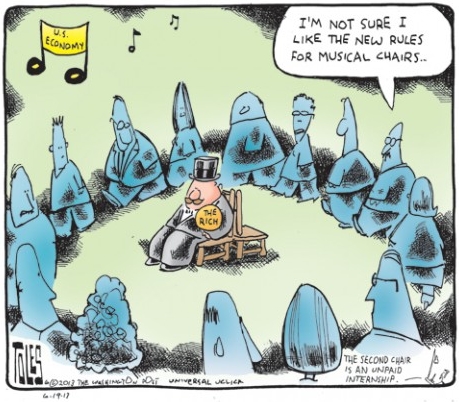
The recession ended 4 years ago. Where are the jobs, and where’s the expansion?

{ 1 comment }