≡ Menu

Worry Free Investing by Zvi Bodie

I started this blog in August, 2007. Before that, I was writing a monthly article that appeared on a static web page that I designed by hand. Not pretty, really. When I flipped to this format, the old pages still existed on the server but not tied in to this site. It’s time I migrated some of the better articles to here, and clean up my server. This is the first of about a dozen articles I plan to move over the coming months. Let’s see which articles stood the test of time and which are showing their age. We start with a book review of Zvi Bodie’s Worry Free Investing.

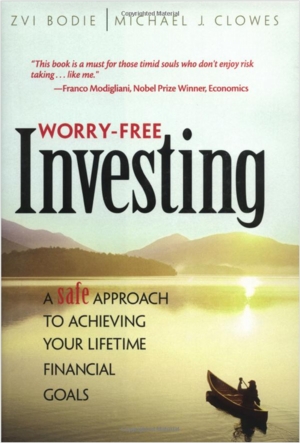
I’ve read the book and wanted to share my thoughts.First, here is the link which provides a downloadable spreadsheet. The first assumption is that the TIPS (he switches between TIPS and iBonds, I won’t object as they are similar in that both are linked to the CPI) have a 3% return. This means 3% plus whatever CPI is running. He also assumes a replacement rate of 70% is the goal, as social security will provide some, and 100% isn’t the target as one doesn’t have to save ‘for’ retirement while retired. No arguments there from me either. The sheet comes up assuming that one starts saving at 35, retires at 65, and dies at 85. A savings rate of 21% is needed to accomplish this. I think 90 is more realistic, the rate has to jump to 24%. Start saving at 25, the rate drops to below 16%. I’d be great with this, only a visit to treasury direct shows that the current rate on iBonds is 1.4%. (note – as of April, 2013, the rate is zero) The real return has dropped by half. Leave the changes I made above (start at 25, live to 90) and the required savings rate shoots back up to 27%.
WorryFree
Had I read the book in 2003 and been sold on this plan, from a savings rate of 16% (which I wouldn’t worry about), I’d find, that as the real rates dropped, the new bonds I purchased would require a saving rate over 27%. This is worry-free?
I appreciated his anecdotes of the people who were on the verge of retiring to then meet up with the crash of 2000-2. And the Enron widow. These stories only reinforced my belief that much planning is needed in those final years, but he suggests that no amount of diversification will protect an investor from a long term bear market. I’m not convinced either way, but I still lean toward the 5-6 years of spending in bonds or cash equivalent, and the rest diversified among stocks, local and foreign.
I wonder if he’s changed some of his advice given that the real return on his suggested investment vehicle has dropped by over half.
He also contradicts “Stocks for the Long Run” stating that there is no ‘safe’ investing horizon for an investment in stocks. In the end I find this author to be misguided at best, and likely dangerous to your financial well being. You should save yourself the two hours and read other books from my list.

{ 1 comment }

Retirement Savings Caps on the Way?

The news is out that President Obama is looking to introduce legislation to limit the value of retirement accounts to $3 million. So far, the claim is this targets IRAs, but it’s a simple matter for many of the big account holders to simply transfer from IRA to 401(k), so it would seem logical that once we see the full details, this limit will apply to all retirement accounts.

The news articles are suggesting this limit was a response to the fact that Mitt Romney amassed an incredible $100 million in his IRA. I spent a bit of time before the election writing about Romney and specifically in an article titled Romney’s Enormous IRA Balance – The Smoking Gun I spelled out the issues of how it’s unlikely the account grew to this value naturally.

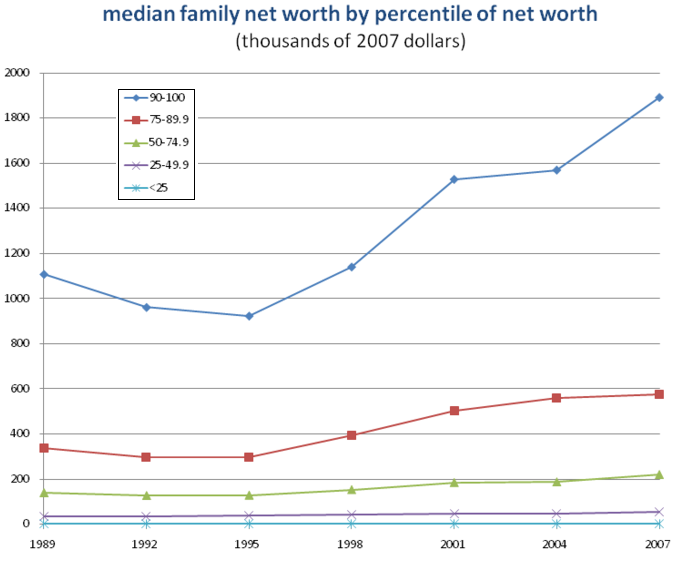
I’m all in favor of Romney’s IRA getting taken apart, i.e. taxed. A current limit of $3 million will not affect the average Joe, take a look at these numbers. You can click the image to enlarge it).

MedianNetWorth2007

The data is a bit old, but 2007 ended with the S&P just a bit lower than it is now, so for this discussion the chart is fine. We’re looking at median family net worth. For those in the top 10%, half have below $1.9 million, half higher.  5% of families have a net worth over $1.9 million. It’s not too great a stretch to assume that to specify $3M in one’s IRA or 401(k) is some smaller fraction, likely the 1%ers or even a bit fewer. So why all the fuss?

Very simple, remember the AMT. Specifically, I mean you should remember the origin of the AMT. It was created as part of the Tax Reform Act of 1969 intending to target the 155 high income households that managed to pay zero Federal Tax. By 2008, 4% of filers were subject to AMT with 27% of these households having incomes under $200K. Today, $3M still seems like a large number, but inflation has a way of eating away at the dollar. An inflation calculator showed that in my lifetime (50 years) the dollar has eroded by a factor of 7.5X. In other words, something costing $100 in 1962 would cost $750 today. That $3 million IRA cap will feel like $400,000 50 years from now. I know, we can’t forecast a few years out, 5 decades seems crazy. For me, it’s a ‘horse out of the barn’ event. $3M now, but easily adjusted down at congress’ whim.

{ 13 comments }

A pre-taxday guest post from Home Daddys’ Mike Freidberg –

Save yourself time and money

April is upon us, and as usual, a majority of Americans are scrambling to get their taxes figured out so they can file on time. As we near the big day, here are 10 of the most common mistakes made by Americans that you shouldn’t be making.

Filing late

One of the biggest mistakes Americans seem to make every year is that they file their taxes late. It’s one of the most talked about dates during the year, rivaling Christmas and New Years in media attention every season. While exact numbers of how many Americans forget to file on time is hard to pin down, the IRS apparently thinks it’s a big enough issue that last year they decided to increase the penalty for filing late, and hire scores of new employees to help enforce it.

Avoiding filing because you can’t pay

You should know that the IRS sets the penalty for not paying and the penalty for not filing separately—meaning even if you can’t pay, you can avoid significant penalties by applying for an “offer in compromise”, or making monthly installments on your tax bill. None of these options are particularly attractive, so you’re better off saving up for tax day, but there’s never a good reason to put off filing.

Under-reporting your income

Whether you use a W-2 or a 1099, there’s absolutely no point in reporting less earnings than you actually received. Your employers and clients have to report what they’ve paid you, and they’ll be sure to declare every penny to keep their own taxes low—so if your numbers don’t match theirs, the government won’t have any trouble finding out about it. Snag every possible deduction you can, but never lie to the IRS.

Incorrect business deductions

The IRS spells it out pretty clearly on their website what can be used as a deduction for your business. Take some time to review it and figure out what deductions apply to you. If you do operate your own business, be prepared by ensure that whoever you use for your merchant card services provides you with annual or quarterly statements for your records.

Claiming phony dependents

It’s hard to see your children leave the home and head off to college, but it’s even harder a couple years later when you realize you can’t claim them anymore. It’s not difficult for the government to cross check your tax returns with those of your dependents, so do yourself a favor and stop claiming them they start paying their own income taxes.

Missing charitable contributions

Turns out America is a pretty generous country when it comes to charitable giving, but many filers forget or neglect to fill out this portion of their taxes. It’s an easy write off and a great way to ensure your money is going to the exact causes you want. Be sure to include any donations you make to Goodwill, as well as any religious organizations or non-profits you support.

Getting your math wrong

Use a calculator. Better yet, e-file. Bad math can not only cost you on getting back all your refund, but it can even spur an audit if you mess up badly enough. Have someone else double check your figures before you file.

Mike Freiberg is a staff writer for HomeDaddys, a resource for stay-at-home dads, work-at-home dads, and everything in between. He’s a handyman, an amateur astronomer, and a tech junkie, who loves being home with his two kids. He lives in Austin.

{ 1 comment }

A Cliff Jumping Roundup

We’ll start this week’s roundup with If Everyone Jumped Off a Cliff … from Paula Pant at Afford Anything. You see, in response to one of Paula’s articles, she received a note, “If everyone did that, society would collapse.” Now, the funny thing is, that’s true. If everybody went in one direction, whether it be savings, investing, or any spending habit, there would be consequences. As much as the financial blogging community promotes frugality, the truth is, if everybody turned frugal, spending would slow us right into another recession. An interesting thing to ponder.

cliff

Lazy Man tell us about his One More Refinance. He’ll be at 2.75% 15 years, and saves from both the lower rate as well as the extended time on the loan, from the remaining 13 years left on the prior mortgage. The key thing is that he knows the difference. What’s remarkable is the comment suggesting that he continue to make the same payment to retire this loan even faster. This rate is below the rate of inflation. Even ignoring taxes, this rate is as low as it gets.

Next, Len Penzo offered A Simple Trick for Getting Credit Card Interest Charges Waived. And I’m not one to ruin the punchline, well, not since I told my sister Soylent Green is people, so you’ll have to read Len’s full article to understand how it’s done.

Cash Flow Mantra discussed Apple vs PC — What Should You Buy? The decision isn’t simple, it’s a chunk of change and a decision you’re likely to live with for a few years. What will your next computer be?

At The Hill an article caught my attention this week. Obama budget to take aim at wealthy IRAs. The devil is in the details which are a bit thin in the article, but the one line is what got me – Under the plan, a taxpayer’s tax-preferred retirement account, like an IRA, could not finance more than $205,000 per year of retirement – or right around $3 million this year.  What will be the method to cap the accounts? Forced withdrawals? Taxation of the excess? I suppose if a cap is coming, this figure is tough to argue with, it’s almost an anti-Mitt-Romney bill from where I sit.

We’ll close this week with two posts regarding Costco, at Bargaineering,  Why We Think Costco is Worth the Membership Fee, written in response to The Wealthy Turtle’s Is the Costco Membership Fee a Bargain or a Scam? My take on this? Know your prices. There are three groups Costco prices fit, (a) the items are always better than any supermarket price, (b) Costco is usually better, except for a good sale at the supermarket, and (c) the price really isn’t good, the supermarket usually better. For me, it’s that simple.

{ 2 comments }

The Tax Jungle

taxjungle

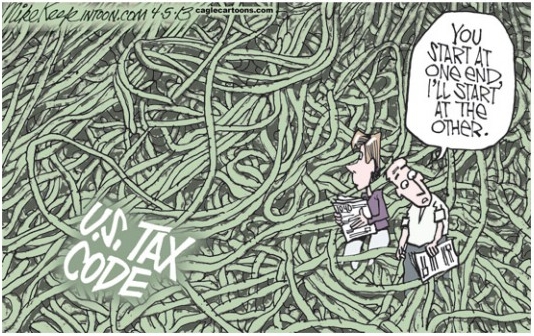
The tax code has gotten out of control, more than 70,000 pages. Some like to say that it’s ten time the size of the Bible, although I tend to stay away from religion, and prefer to compare large books to War and Peace. My latest guest post at Turbo Tax might help you with a few Last Minute Tax Tips if You’re Still Working on Your Tax Return. Check it out and ask a question if you’d like.

One week to go!

{ 0 comments }