≡ Menu

A Fall Harvest Roundup

After missing a round up last week, with good reason of course, I have some catching up to do. So, no banter, let’s get started:

At Narrowbridge Finance, Eric explains how to Get Your Credit Score For Free and Save Money. Eric recommends Credit Sesame, which I’ve not tried. It may make a nice complement to using Credit Karma as they probably are pulling data from different sources.

At One Money Design, Jocelin Boutet gust posted an article,The Entertainment Book: Good Deal? You know, it’s the book of coupons you can often buy at the local drug store or supermarket, or perhaps the neighborhood kids were selling it as a fundraiser. A good overview of this book and some interesting comments.

Kelly Whalen, founder of The Centsible Life, offered some lessons from fellow bloggers in What You Can Learn from Financial Bloggers About Being Frugal in a thoughtful guest post at Budgetable.

At Retire By 40, Joe Udo asked himself Did I just spend $24.89 to save 43 cents a month on the electric bill? Well, he might have, but that’s not a bad deal to me, over 20% return. As long as the savings lasts for 10 years or more the expense was well worth it. Joe borrowed a Kill-A-Watt device from his library and has been discovering all the energy wasters in his house.

Dear Friend: Here Are 41 Reasons Why I’m NOT Lending You the Money
, sincerely, Len Penzo. I like Len a lot, but if I should ever need to hit a friend up for a few bucks, I know better that to go to him. I’ve lent people money and not seen it again, sorry I hadn’t met Len 20 years ago before I gave it away.

My Tax Crush Kay Bell reminded me that It’s workplace benefits — including spending accounts — enrollment time. Start planning and make the decisions before the deadline.

The prolific Miranda Marquit explains What You Must Know Before Transferring Credit Card Balances. These deals can either help you dig your way out of a hole, or dig yourself a deeper one. Miranda explains what to look for to get it right.

Disclaimer – when I think Fall Harvest, I think “Sam Adams Harvest” mix pack. I was not compensated by the Sam Adams folk for using the image above, but the FTC wants me to tell you that, and the folk at MADD want me to tell you to never drink and drive. Especially if you’re drinking while watching the presidential debates, but that’s another story, I suppose.
{ 0 comments }

US Skyrocketing Debt

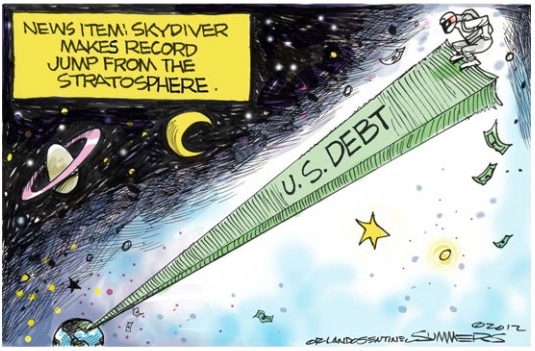
This week, Felix Baumgartner dove  from 24 miles above the Earth in a record breaking skydiving feat. I salute him and chuckled at the cartoon that acknowledged his amazing accomplishment.

{ 1 comment }

Thoughts on Age Based Savings

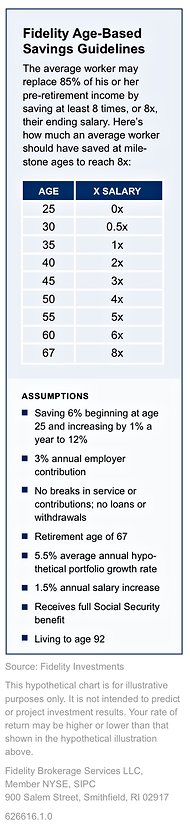
fidelity chart

Many articles have been written about the savings you need to have at different ages. In 2009, I wrote my own article Retirement Savings Ratio, which included a spreadsheet to track your own situation. Fidelity recently offered a chart which the New York Times picked up and ran as a story. What’s amazing to me is the numbers are not correct. To be clear, I’m accepting the assumptions Fidelity offers. 5.5% is a pretty conservative growth number, as is a 1.5% annual raise.

Now, when you take the spreadsheet and do a bit of editing, the numbers speak for themselves.

  • Zero out savings from 20 through 24.
  • Change Annual Raise to 1.015 (this is 1.5%)
  • Change percent saved to .15, then manually change the percent to 9 for age 25 and increase 1% each year till age 30
  • The above builds in the 3% employer deposit, so all set there.
  • Annual return is 1.055 (this is 5.5%)

Sorry if this is a bit tedious, but it’s how you can see the numbers for yourself. The result is that the chart underestimates savings by nearly 50% by retirement at 67. From the spreadsheet I wrote:

Age X Salary
25 0x
30 .09x
35 .75x
40  2.91x
45  4.34x
50  6.07x
55  8.18x
60  10.73x
67  15.25x

I was tipped off that something was wrong when I saw linear growth, 1x through 6x every five years. That alone told me these numbers weren’t calculated correctly. Growth over time is exponential, not linear. Don’t believe me, pull a copy of the spreadsheet and run the numbers yourself. Most important, don’t believe everything you read. Unfortunately, I can’t get a copy of the underlying spreadsheet Fidelity used to produce their chart, but you can grab a copy of mine.

Keep in mind, rules of thumb are just that, guidelines that apply to people in the center of a range. Some people retire and find that with 40-50 hours more time each week, are spending far more than they did prior to retiring. Others were saving 20% for retirement, 20% went to the mortgage, and 20% or more to college tuition payments. These folk were living on less than half their income. This article was not about calculating your number but about my observation how one pro got it wrong. A future article will discuss your number in greater depth.


{ 12 comments }

A Guest Post from Shawna Davies –

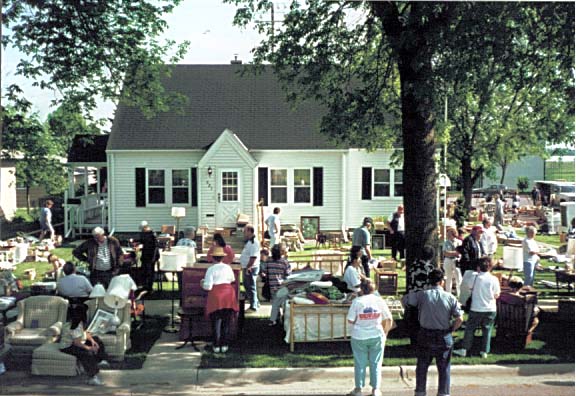
Estate sales can be intimidating, and they tend to happen in the midst of challenging circumstances; but whatever the reason, planning an estate sale can provide much-needed financial help at a difficult time. If you need to plan an estate sale, have a look at these tips to make it as painless and effective as possible.

1. Don’t assume everyone shares your taste

If you’re preparing to move a parent into a retirement community, there may be quite a few things around their home that you think are tacky or undesirable, that you may be tempted to throw away; but as long as the item is functional, resist the temptation! Many people shop estate sales in search of retro furnishings and curios, and if your crowd is large enough, you’re virtually guaranteed a few surprises.

Get the estate clean and presentable, of course—but the time to haul working items off to the thrift store or junkyard is after your sale is finished.

2. Have a careful discussion with any involved parties

Discussing beforehand what you will sell, and at what price, is an important step to avoid hurt feelings or disagreements in the course of your estate sale. It will also provide a stronger bargaining position—antique dealers and collectors can be highly-motivated and will often haggle aggressively, so it’s important to present a united front when the time comes to discuss price.

3. Provide food

A couple boxes of donuts and a pot of coffee will draw traffic and keep customers browsing, as well as contributing to an open, friendly atmosphere in which more people will feel comfortable buying. If you have kids, encourage them to set up a little concession stand with candy bars and drinks. These little investments will be well worth the cost, and you’ll clear out a lot more of your inventory.

4. Get a mobile credit card reader

Hardly anyone regularly carries cash anymore, and you’d be amazed at how many people will pass over your sale rather than make an extra trip to an ATM. Taking checks is more risk than it’s worth, of course—and most people don’t carry their checkbooks around anyway—but Square, PayPal, and Intuit all offer a free card reader and mobile app that allow you to start taking credit cards face-to-face at your estate sale. You pay a small percentage on each swipe (around 2.75%), but your sale will be far more successful.

5. Display items attractively

Any item that you expect to bring in more than $5 or $10 should be dusted and cleaned off before your sale, and displayed at eye level. If you have items that you think are worth a little more, consider printing out positive reviews from Amazon. For TVs or other consumer electronics, have them running so that people can get an idea of display quality, etc.

6. Determine the reason for your sale

Estate sales can be an excellent way to raise money or clear out clutter, but if you know which one is your primary goal, you’ll be more successful. If your main concern is clearing out the estate as quickly as possible, price accordingly. If you need to turn a significant profit from the sale, you can set prices higher—but be prepared to defend those prices by talking up your items, interacting assertively with customers, and putting on a bit of a show.


Shawna Davies is a staff writer for Going Cellular. She has a talent for organization and helping people navigate new technology. She’s a confessed gadget freak—her latest toy is an iPhone credit card reader for her Etsy home business—but when she gets out of the house, she loves spending time at the lake with her husband and young son. They live in Beaumont, Texas.

{ 1 comment }

Our Amazing Postal System

I saw a news blurb that announced that on January 27, 2013 the price to mail a one ounce card or letter will rise to 46 cents. Any price increase anywhere for anything is going to bring complaints, but I’d like to share an opposing opinion. I think they should have started charging 50 cents a number of years ago.

Gas is about $4 and if I get about 25 miles a gallon, it’s 16 cents to move one mile. So, a round trip of anything over a mile and a half each way and I just burned over 50 cents in gas. My supermarket is nearly 5 miles away, so even without counting the value of my time, it’s $1.60 to go there and back. On the other hand, if I need to send a birthday card to my family in NY, just under 200 miles away, for 45 cents, it’s there in 2 days, max.

With on line bill payment, I send fewer items by mail, greeting cards, thank you notes, and a very small number of checks that go to people I don’t pay on line. Even if that stamp went up to a dollar, I’d not have the same annual postal bill I had ten years ago. Congress has forced rules regarding future health care funding onto the Post Office and they now have a higher burden than  non-quasi-government companies. This is really a shame, and gives the appearance that our congress folk are looking to do away with the traditional post office and let private carriers take over. I hope that doesn’t happen. I like my postman and in all my years, have had a few pieces of mail that didn’t quite get through 100%. Compared to my driving 33 years and being in 6 accidents, I think the post office record of getting to the destination on time puts my own reputation to shame. If you are a postman (or woman) or have one in the family, please accept my complements, my respect, my sincere gratitude.

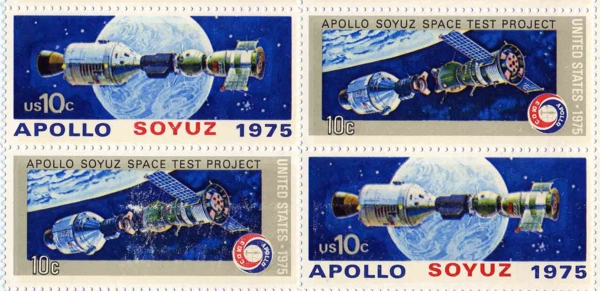
Aside from the great service I get, I collected stamps as a youngster, and remember buying the stamps pictured above. There was an excitement that’s tough to describe, to see the new stamp designs each year, designs that included simple thinks like flowers and animals, as well as the stamps that commemorates historical events. It would be the end of a era to have that come to a stop.

{ 2 comments }