≡ Menu

Paying your Credit Cards on Time?

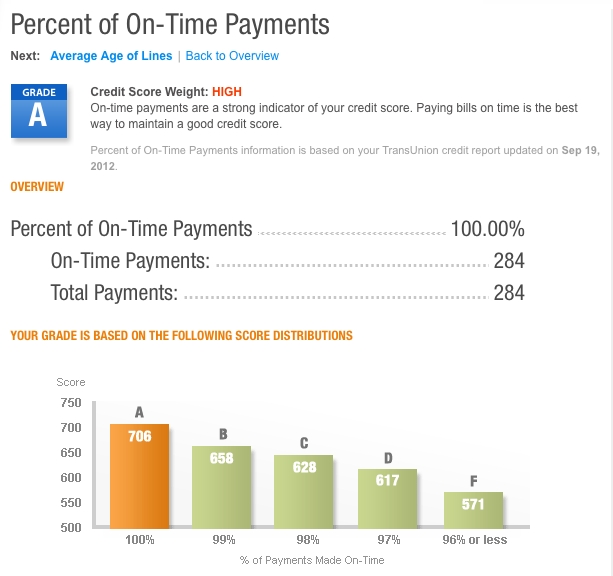
I’ve written over the past months about the different factors that make up your credit score, and have referenced the site Credit Karma which provides a free scoring service that will help you monitor and improve your credit score. Today, let’s look at on time payments.

This one is a no-brainer. It’s a highly weighted part of your score but it’s also the one that you should never fail to keep at 100%. Even letting one account go past 30 days will have a detrimental impact to your score. It’s very simple. Pay the bill when it’s due. Never let your minimum payments become so large that you risk not being able to pay that bill. For the three cards I regularly use, I have a payment sent automatically each month, enough to cover the minimum so if the bill gets lost or misplaced, my biggest risk is to pay interest, but not to have missed the payment completely. One more article in this series, and then a wrap up and summary. Stay tuned.

{ 4 comments }

A Post FinCon12 Roundup

Time for another Roundup. I missed last weeks, as I was away at the second annual financial blogger’s conference. 400 attendees this year, excellent group of speakers talking about their passion, financial blogging.

Let’s start this week with my Friend Roger Wohlner’s article remembering Lehman goes Bankrupt – Where Were You? Hard to believe 4 years have already past and the events that nearly took down the financial industry as we know it are now history. Just as we’re told to remember other events through time, can we count on remembering this one so we are not doomed to repeat it?

Home Equity Loan (HEL) Vs. Home Equity Line of Credit (HELOC): which is Better? That’s the question discussed at G.E. Miller’s 20 Something Finance. You probably know what a Home Equity Line of Credit is, but do you know how it differs from a Home Equity Loan? You will.

At Free Money Finance, an interesting guest post The False Promises of Annuities and Annuity Calculators. I’m pretty anti-annuity, but thought immediate fixed annuities were ok. This article describes why I may be wrong on that front. The only thing I am missing is where the author states, “the S&P 500’s return over the past 10 years was 6.34%.” Not sure exactly which 10 period he references, but I’m not finding a 6% return in any recent 10 year timeframe.

I am 1 percent shared why we should Stop Non-Value Added Activities. For the most part I agree, time is money, and you need to value your own time. In the end, doing what makes you happy should be the goal.

Let’s wrap up this week with J Money’s The Change In Your Pockets May Be Worth More Than You Think… I remember being quite young and doing my best to go through change and pull out silver coins (the dimes and quarters were silver until 1964) but the new coins soon flushed out the chances of finding anything good in one’s change for the last few decades. Maybe J has had better luck than I have.

Have a great week.

{ 2 comments }

The New False Idol?

This week, skipping a political cartoon in favor of what some say “will do more to help the economy than QE3.” We’ll see. I’m still waiting on the 7″ iPad, was hoping it would be introduced this week.

{ 1 comment }

Today, my thoughts are more personal than about finance or business. Before you click away, it’s not a sales pitch, just a thought I’d like to share. You see, I know I’m not the only person dedicated stupid enough to take their cell phone with them on vacation and answer it throughout their week off. There have been times that I planned to spend a week working in the basement (I’ve been finishing the basement, mostly by myself, and it’s nearly complete, waiting for the flooring to come in) and didn’t mind a break or two to catch up on business. In fact, I was able to tell me manager that I planned to take a few conference calls and keep up with email, so I put in 3 days vacation but was in the basement most of the week.  Truth be told, that’s not quite a real vacation, although it’s rewarding to just get a project completed.

On the flip side, there are times I’m away with the family, but because I don’t have my own cell phone, I’d still have the work cell on me in case my wife or daughter need to contact me. Unfortunately, this means looking at the phone and doing my best to ignore business calls. Easier said than done.

For a few weeks vacation a year, it would be crazy to get a full feature $50/mo phone. As I started to get closer to FinCon12, the second annual conference for financial bloggers, I thought about this a bit more and decided I wanted to enjoy myself, not take any business calls, and have a phone that would be only for my family and other bloggers who I wanted to keep in touch with. I almost walked by the phone pictured here when I saw that $50/mo working. I looked on the inside cover and saw the phone had a feature that let you use it for one day, unlimited voice anywhere in the US, for $1.99. And the phone came loaded with a $10 credit which means if used on the day at a time plan,  it would be good for any 5 days, not necessarily consecutive. This phone will also take pictures, text, and has limited web browsing, each for a small fee. Finally, the cost. It’s normally $20, but happened to be on sale for $10 last week at Staples.

Perhaps because I’m old enough to remember the early cell phones, like Gordon Gekko sported in the movie Wall Street, along with its huge fees. I recall coworkers’ bills exceeding $600 in a month when they used “only” 1000 minutes. The first clamshell style phone was compared to the communicators in the science fiction TV show Star Trek. And here I found myself buying this one for $10.

For those who have no cell phone, but would like to have occasional access, this pay-by-the-day plan can make sense. A reload of $15 can be used for up to a month before expiring. If you deposit $100, the credit lasts a year, and you can authorize the phone on any day you plan to use it. An interesting idea for those who might want a phone for trips or when their youngster needs a phone for a limited time. Even at the $20 retail, it’s pretty cool to be able to buy a working cell phone you can use and discard if you wish.

{ 0 comments }

Mortgage – 15 year term vs 30

In the day to day conversations about money there are probably a good dozen recurring themes that are brought up frequently. One of them is refinancing the mortgage, and with rates as low as they are today, the debate of 15 vs 30 year terms is still being tossed around. There are compelling arguments for both sides, after all, wouldn’t it be cool, at say, 25 years of age, to know you’ll live in a fully paid for house by age 40? But wait, wouldn’t it be cooler still to have money owed out at 4% or less but see it grow at 10% per year or more, and 15 years into the mortgage have an investment account worth three times the remaining balance? Good luck, the ’00s would have scared you straight. (Am I the only one that recalls the documentary Scared Straight?)

Back, even in the 90’s the choice was a bit simpler. Mortgage rates were higher and the ratio of the payment for 15 years term was lower. ?? I lost you? Ok, let me walk you through this:

$200,000 LOAN
30 Year 15 Year ratio
7.50% $1,398 7.00% $1,798 1.29
4.00% $955 3.50% $1,430 1.50

I calculated the payments on a $200,000 loan, with rates over 7%, and the rates you’ll see today. You can see that it would have taken a 29% higher payment to bring the 7.5% mortgage down to 15 years and the lower 7% rate. Of course today, we get to start at 4% for a 30 year fixed, but as you can see, the payment is a full 50% higher to pull the term into 15 years. Sound strange? It did to me until I realized that if we took this to an extreme, a loan at zero percent, it would take twice the payment to pay the loan off in half the time. When rates were truly insane (18 percent mortgage anyone?) it would take less than 5% higher payments to knock 15 years off that mortgage.

Note – the 15 year term typically comes with a slightly lower rate, about 1/2%, this isn’t fixed, you need to see what rates your bank offers for each term.

There are some good things to consider before going for the 15:

  • Are you depositing to the match in your 401(k)?
  • Is all higher interest debt paid off?
  • Are you planning to expand the family?
  • Might you or your spouse change jobs or reduce hours?
  • Is your emergency fund sufficiently funded?
  • Have you and your spouse sat down to create a budget that accounts for 100% of your known expenses?
  • Do you have plans for your roof, furnace, air conditioner, hot water heater, and all appliances to be replaced?

You see where all this is going. If you were looking at having your mortgage payment be a reasonable 20% of your income, going for the 15 year term pushes you to commit to 30%. Considering the chunk that goes to taxes, retirement savings, food, etc, it’s this 10% push that may leave you in a bind.

Note, my view of this shifts as one gathers assets over the years, or pays the mortgage down to where the 15 year is a small portion of their income. Our current mortgage is half of what it was when we bought the house, and the rate is also half, so the payment for our mortgage after the last refinance accounts for less than 10% of our monthly income even though it’s a 15 year term.

What do you think? Is a 15 year mortgage risky for you because it ties up too much monthly cash?

{ 5 comments }