≡ Menu

The Poor Millionaire

In this past Sunday’s roundup I cited Bargaineering’s post which discussed a guy who had trouble on a million dollar income.

I missed the original article when it was posted a year ago, Getting By on $1,000,000 a Year, by James Altucher. In his article he discusses how his friend (Mike) just had a million dollar year, yet  sounded like he was in dire straights. Forget for a moment that half the world lives on less than $850/day. Or that half the families in the US “survive” on less than $50,000/yr. I was inclined to simply dismiss this as someone living beyond his means, and I’m still on the fence about that.

Here’s where things started to get pretty crazy. Half the income was in deferred compensation. So, $500K isn’t his until it vests over a five year period. Still, the remaining $500K should to enough to get by on, even in New York City. Now is when his (and his wife’s) lifestyle gets in the way. $50K to a summer rental? $60K for private school? $60K per year for his mortgage? Yes, it’s actually possible to blow through a half million dollars with no jet and no yachts. Living in Manhattan, he doesn’t even mention a car, and probably doesn’t have one. Still, he’s living beyond his means, obviously.

What did hit me was one final point he made. That he works 70 hours a week. I’d not want to work that many hours a week for the whole million. Really. Time with my family is too precious. My daughter is now 13 and five year from this summer she’ll be off to college. Income has a rapidly diminishing marginal return for me. By that I mean I don’t mind the occasional business trip or evening function, but I’d not want to give up my evenings on a regular basis for any price. When she’s off to college I might feel otherwise, but for now I’ll listen to her stories of classmates whose fathers never seem to be around. I’m not a big sport fan, but put my daughter on a basketball court and I’m there. As far as Mike is concerned – it’s for him, his wife, and their three shrinks to figure out what’s going to bring him happiness.

{ 4 comments }

A Milion Dollar Roundup

Let’s start this week with a book review at The Financial Buff.  TFB reviewed A Social Security Owners Manual.  A compelling overview of this book, with brief discussion of each of the four major sections. While the rules are changing all the time, if you are retiring soon, or just want a better understanding of the current rules regarding Social Security, a great read.

Boomer and Echo ask, “Will that be Paper or Plastic“? I never tire of this discussion, and this was Boomer’s pros and cons list for the use of cash money vs a credit or debit card. Of course there’s no general right or wrong, just what’s right or wrong for you.

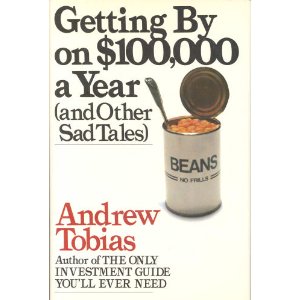
In 1980, Andrew Tobias wrote a book titled “Getting by on $100,000 a Year (and other sad tales).” The title was meant a bit tongue-in-cheek, as in 1980, $100,000 was a tidy sum of money, equal to about $260,000 in today’s dollars. But, I digress. This week I read When $1 Million Isn’t Enough at Bargaineering. In this article is referenced a post by James Altucher, whose friend made a million dollars but is stressed out over the lack of money. No sympathy, but yes, I understand if you manage to create a lifestyle that’s 10% above your income, you too can be stressed.

At Lazy Man and Money, Determining Your Retirement Expenses. All the rules of thumb are pretty pointless if you are not that average person. The rule that you’ll retire needing 80% of your preretirement income is one such rule. Lazy Man talks about what his retirement needs might be and how you can start to project these numbers now.

And to wrap up this week, let’s stick with the retirement theme. At My Retirement Blog, Almost 50% of Boomers Don’t Have Enough Retirement Savings: So What Can They Do? I had to do a double take there. 50%! The author of this post has written a book promoting starting a business and retiring with a continued stream of income from that business. Not a bad idea if you can swing it.

{ 0 comments }

Thank You

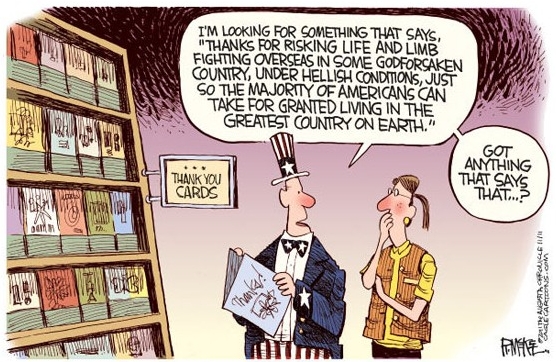
I think the best way to say thanks is to make a donation to your local Veteran’s Shelter. In my case, it’s the New England Center For Homeless Vets. You can read about the fine work they do, it’s not a handout, but help and training to get back on one’s feet after serving.

{ 0 comments }

A guest post by fellow Personal Finance Blogger, Mike –

Back when I was a kid, there was a friend of mine whose family owned a restaurant in town. One day while visiting, I remember hearing the father harp about credit card payments. Was he ranting about the 1-3% surcharge? Nope. He was whining about the fact that he was forced to pay taxes on those transactions (or in other words, he couldn’t break the law and make money under the table with them).

In the years since, the battle over card payments have only grown stronger. You rarely hear a company like McDonald’s, Target, or even a mid-size chain complaining, but rather the mom and pop businesses; independent liquor stores, gas stations, dry cleaners, eateries and the like. Which has naturally led me to wonder – How much of this hoopla is about the actual fees? And how much of the card hating has more to do with small biz owners paying Uncle Sam his fair share?

The argument for small businesses

On one hand, I sympathize with the mom and pops. Keeping a small business out of the red is hard enough as it is, so any fee or expense is a burden. This is especially true for small transactions, whereas the percentage paid for processing is higher. There’s the inquiry fee (say, 12 cents) and then the percentage fee (2% for example). On a $100 purchase that would only be $2.12 (2.12% of the price). However if the customer were just buying a $1.50 bottle of soda, then 2% plus 12 cents = $0.15 (which is a whopping 10% of the purchase price). Sure enough, the industries which are affected by this model the most seem to be those who are most vocal in complaining – the convenience stores, gas stations, and so forth.

Another obstacle for mom and pop businesses is that they have little to no negotiation power. That being said, the wiggle room is not as large as you may think. The card’s issuing bank (e.g. Citi) and the payment network (e.g. MasterCard) get the lion’s share. The portion that can typically be negotiated is the piece of pie that the processing service gets, which is a sliver. So while it’s true big business pay less, the difference might not be as drastic as you think. However the uber-big (think Walmart and Costco) do sometimes have the ability to negotiate the payment network’s cut, too.

Lastly, to say the fees are confusing for a mom and pop would be an understatement. There are multiple risk tiers, which all cost different rates. Take an online retailer, who would probably pay a higher rate than a restaurant where the card is physically swiped. To further complicate matters, different cards have different fees. For example, my business credit cards and Joe’s 2% cash back card are amongst the most expensive to process. All of this can lead to sticker shock each month, when the business owner sees just how much they’re forking over for those card transactions.

The argument for banks

For the pro-credit card camp (which admittedly, I am a part of) there are several aspects which even the naysayers must at least consider.

For starters, credit cards are a service that must be paid for. While it’s true that some people carry a balance and pay interest, the majority of cardholders pay their bill in full every month (Joe and I being two such examples). The fraud protection, insurance benefits, cash back, travel rewards, customer service, printed statements, and other expenses must be paid for somehow, right? Well that’s where those processing fees come in handy.

Secondly, thanks to Senator Durbin, businesses small and large have the ability to now place a minimum spend requirement on debit and credit card purchases (before the payment networks wouldn’t allow that). So that $1.50 soda conundrum can be circumvented by imposing a $10 minimum. Problem solved.

Third, there’s a good reason why you don’t see big business rallying against the card industry. Why? Probably because they’ve discovered that cards encourage spending. A few years ago when McDonald’s was trying to decide whether or not to accept plastic, they ran a pilot program and reportedly found that the average transaction size rose from $4.50 to $7.00 when paying with a card. After the discovery, they rolled out card acceptance nationwide in a hurry. Reportedly there is also a Dunn & Bradstreet study out there which claims a 12-18% increase with credit cards, though I have yet to read it myself. Either way, there is ample evidence to suggest that more will be spent. Is it worth paying 2-3% in fees for your business to rake in significantly higher purchase volume? You be the judge.

The argument for taxes

Last but certainly not least, we come to the taxes. If you’re up for some reading, check out this 30+ page article titled Cash Businesses and Tax Evasion. It was authored by three faculty members from various law schools in California. Nearly 275 interviews were conducted with cash business owners, as well as their tax preparers and bankers. They offer a fascinating insight into how cash payments from customers and to suppliers are used to grossly under-report income. The paper concludes:

ìCash business owners rely on parallel cash economies to under-report receipts and thereby evade income, employment and sales taxes. Many preparers in this sector adopt a “don’t ask, don’t tell” attitude toward their clients reported receipts. A small minority of preparers, however, actively aid in their clients’ evasion. Evasion seems best explained by opportunity, including the low-perceived likelihood of detection and penalty, and by peer norms. The perceived equity of the tax system has less importance, and the complexity of the tax law does not appear to play a significant role.î

While each page is riddled with example after example of how cash is drastically under-reported, the finding for credit card payments are a stark contrast: ìmost interviewees reported that credit card receipts were generally reported as taxable revenue.î

Going back to the industries mentioned above which appear to be most against cards, I find it interesting that they also seem to be the mom and pops who, historically, have largely been cash-based. While I sympathize with the high cost on processing small transactions, I find it ironic that large chain eateries (who are more likely to report all income, regardless of source) seem to feel the complete opposite ñ they love credit cards, even for the small transactions.

So which is it?

So that brings us back to the question, is it really the fees on the bottom line? Or the fact that card payments make tax evasion tough to pull off?

This post was written by Mike, the guy behind Credit Card Forum. Thanks, Mike, you looked at this topic from an angle that never really occurred to me before, very interesting.
{ 0 comments }

A Snowy Roundup

Snowy? On October 30? I’m afraid so. We’re expecting as much as a foot of snow overnight in the Northeast. But I digress.

The first fellow bloggers article was the stupidest idea I’d heard in a long time, Five Cent Nickel (who’s quite bright, he was just the messenger here) shared how two Congress folk want to allow people to Pay Off Your Mortgage With 401(k) Funds? As I started, I think this idea is pretty awful. Tax would still be due at your marginal rate, and there’s no telling this amount, limited to $50K would be enough to get the homeowner out of trouble.

The financial buff explained how Social Security Benefits Increase More Rapidly For Retirees Than For Those Still Working. It seems the increases are tied to different indexes, I never knew this. I also am not convinced that social security will be around long enough for my wife and me to collect. Which means if I hope to retire early, I can’t count on that future income stream, need to make sure the retirement accounts are full-up.

Clever Dude gives Two real-life examples of why emergency funds are important! Great examples, I can probably come up with a dozen more. Hint: Everything you own can and probably will break one day. Most of what breaks you’ll want to replace.

At Boomer and Echo, Boomer unravels The Case Of The Shrinking Food Package.  I’ve watched this phenomenon for years, as cans of coffee dropped from 16 ounces to 14, 12, and whatever they are today. Some companies *cough* Friendlies, dropped their half gallon and started offering 56 oz, and more recently, 48. Well, we’re half way to 32 oz and by the time they get there it will be a great time to off the “new” supersized half gallon.

Last, not a finance story, I read that a professor of medicine at the Mayo Clinic decided there’s a correlation between premature death and TV watching. He was clear that watching TV meant not exercising and sitting on the couch led to snacking on junk food, but is TV really the culprit here?  I have a treadmill and in from of it is a TV. So for me 3 hours of television takes 2 hours to watch on the TiVo, and I’m good for 9-10 miles depending on my knees. The same way not all credit cards lead to debt, not all TV leads to death. In fact for me, there’s a direct correlation between the TV and being in better shape.


{ 1 comment }