≡ Menu

Homeless: An Introduction

I’m in Chicago on a business trip and as my customer and I are walking from our hotel to a local restaurant, he noticed that I handed a dollar to every person with his or her hand out. We had a nice dinner, and I made sure I had enough singles for the walk back, all told, I must have given away no more than ten dollars. He asked me, “how can you give money to every person you pass by?” I didn’t miss a beat, and asked in response, “how can you walk by so many people asking for money and not reach into your pocket once?”

Years later I heard this anecdote which reminded me of my own story above. Two men of the cloth (I don’t recall the religion) are walking in an area where there are many homeless asking for money. One man gives to everyone with his hand out, the other doesn’t give at all. The non-giver says, “I don’t give to people on the street, I only donate through the soup kitchens and institutions, as I’m afraid that someone I give money to on the street will use it for alcohol.”  The giver responds, “I know that many I give to will buy alcohol or drugs, but I give to everyone with his hand out in the hope than one person will spend the money on food.”

I don’t kid myself, I know that giving away a dollar here and there probably makes me feel good more than it helps the guy on the street. On the other hand, symbolism can go a long way, and I think there’s much to be said for the act of not walking by someone in need when you can help a bit.

In an endeavor unrelated to this blog, I’ve spent some time on a board discussing Amazon’s Mechanical Turk, a system of paying people for relatively small, simple transactions. I met a writer who mentioned he had spent time being homeless, and we had some discussion on that topic. I invited him to share his story with my readers and soon after I received an article than ran over 4000 words.  It’s really an amazing story, one I look forward to sharing with you over the next eight weeks.

Next Week – The First Days

{ 12 comments }

An Ice Cream Day Roundup

Is it National Ice Cream Day already? I’m still burning off the calories I ate last year at this time. Whether you’re a big fan or treating this like any other day, let’s get on with the roundup.

I rediscovered a classic post from Jim at Bargaineering, 50 Financial Skills Every Person Needs To Know. An excellent list of skills one should have. And a welcome addition to my Joe’s List of Lists, which I edit every so often.

At Wealth Pilgrim, my friend Neal gives advice on IRA Restrictions – A Guide To Your Best IRA. I find it remarkable that the rules are so complex for retirement accounts that most people are clueless to how IRAs work. Let Neal get you up to speed on the basics, and maybe save you from a costly mistake.

Posting at MoneyWatch, I read an interesting article by Farnoosh Torabi, Extreme Coupons: TV Show Draws Extreme Backlash. A coupon backlash? Well, when people see that with some (ok, a lot) effort, they might be able to save hundreds of dollars on a grocery or drug store visit, I can understand the stores getting nervous. Check out her article, and let me know if you found your local stores starting to change their policy regarding coupon use.

North of the (US) border, Robb Engen guest posted at Canadian Finance Blog, Freedom 55 Is Just A Dream. Perhaps, but it all starts with education, a decent income, and living sufficiently beneath your means to start saving aggressively at a young age. For me, I may be able to retire at 55, but will likely work a bit longer, depending what else is going on in my life.

Emily Guy Birken Guest posted at Moolanomy on Estate Taxes: Planning Now to Avoid Taxes Later. If you thought retirement account rules were complex, the Estate Tax is bound to confuse you. Emily does a great job explaining your options to keep more money in your beneficiaries hands and out of Uncle Sam’s.

Money Guy debunks POTUS’ looking to tax jet owners and others at Jet Owners, Ogres, and Other Millionaire Myths. Tax jets and the workers who build jets will be out of work. I don’t have the answers, but the path we’re on isn’t the right one. I agree with Money Guy.

And to wrap up the week, Kay Lynn at Bucksome Boomer tell us what she’d do “If I had a Million Dollars.” I believe I deserve the award for most boring answer in her comments, I’d put it away towards retirement, 100%, every last dollar. I’d still work for the next 6-10 years, and pay the mortgage over the next 6 as well. No big spending spree, no unplanned trips. Boring, sorry.

{ 1 comment }

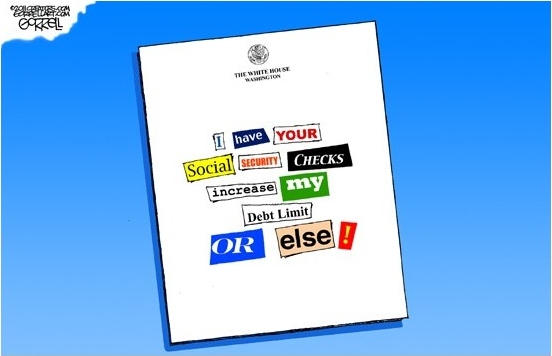
A Ransom Note?

It may be an exaggeration, but it sure feels that way…

{ 0 comments }

Netflix Anchoring Blunder

Anchoring? Exactly. I noticed my wife and daughter’s tendency to remark how something they bought for 25% off was a bargain. Perhaps, but was it a value? I tried to walk them though the process merchants use to price their goods, setting an anchor value in our minds. If the ‘sticker’ price of an item is $200, it surely must be a great deal at $100, no? Well, no, not when it’s a sweatshirt that’s hardly worth even $50. You get the idea.

How did Netflix stumble? In a sense, by offering too much value, and then trying to raise their price after the fact. They recently announced that the current plan of unlimited streaming and one out at-a-time DVDs which currently cost $9.99 will be split into two plans, each $7.99, or $15.98 to keep the current features. What I find so curious is that the DVD plan has a lot of value, $30 or so, I’d say. We have a RedBox at our supermarket, but it’s 10 miles round trip, so that $1 rental pushes $5 when we get a DVD for a specific night and not during a regular shopping trip. On the other hand, I can flip the Netflix around fast enough to get 8 in a good month, just over 6 on average. Unfortunately, Netflix had me trained that the DVD plus streaming was worth the $10 I was paying, and any increase just felt like a rip-off. We weren’t using streaming that much, so by breaking out the service to 2 plans, I’ll actually pay less as I’ll drop to the $7.99 plan, now an even better deal for us.

Are you a Netflix customer? Will you change your plan after this price increase goes into effect?

{ 6 comments }

The Stagnant Median Income

I’ve always been intrigued by data, statistics, and how the numbers are interpreted.

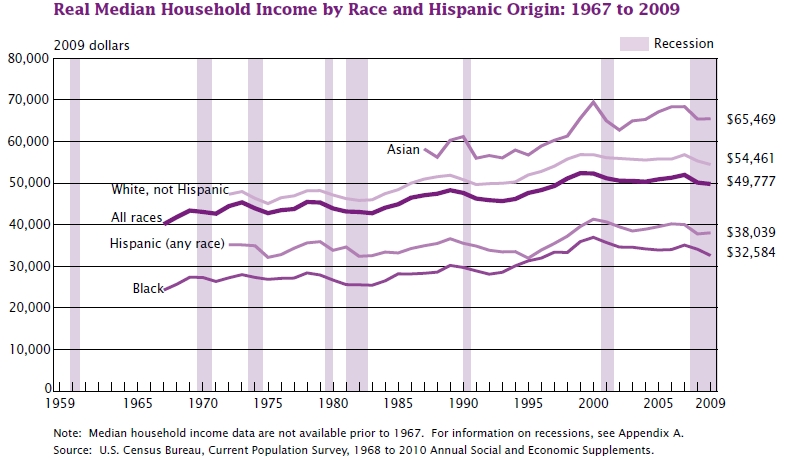
I look at this chart of inflation-adjusted median income and it seems we have stagnated the last dozen years or so. Over the 42 years represented in this chart, real income has increased by less than 25%, or about 1/2%/yr compounded over that period. I don’t know which aspect of this chart I find more disturbing, the racial disparity that seems to go along with no solution, or the lack of a major rise sourced from the productivity gains we were supposed to see as we became more reliant on robots and electronics. This productivity should have spilled into all our paychecks. Want to look at this chart’s source? See Income, Poverty, and Health Insurance Coverage in the United States: 2009

{ 2 comments }