≡ Menu

A Fooltong Round Up

This week, let’s start with a recurring question – Pay Off the Mortgage or Keep the Money in Savings? This question was asked by JD Roth at Get Rich Slowly. It’s both a thought provoking and emotionally charged question for many. Personally, I’m on track to pay off the mortgage by the time Jane 2.0 goes off to college. After multiple refinances, all no cost, the house will be paid off 21 years after we bought it. My advise to others – be sure to get your employer’s 401(k) match if any, then be sure your emergency fund is well positioned. After that, if paying the mortgage at a faster pace will help you sleep, go for it.

The Financial Buff observes an Irrational Sensitivity to Gas Prices.  I agree that driving around or waiting on a long line makes no sense when the dime you may save only multiplies to $1.50 or so. I’ve started to use GasBuddy more often. When I see my gas tank is starting to run low, I’ll take a peek at prices on the next drive I’ll take. Depending on my direction I’ll save $2 or so, but I avoid the station if there’s going to be any wait.

At Saving – Frugal Living, Mary Ann Romans asked (and answered) Are We in a Depression? I’m reminded of the quote, “A Recession is when your Neighbor is out of work, a Depression is when you are out of work.” Truth is, this recovery is not as robust as past recoveries. As they say “past performance is no guarantee of future results.” So, this economic cycle will simply be a new data point, one that shows that not all slowdowns are folowed by big moves up.

Lazy Man and Money has had another run-in with an MLM (Multi-Level Marketing scam). Read about it at his site One24 Responds to “The Scam”. I’d never heard of this company before, and with any luck, never again.

At Money Hacks, BillSpaced offers a somber  chart showing that Real Median Household income was the same at the end of 2009 as it was in 1995. Tough times.

At My Money Blog, as interesting article on Mortgage Down Payment Size vs. Delinquency Rate. I’ve been a fan of getting back to basics, a 20% downpayment requirement, and more stringent underwriting requirement for mortgages that are going to be collateralized. Low downpayments were not the only cause of the financial meltdown, but they were part of it.

And in a completely stream of consciousness post, Brainy Smurf over at Pants In a Can tells us why he thinks Avocados are Gross. More important, his post inspired the strange name of this roundup…
{ 2 comments }

Descartes Economics

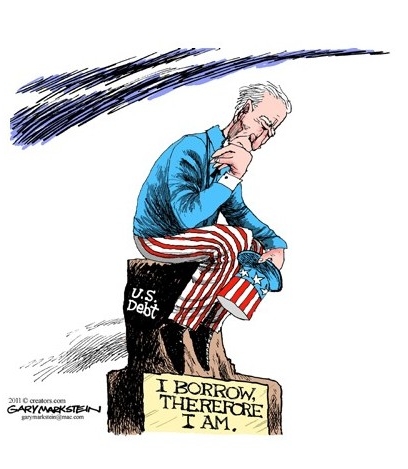
One of my favorite bar jokes goes like this – René Descartes walks into a bar. The bartender asks, “can I get you a drink?” Descartes replies, “I think not” and disappears. Maybe that’s what I thought of when I saw this cartoon, the idea that we are the country we are because of our borrowing not despite it. Maybe not, maybe it was the take off of Rodin’s The Thinker. Jane is always telling me, “Joe, you’re always thinking, doesn’t your brain get tired?” Tell me about it.

{ 0 comments }

Diversifying to Reduce Risk

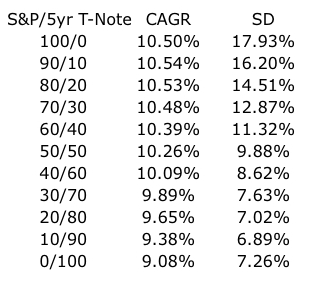
While answering a question at StackExchange regarding backtesting of investing strategies, I came upon a web site, AssetPlay, which lets you test a variety of different asset class mixes over the last 36 years or so (currently 1972-2008). While tinkering to find the returns from 1980-2008 for different S&P and 5 year t-Notes I discovered the following returns;

This shows mixes from 100% S&P index, and adds 10% increments of 5 yr T-Notes, to show the different Compound Annual Growth Rates (CAGR) and Standard Deviations (SD).  I find a few things curious about these returns. First, the addition of the T-Notes reduces volatility dramatically, yet, the first two 10% increments actually increase growth. So the 70/30 mix lagged by only 2/100 of a percent, yet the volatility was fully 5% lower. Of course, this isn’t new, it’s the basis of the Efficient Frontier, the theory that proposes the optimal mix of assets based on risk. While I still find the concept fascinating, I’d warn that part of the success shown here is based on the fact that the 5 year note by itself had a return over 9% during this time. I’m not in possession of a crystal ball, but I’m willing to bet the next  decade won’t be so kind to the bond market. Regardless of bond returns, I suspect the stock/bond mix will continue to mitigate risk will little impact to one’s overall return.

{ 1 comment }

How Many Cards are You Carrying?

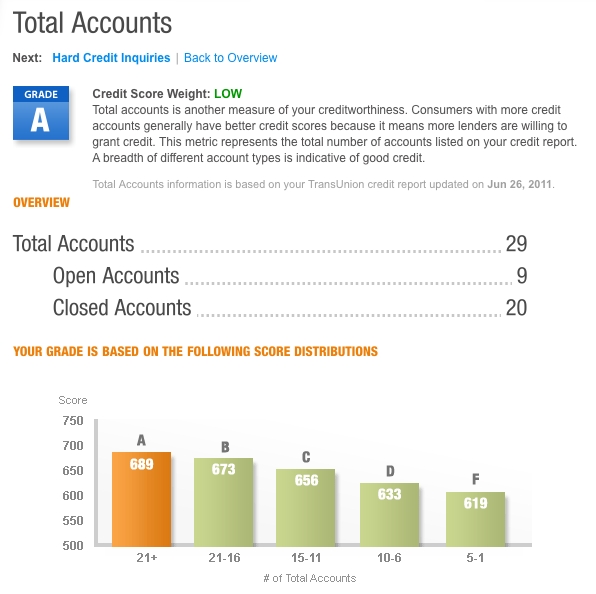
I thought it a good idea to continue the series on your credit score, started with Too Little Debt, and then How Old is Your Credit Card? Today, let’s look at my score (provided by Credit Karma) for total number of accounts.

Well, I got an A, which is cool, even though I’ve canceled a number of accounts and moved on. The 9 sounds about right, a mortgage, home equity line, and 7 different credit cards.  More than anything, I find it interesting and curious that the score basically says “more is better.” Just getting the couple credits cards and one mortgage would keep you at the bottom of this scoring criteria. Hey, don’t shoot me, I’m just the messenger.

How many account do do have? How many are still open?

{ 0 comments }

A Summer Soltice Roundup

First this week, Another example of why the rich are different from you and me an article focused on a financial ad in which the bank talks about long term planning. So many of us are living check to check, the idea that we should plan for the next generation, let along the ones after, is like talking a foreign language.

At Rick Kahler’s Financial Awakenings I read Defining Rich.  A recurring topic, the question of whether “rich’ can be defined by income or only by accumulated wealth is one to consider. I agree with Rick, when we talk about whom to tax (well, not me, but those talking about such things) the words used should be “high earners.” The doctors making $250,000 per year may not be rich, not after malpractice insurance, and three kids at home.

At Get Rich Slowly, JD discussed how he and the missus handle their money in How to Make Separate Finances Work: An Interview with J.D. and Kris. This is one of those situations where I’d say “whatever works.” Jane and I have separate check books but deposit most of our paychecks into the joint account. Purely for convenience. I handle the bills and keep written checks to a minimum.

Beating Broke asks What if Everyone Was a Frugaler? It’s actually an interesting question to me. It would mean a shift in consumption that would result in a depression, I’m sure of that. But what if the last 12 years scared us enough that we’re on a path to frugality, not an instant flip of a switch? That really is something to ponder.

At My Money Blog, I read that Investors Again Had Poor Timing During Recent Market Crash and Recovery. No surprise, I wrote about this some time ago in an article titled Disappointing Returns in which I cite data showing investors lag the market by a wide margin year after year.

A Simple Way to Add $100,000 to Your 401(k) was posted at US News Money. A nice article showing how expenses are key to long term success.

The Wandering Tax Pro Posted THE NEW TAX CODE – TAXATION OF SOCIAL SECURITY AND RAILROAD RETIREMENT BENEFITS.The whole Social Security taxation issue is one near and dear to my heart as Jane and I get closer to retiring. The system needs fixing and Robert proposes his own way to do that.

At Money Ning, Miranda Marquit asked Do You Really Own That? Of course she was asking whether you really own your house so long as it’s mortgaged, or your car on a five year loan, for that matter. This is one of those articles that’s more an attempt at getting you thinking,  a different spin on what it really means to “own” something. Nice article, Miranda.

{ 1 comment }