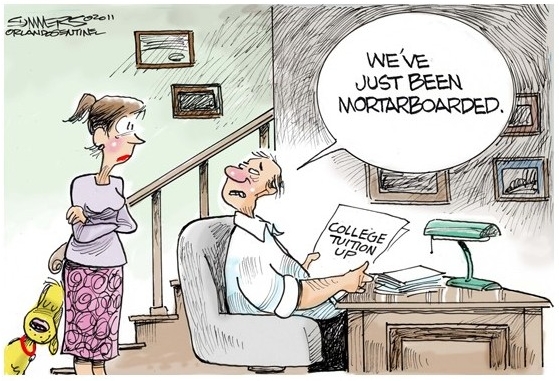
College costs continue to spiral, rising faster than inflation. 2010-11 tuition was up 4./4% from the prior year at private colleges and up 5.8% at public schools. Detailed report available in an article titled Trends in College Pricing 2010.
College costs continue to spiral, rising faster than inflation. 2010-11 tuition was up 4./4% from the prior year at private colleges and up 5.8% at public schools. Detailed report available in an article titled Trends in College Pricing 2010.
Let’s start this week’s roundup with Micro-frugality VS. Macro-frugality, posted by my friend Kevin M at Out Of Your Rut. It’s less about “not sweating the small stuff” and more about the limits of frugality. In the end, it’s the large things that make nearly all the difference, kinda like the 80/20 rule that applies to most stuff.
At One Money Design, Danny Kofke asks his readers Are You Ready for Retirement? He discusses a poll showing that 44% of boomers say they are not confident they’ll have enough to retire comfortably. I believe it, especially after the decade we just had.

In Forbes this week I caught an article titled The Retirement Spending Solution. The author cites a study by Bill Bengen from 1994 in which Bill concludes that 4.5% is the retiree safe withdrawal rate. I’d be cusious what Mr Bengen would conclude today after the decade ending in 2009.
The Weakonomist thinks The Rich Should Want To Be Taxed More. Aside from Buffett’s remarks that his secretary is in a higher bracket than he is, I don’t see too make rich people asking to pay more. You know, if you want, you can send money right to the treasury to pay off the national debt. So if you have fourteen trillion dollars burning a hole in your pocket, just send it on over to Uncle Sam. Me, I have bills to pay, and can’t count on social security, so I also have a retirement account to fund.
And to close this week, Phil Brewer talked about Raising your standard of living by focusing your spending, suggesting that we focus on maximizing our standard of living by how we spend, focusing on what gives the most satisfaction. Sounds good to me.
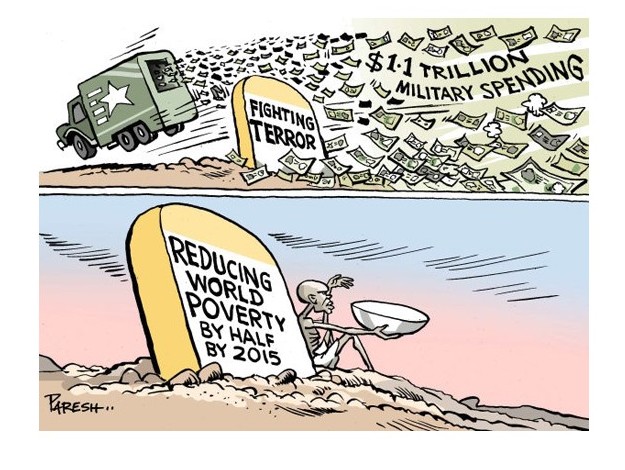 I was reading the estimates for what the war on terror has cost the US so far, and thinking about the things we might have spent this money on. Of course, the deficit has exploded, so it was money we didn’t have to spend, and wouldn’t have appropriated elsewhere.
Last year, I wrote Your Credit Score, in which I discussed the factors that go into the Fico Score. One item, representing 30% of your score was credit utilization. In other words, using $1000 of a $2000 total credit line was far wore than using $2000 of a $10000 line. Since the amount reported is what’s shown on the bill, regardless of how much you pay or even if you pay in full each month, the bill amount still ripples to your score. So as part of some experimenting, I paid my cards in the last cycle before the bill was cut. Yes, just before.
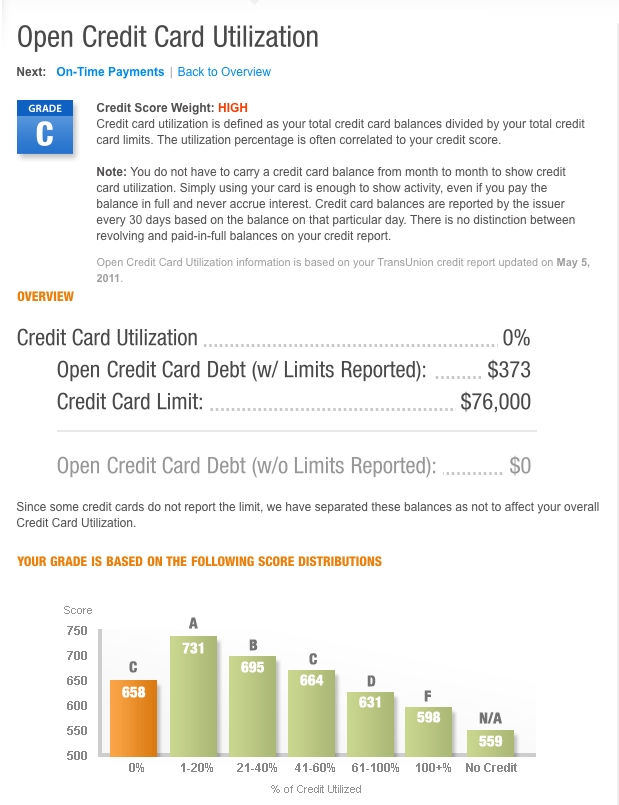
(Note – you can click to enlarge the image) You see, this was just brilliant. By owing less than 1/2% of my available credit, I managed to go from a potential A to a C for this criteria. Owing zero is exactly as bad as owing 41-60% of your available credit, which in my case would mean $30K+. An A ranges from 1% to 20%, so unless the Janes and I plan to do some real damage, I think I’ll quit this experiment and let the bill come in before I pay it. Lesson learned.
Joe
Hmm. I had a long weekend, out of town attending a wedding. As I sat down to review the links I saved from my reading this week, the news of Osama Bin Laden’s death hit the news. It’s the end of an era, I’m sure, but not the end of the war on terror. Someone will always be there to take his place. In a post last night, Sam asked Osama Bin Laden Is Dead: Good Or Bad? Well, I say ‘good’ but I agree with Sam that we are not out of the woods.
On to the roundup – Tom Drake at Canadian Finance Blog offered 3 Ways for kids to Start Saving for Their College Fund. It’s never too early to start, 18 years from birth to college goes by all too fast.
My friend Jeff at Deliver Away Debt posted Financial Literacy Month – April 30 Featuring Steve Stewart to close out the month of April. Well, as my readers know, every day is financial literacy day for me, the learning never ends.
On a frugal note we have Cheap Cool Activities at Green Panda Treehouse. A nice list to help your wallet and your health.
At Out of Your Rut, Kevin tell us How Frugality Becomes Counterproductive.Kevin has written a number of articles over the past months focusing on how income is far more important and longer lasting than anything you can do to be frugal. His points are well taken, and I agree that so long as one spends less than they earn that pushing your income up will be far more rewarding than anything extreme frugality will produce.
Next, at Fiscal Fizzle we have Americans and Money: 3 Reasons Why We’re in Trouble. A simple but “to the point” article on what our issues are as a country.
To wrap up this week, Monevator offered Weekend reading: Free your mind and your future with Free Capital a review of a book that describes how 12 investors made their millions.
A great week of reading.