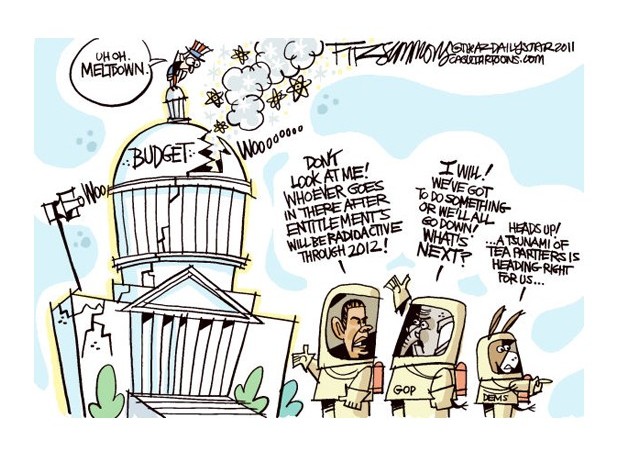
 I’m sure this won’t be the first in a series of “meltdown” overuse in the next few months. Or tsunami, for that matter.
This past Saturday I reprinted a political cartoon that questioned the future of nuclear energy. I got two comments on it, citing the age of the reactors in Japan and implying that nuclear can be safe. Then I received a comment from regular reader and sometimes guest poster, Elle. It was long enough and thoughtful enough to have a post of its own (with her permission of course.) Here’s Elle’s thoughts on this matter:
The basic technology of the boiling water reactors (BWRs) in Japan is from the 1970s and 1980s, with upgrades being constant. The idea for a boiling water reactor was hatched in the 1950s.
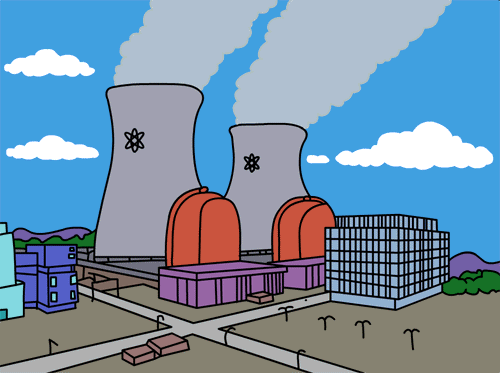
Regarding the safety of BWR plants, in my opinion and writing as a retired nuclear engineer, every nuclear engineer who swore by the BWRs’ safety must eat crow (to say the absolute very least, and with great sympathy for what is a horrible situation in Japan). Nuclear engineers are trained in risk assessment and so planning for the worst case. Manuals that stack up to many feet high address everything, step by step and with numerous permutations depending on what was available in a disaster, from flooding to earthquakes to multiple failures to a rogue airplane hitting the containment structure to more. The size of the earthquake and tsunami that afflicted Japan were not unprecedented. Designers should have considered such an earthquake and tsunami, particularly insofar as anticipating a complete loss of power to run the motors that run cooling water pumps. That the diesel generators to be used for backup power were in the basement (so I have read) boggles the mind.
“This is not Chernobyl†is a platitude that ignores the massive devastation that is reality now and will be for years in this part of Japan. I am embarrassed to have said in the past that nuclear power in the U.S. (and by implication, Japan) is safe. Those poor people in Japan, especially the on-site workers who had nothing to do with the design of their plant. Never would I have forced nuclear power on anyone. But now I would not even suggest it without a complete analysis of what went wrong in Japan and the possibility of this going wrong elsewhere in the world. Coal powered plants (the leading source for electric power) have their evils and do their own kind of
pollution. This will continue to have to be weighed against the risk of the pollution of nuclear power.
This week, I read Jim Yih’s Money Tip – Know Your Spending. To many, this may seem very basic advice, yet when I ask around, I’m always surprised how few people actually do this. Maybe it feels to much like ‘budgeting.’ Maybe people (not you, dear reader) are too lazy. If you are not already doing this, read Jim’s take on it and see if this exercise helps you.
And to wrap up this week, the Enemy of Debt wrote Got Kids? Start Teaching Them Solid Financial Principles. Agreed. Even kids at a young age can understand that money comes from hours worked and can be used to purchase item we need/want. Do your chores, get $1, save it for that $10 toy you want. Simple enough. Now how did those old smart guys break the economy a couple years back?

photo credit: Profound Whatever
A Reuters article caught my eye, Is $250,000 in savings enough to retire? Turns out, for some, it might just be. You see, 25% or so make less than $25,000, and they’ll get enough in social security that the $250,000 isn’t too far from the number they need to fill the gap.
At Wealth Pilgrim, Neal Frankle tells us Life Insurance For Children. Never Buy It. Here’s Why. I agree with Neal, although one comment to the post was heart breaking, a father who lost his 9 year old son in an accident, and couldn’t afford the funeral cost. If you have a child and are living with too small a cushion to afford a funeral, maybe this insurance isn’t a bad idea.
At Faithful With a Few, Tips For Using Credit Cards Responsibly: Advice from Nora Dunn.The discussion included the good reasons one might use plastic, and warned against carrying a balance. Good advice.
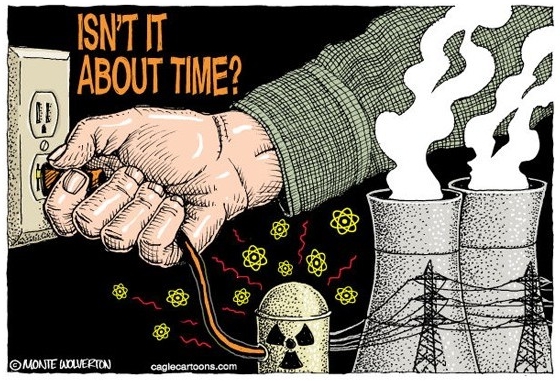
The recent tragic situation in Japan may make us rethink just how safe nuclear is. Is the risk really worth it?
First, you know that in the US, April first is called April Fools’ Day, and (mostly) kids play small pranks on each other. I’m always on the lookout to not fall for this should a friend or coworker try to have fun at my expense. So in today’s email it was interesting that I saw an ad from Borders:

I’ve been meaning to write about this for some time. BOGO means “Buy One Get One,” and that’s how I note it on a shopping list when the supermarket has a sale of this kind. But here, when I clicked through the email, I saw this, Buy One, Get One at 50% off. Sorry, you do the math and realize you have to buy 2 books and the deal is really 25% off. But wait, there’s more. My daughter’s wish list has trade paperbacks that are usually $15 or so, but books I’d buy are typically $30. This deal benefit is only 25% if the books are both priced the same. In the end this deal is less attractive than a straight 25% off of one book, and if I’m going to buy 2, the online prices are going to be far less than that with free shipping.
A you a BOGO fool? You ever get to the register and realize you didn’t quite get the deal you expected?
Joe