by Joe
on January 21, 2011
From the department of “time flies” – back in October of 2009 I wrote a post titled “Will Gold Break $1250 by 2011?” At the time, gold was trading for $1034, and many people were saying they expected it to go still higher. Now, I wasn’t a believer, I made that clear, but for those who were, I offered a way to make 4X on their money (a 300% return) over the next 15 month through an options spread.
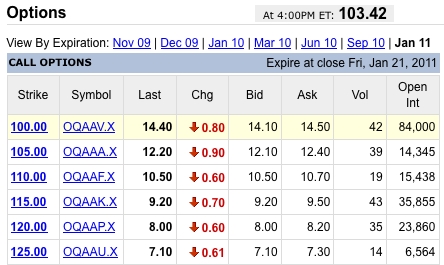
Allow me to recap the strategy. First, gold is traded as an ETF priced at 1/10 the price of one ounce of gold. The above snapshot is from October 2009 when I wrote the first article. Now, a brief explanation of options. An option gives you the right but not the obligation to buy the underlying stock at the strike price you choose. For example, $1450 gives you the right to buy 100 shares (options are priced per share but trade 100 at a time) of GLD until Jan 21, 2011 for $100/share. If GLD rose to $120, your $1450 would rise to $2000. Make sense? At $120 you would make the profit from the $100 strike to the $120 current price, a $20 gain or $2000 for the contract. For this play, however, I suggested buying the $115 strike for $9.50, and selling the $125 strike for $7.10. This way, you are out of pocket $2.40 but can gain watch that $2.40 rise to as much as $10 as GLD goes to $125 (or gold to $1250). Keep in mind, even at $120, this bet would have doubled your money. The downside is that if gold didn’t rise to at least $1150, the entire investment would be lost.
Really, it would have be sweet if I were a gold bug and claimed to put my money where my mouth was, putting up, say $25,000 and claiming it’s now $100,000. No such luck. But in the end, if anyone were so bullish on gold that they followed this strategy, they would have seen a 27% move in gold produce a 300% return on their money. Not bad. I believe gold is in bubble territory and there are similar trades that when the bubble bursts, there’s some good money to be made.
Joe
{ }
by Joe
on January 18, 2011
The Pension Protection Act (PPA) of 2006 introduced a little-used tax trick – you are allowed to donate money directly from your IRA and have it count as part of (or all of) your Required Minimum Distribution (RMD). You must be 70-1/2 or older, and the limit is $100K. Who does this benefit? For starters, only those who are taking RMDs, about 9% of the population. Next, it really will just help those who don’t itemize, after all, if you itemize, a charitable donation is a deduction added to your schedule A itemized deductions. Last you have to want to donate to charity anyway. You see, donating $1000 to save $250 in taxes makes little sense. But if you planned the donation anyway, this will save you some tax in the process.
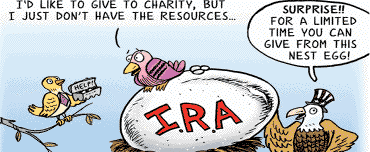
I started by discussing PPA, passed in 2006, so why do I bring this up now? The rule allowing the donation from your IRA had expired in 2009. It was only the Tax Hike Prevention Act passed in December 2010 that revived this opportunity. Since it was passed so late in the year, you have until January 31 to make that donation and have it count for 2010.
Joe
{ }
by Joe
on January 16, 2011
This week I read a post by Monevator titled Why a little passive income from a side project is worth a lot more than you think. I liked this article, people need to get thinking about income beyond their day job and this is a great first step toward that goal.
Neal Frankle takes a crack at explaining How A Mortgage Works. It’s remarkable how many people don’t quite understand this yet, and you are among them, let Neal give you a hand.
At Canadian Finance Blog, Tom Drake explain what a Price to Book Ratio is. This is yet another one of those Wall street terms you hear, but may not understand. A quick read and you will.
Craig Ford tells his readers how to Send Money or Transfer Money With These Fast Free Ways.
And one of my fellow Mavens, Len Penzo Is Giving Away $100 to a Lucky Reader. Who can’t use an extra C note in his pocket? Submit your name and tell Len Joe sent you.
That’s all for now, back to a regular roundup from around the blogosphere next week. Be well.
Joe
{ }
by Joe
on January 15, 2011
There were many political cartoons this week that referenced the Tucson shooting. I think artists have a right to voice their opinions, I just didn’t find any appropriate. My prayers are with the victims and their families.
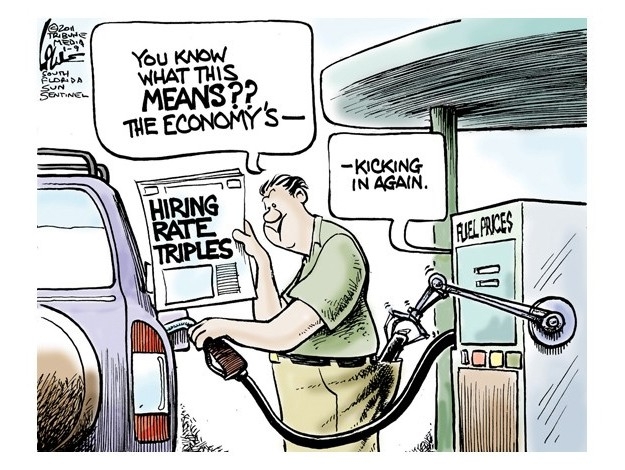
Now, this one stuck out as I filled my gas tank and hit $50 again. Haven’t seen that in a while.
Joe
{ }
by Joe
on January 13, 2011
In the past, I’ve written about Variable Annuities and how I don’t care for them for many, many reasons.
Another product I put into a similar category is the Equity-Indexed Annuity. These are products that claim to provide “equity-like returns” with no possibility of loss. Really? Years ago, I analyzed the prospectus for one such product and found that what they called an Equity-Like return was anything but. The calculation for a given year’s return was taken by adding the 12 monthly returns, with a maximum credit of 2% in any one month. Then, if the year was positive, this was your return. The seller of this product said that in good years you could make as much as 24%, but with zero risk on the downside.
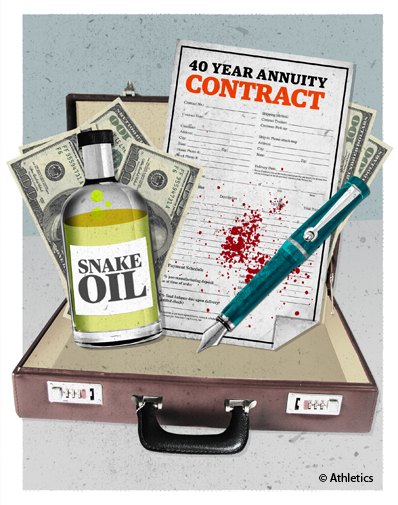
Now, in the two years, 2009 and 2010, you would think that since the index (S&P 500) rose 52% you’d have seen at least in the mid to high teens in your account, right? Hardly. You see, 13 of the 24 months were more than 2% up. In fact, four of those 13 months were over 7% to the positive, so that these 13 months of highest gain averaged 6%/mo. Since each of these months’ returns gets cut to 2%, that’s 4% * 13 or 52% skimmed off the top. The punchline is that in two excellent years, the EAI return was zero based on the crediting equation used. Now, you may ask, what about 2008? Well, zero there as well, of course. Which prompts the question – with high fees, 2%/yr or greater in most cases, and zero returns in stellar years, why botther with these products at all? Why not just stick to treasuries if you are market-phobic? Why, indeed.
Joe
{ }