≡ Menu

Tax Changes for 2011

My friends at the IRS (remember, these guys are just doing their job, it’s congress that makes up out crazy tax code, the IRS just enforces it) recently announced the changes we will see in 2011 based on the December 17 passing of the Tax Relief, Unemployment Insurance Reauthorization and Job Creation Act of 2010:

* The value of each personal and dependent exemption, available to most taxpayers, is $3,700, up $50 from 2010.
* The new standard deduction is $11,600 for married couples filing a joint return, up $200, $5,800 for singles and married individuals filing separately, up $100, and $8,500 for heads of household, also up $100. The additional standard deduction for blind people and senior citizens is $1,150 for married individuals, up $50, and $1,450 for singles and heads of household, also up $50. Nearly two out of three taxpayers take the standard deduction, rather than itemizing deductions, such as mortgage interest, charitable contributions and state and local taxes.
* Tax-bracket thresholds increase for each filing status. For a married couple filing a joint return, for example, the taxable-income threshold separating the 15-percent bracket from the 25-percent bracket is $69,000, up from $68,000 in 2010.
* The maximum earned income tax credit (EITC) for low- and moderate- income workers and working families rises to $5,751, up from $5,666 in 2010. The maximum income limit for the EITC rises to $49,078, up from $48,362 in 2010.The credit varies by family size, filing status and other factors, with the maximum credit going to joint filers with three or more qualifying children.
* The modified adjusted gross income threshold at which the lifetime learning credit begins to phase out is $102,000 for joint filers, up from $100,000, and $51,000 for singles and heads of household, up from $50,000.

Joe

{ 2 comments }

An Eight Ball Round Up

First this week – Len Penzo takes out his Magic 8 Ball, and asks a series of questions about the economy in 2011. The success rate of the 2010 8-ball interview was 70%, so who am I to argue with Len’s The Magic 8 Ball Makes Its Predictions for 2011.

Next, one of my favorite financial writers, Scott Burns fielded a Roth IRA question in an article titled Roth conversion could be answer to IRA withdrawals. In his answer, he states “one option is to treat the Required Minimum Distribution as a Roth conversion.” Unfortunately, I believe this one got by his editor. An RMD from a traditional IRA can not be converted to a Roth IRA. In fact the RMD must be made first, based on prior year end balances and only then are you permitted to convert any funds.

At All Financial Matters, 2010: The Year That Was (A Look at the 2010 Performance of Various Indexes) a review of the monthly returns for the S&P, MidCap 400, SmallCap 600, and Bond Index. Also, a nice PDF to pull down which shows how each sector of the Dow Jones Total Market Index has performed since 1992, interesting to see the top performers each year.

At CafeTax, Joe Arsenault wrote A Guide to Roth Conversions 2010 Rules. A nice overview. Keep in mind, any conversions after 2010 are taxable in full the year they are made, the 2 year split was a one time deal.

Anyone who has been reading me for a while knows I am anti variable annuities, but not so again immediate annuities. The Oblivious Investor posted Single Premium Immediate Annuity: Why They’re Useful and When to Buy Them. A great help in understanding the immediate annuity product.

Last a bit of consumer news – Caller ID Spoofing Now Illegal. I’m surprised it took this long, it should have been illegal all along. About time.

Joe

{ 3 comments }

Raising the Debt Ceiling

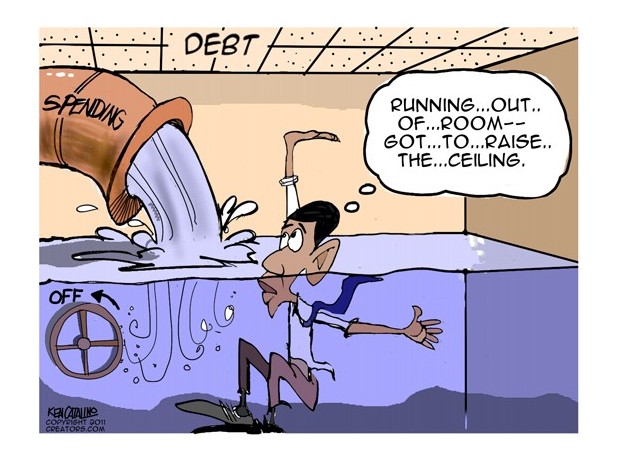
The national debt is currently $14 trillion dollars, give or take. That’s nearly $45,000 for every man, woman, and child in this country. And this debt is growing so fast that within a few months it will exceed the amount authorized by congress, $14.29 trillion. Now you know.

{ 6 comments }

About that Tax Refund

And, another guest post at the TurboTax Blog, this time asking the question, “How are you going to spend that tax refund?”The IRS tells us that last year’s average refund was just shy of $3000, so I offer a number of ways you might choose to spend this money, with choices from both the “naughty” and “nice” categories.

So, why not visit and let me know, how will you spend your refund this year?

Joe

{ 5 comments }

The Rule of 72

I mentioned the Rule of 72 in casual conversation a week or so back, and quickly realized that there are many who don’t know what it is.
So it seemed a good idea to give a brief explanation of this rule.
Simply put, given an interest rate, say 8%, it will take 72/8 = 9 years for money to double. Got that? The rate, taken as a whole number times the years equals 72.

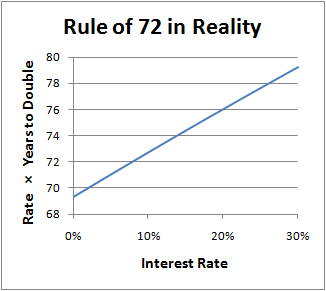
The rule isn’t perfect, as the chart above (produced by Michael Jameson Money) shows. when we calculate the exact time to double for any given rate and multiply, we get a series of points that shows the rule of 72 is only exact for a single point, an interest rate of 7.847%. Still the rule is good enough for an estimate. At 6%, I’d guess money will double in 12 years, so over a 36 year period it will increase eightfold. A quick calculation shows a result of 8.14 a 2% error over that 36 year period. Of course there are times when you need an exact answer to a given math problem, but for those times when it’s “close enough” the rule of 72 is good to know.

{ 0 comments }