≡ Menu

The Recession is Over

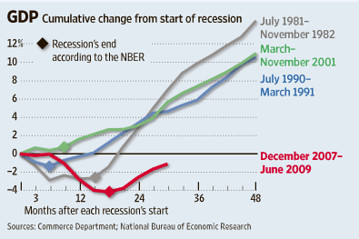
The recession lasted 18 months and just as we didn’t know there was a recession until we were well into it, we are now told it ended in June 2009.

I was thinking back to my post last July, Dennis Kneale Recovery in which I remarked that he had declared the bottom was behind us, and it would just take time before it was declared. As you can see, the recession lasted longer the the prior three, and it will take somemore time before we feel that we are in a vibrant recovery. a bit of patience.

{ 4 comments }

Welcome New Money Mavens Roundup

Back in April I announced that I had joined a new group of PF bloggers calling ourselves the Money Maven Network. We’ve been slowly gaining some traction, and recently invited a number of bloggers to join us as a couple had dropped out, selling their blogs. So in today’s roundup, I’d first like to introduce my new fellow Mavens.

First, let’s welcome Jeff Kosola who blogs at Deliver Away Debt. His blog was named for the fact that he started delivering pizza on Friday and Saturday night to make some coin to pay off his debt. Recently, his day job’s time demands grew to the point where he stopped delivering pizza, but his fellow bloggers all agreed the name was still valid, this was how he paid his debt, even if it was behind him. I’ll miss his clever tweets about the customers he delivered to, but am glad he still make the time to blog, and glad he accepted our invitation to join the Mavens. His post I’d like to highlight this week is How a Debt Snowball Works in which he offers a video to help explain it. Let me say two thing here. He uses actual snow to make the point. In Michigan. In the summer. Nice work, Jeff, welcome aboard.

Next we have Monevator asking Do You Hate Your Work? A pretty deep dive into how we think about our day jobs and a great read. Before he joined, I’ll admit, I hadn’t seen too much of his work, but I’ve started to see why the other Mavens added him to the list to join out group. A good choice, guys.

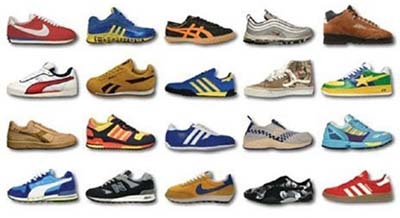
Next we have Kelly from The Centsible Life. Kelly, I’ve known for sometime, she’s a mom of four kids and an avid blogger. Her posts are often more personal than mine, sharing stories of her efforts to keep organized in Shoes, shoes and more shoes: what’s a mom to do? (Seems like she needs a custom shoe rack!) or sharing her Life List. She has a writing style that makes you want to invite her over for coffee and ask her for advice on one topic or another, and was a welcome addition the the Mavens. Now, I need to get my own list going, I love that idea.

The last addition is Ryan from The Military Wallet. If you don’t know, I have a soft spot in my heart for vets. One of the links (to the right) is to my favorite charity, The New England Center For Homeless Vets, and when any reader offers to throw me a tip, I suggest they donate to the Vets. Ryan fills in a nice gap in the blogging community, helping this special group of people understand their benefits and needs. His latest Get a Free Flu Shot from the VA is just one little benefit our vets need to be aware of. Welcome Ryan, I tip my hat to you.

Elsewhere in the blogosphere – Kevin at Out of Your Rut offered 10 Things You Should Buy Used, an interesting take on the things you can really save by buying second hand. This is a great list worth reading. In these tough times there’s some easy money you can save by being flexible and not thinking there’s anything wrong with “used.”

Free From Broke explains Why We Chose A 30 Year Mortgage When We Bought Our Home. Hey, you don’t need to explain it to me, that was the way I went. You can always pay extra, pay early, and accelerate your payoff. But in bad times, you’re not obligated to pay that higher amount. This is always an interesting topic as we all seem to have a mortgage and trying to navigate how to handle it.

Last this week, from another fellow Maven, Neal Frankle, Best Inheritance Tax Advice Neal discusses some of the ins and outs of the estate tax. I’m looking forward to the day this is no longer a topic for discussion, no more estate tax. But until then…

Joe

{ 4 comments }

A Retirement Shortfall

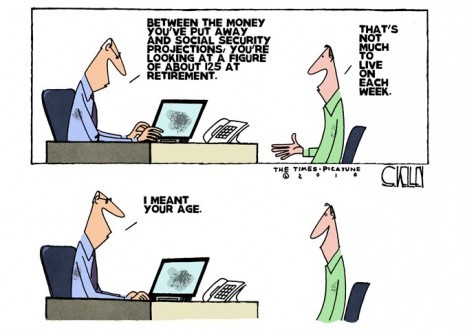
Sorry to be a downer, but a study suggests a shortfall of $6.6 Trillion in Americans’ retirement account. Scary numbers.

{ 0 comments }

Super Freakonomics

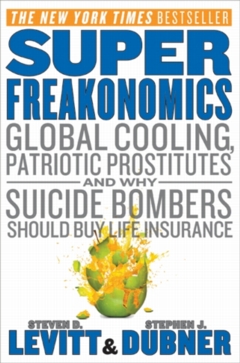
I recently read and enjoyed Super Freakonomics. The book was a worthy sequel to its predecessor, of course, titled Freakonomics.  Unlike most other books I’ve read, it’s tough to put in a few words what the underlying theme of this book is.

Instead, I’ll offer my take on a few of the anecdotes the book presents, and not assume that you are familiar with either the original book or the co-authors and their work.

Global Warming, not. If there is such a thing, its source isn’t any of the energy related fuels that are routinely blamed. Instead, it’s cows and the methane they produce. Increasing wealth across the world had shifted the demand from grain to meat and this shift is ultimately the cause. The Mount Pinatubo eruption? It actually helped cool the planet a bit, negating nearly a hundred years worth of observed warming. (I am not saying I agree with their conclusions, just sharing them. A number of scientists have spoken again these claims.)

Next, there is a discussion of suicide bombers and the criteria that one would use to discover them in a large population. Unfortunately, even a 1/10 of 1% false positive means that when analyzing a group of say 100,000 suspects, there will be 100 innocent people who are falsely accused. One factor in the data mining is that suicide bombers don’t buy life insurance, at least not until this book was published.

You drink just a bit too much at a party, and live just a mile or so from home, do you walk or drive? We are offered data that suggests it may be safer for you to drive, as you may have a lower chance of injury per drunk mile driven vs walked. (Disclaimer – Don’t do either. Get a ride from a sober person or call a cab.)

Last, a look at the impact of The Club (a metal anti-theft device that goes across a car steering wheel) vs LoJack (a hidden transmitter used to track a car after it’s stolen) and how the visible Club effectively says to move on to the next car, while LoJack has every thief wonder which cars are protected. Interesting way of comparing these two anti-theft devices.

You see, the chapters within the book skip from one seemingly unrelated topic to the next but still maintains an overall feel. Sort of an economist looking at the world through some strange glasses  and sharing his observations. Have you read this book, or the original? What did you think of them?

Joe

{ 6 comments }

Note from Joe – following is a guest post from one of my readers and fellow Usenet group poster, Elle. (Do you know what Usenet is or am I really showing my age?) Thanks, Elle!

Joe has run a column or two on ‘accumulating stuff.’ I ran into this in particular with two elderly relatives in the last ten years. Both relatives went into nursing homes. Their families were left with the responsibility of taking care of their belongings. Many of the relatives’ possessions were not wanted by anyone in the family. Yet the possessions had value.

Estate sales can take away much of the stress of this process. But the drawback to an estate sale is that commissions run on the order of 40%. For those wanting to retain more of the value of the goods, a low-labor alternative to an estate sale may be eBay.

Prior to this past June I had been using eBay exclusively for small purchases such as hard-to-find books, OEM car parts, swimsuits, repair parts for appliances, DVDs and more. Then in June I suddenly needed to dispose of some sterling silverware. I began doing some research. With trepidation I set up an eBay seller’s account for the first time and put some of the silverware up for auction.

I was surprised at how easy setting up a seller’s account is. Follow the prompts at www.ebay.com. If you do not already have a paypal account, then follow the prompts for paypal as well. When I started selling a few months ago, there were three fees: a listing fee (which sometimes is waived but otherwise runs around a dollar); a final sale fee (presently 9%); and paypal fees (presently 3% + 30 cents). There is no charge until you put something up for sale. In some cases, there is no charge until there is a sale. Also, eBay has recently had promotions where the listing fee for many items is waived.

The items you want to sell preferably are easily mail-able, so smaller is better. With a scale and tape measure you can use www.usps.com’s online postage calculator for good estimates. The usps.com postage calculator was invaluable and completely accurate for all my shipping costs. When posting the cost of shipping, always add one to a few dollars more than what the USPS calculator gives, to cover the cost of
packing supplies. Mailing envelopes and bubble wrap costs do add up quickly. I try to keep shipping costs low so as to increase the chance of a sale. When I am buying something on eBay, I am aware I am always a little turned off by a shipping charge clearly higher than the actual cost of shipping and supplies.

For fragile items I see eBay sellers using “standard flat rate shipping.” I have an antique clock of my relative’s that I hope to sell on eBay for a few hundred dollars. I see similar ones on eBay being offered for a shipping cost of about $20.

A friend also selling a relative’s belongings counseled me to keep my starting prices low. Try a starting price of 99 cents for items you expect to go for between $10 and $50. Try $9.99 for items you expect to fetch more than $50. Auctions seem to get more attention and better results than fixed price items, as long as the starting price of the auction is low. At auction most of the time (but not always), the item gets bid up to a reasonable value. I tried starting at higher prices and often found little-to-no interest (based on the number of views), and always no sale. All the items I successfully sold on eBay started at prices much lower than their final auctioned price.

Watching one’s auctions and the market at work is fun. About half the items I have sold were bid up substantially in the last minute.

In addition to estate sale items, I had some other items taking up space in my house. I was delighted to find them good homes using Ebay. The alternative was the city dump, which by itself costs money.

One peculiarity to me was how long it took buyers to pay. One buyer took almost three days. (I sent a reminder late on day 2, and the next day payment was made.) On average people took about half-a-day to pay. I advise waiting at least two days before contacting the buyer with a reminder. When I was heading near the post office anyway, I sent an invoice shortly after a sale saying if payment is made by such-and-such time, then I can have the item in the mail by afternoon.

I always included a hand-written thank you note. After dropping an item off at the post office, I let the buyer know I have shipped the item, so he or she can look for it in the mail.

The internet has many how-to sites on selling on Ebay. Some are a bit outdated, since Ebay’s policies do change over time. One interesting caveat is there is a wide difference of opinion on when to have one’s auction end. Some say on the weekends. Some say on Wednesday early evening California time. And so on. I am doubtful it makes too much difference for most items.

When I first started selling on Ebay, I decided I was taking a calculated risk. I also reasoned that the education I was getting from this process might offset any potentially small loss I might take. I have sold six items now. All but one reached a price that beat the price I would have obtained through other resources (scrap silver recycler; automotive junkyard; used book resale store). After six weeks of selling on Ebay, I have come to think of it as a high-tech garage sale and recycler. Overall I have come out ahead both in education and dollars.

Elle
{ 12 comments }