≡ Menu

A Super Longevity Roundup

Let’s start this week’s roundup with one of my most prolific fellow PF blogger, Miranda Marquit, and her post Is Your Rebate Check Really a Gift Card? In my case, the answer was yes, I bought a hard drive that after rebate was a great price, of course, the rebate came as a gift card. Fortunately, my local grocery store cashiers are great at partial ring-ups and easily applied the card’s value. So, yes, I do buy based on post-rebate prices, whatever form that rebate takes.

I don’t know what share of my readership are fellow bloggers vs interested readers, so I don’t often post about blogging itself or about making money blogging, but my fellow Money Maven Craig Ford’s Make Money Blogging | A Guide for Beginners on How to Make Money Online is an excellent read.This is no ordinary post. Most blog posts top out at 500 words, this one is 7500. Enough so after Craig posts parts 2 and 3, he’d be close to having a full book’s worth of information. Good job, Craig.

My favorite tax tweep Kay Bell had an interesting post on Where does your taxable income rank? As I read her post, I thought how we are a nation obsessed with rankings. You know what I mean, from our sport teams to our school’s rank within our state and our child’s rank within her class. Income is no different, we compare ourselves to our in-laws, our friends, our neighbors. Take a read at Kay’s Don’t Mess With Taxes and see where you rank.

Next, at Wealthyboomer, Jon Chevreau asks Super longevity — are baby boomers up for it? In this post Jon discusses a book titled You Could Live a Long Time: Are You Ready? That’s the trick, I’d say. Die tomorrow, and you can’t take it with you, but live too long and you may easily outlive your money. Jon is one of my fellow PF bloggers from Canada, but nearly all his posts are relevant in the states. With the exception of some specific tax issues, and a bit of an accent, we’re not much different, eh?

Next, we have Financially Poor’s Debunking 401(k) Theory, at look at why cashing out to pay off some high interest debt may actually benefit you in the long run. My observation is that after taxes and penalty, you lose enough on a withdrawal that a loan, currently at 3-4%, may make better sense. I’ve said it before, finance is an individual matter. What’s right for one may not be right for the next guy. For every person who borrows and pays off his 401(k) loan, there may be three who blow it, rack up debt on the cards again, and when losing their job, can’t repay that loan.

Joe

{ 2 comments }

Lennon’s 9/11 Tribute

I saw this cartoon that paraphrases John Lennon’s “Imagine” in a tribute to those who were killed on 9/11 and chose to share it today. If you’d like, please share your thoughts, where you were, and how this day impacted you.

Joe

{ 0 comments }

The 529 Plan

These plans have become more popular over the past few years. Let’s look at a few pros and cons of 529 plans;

Pros
You may deposit up to 5X the annual gift limit (in 2010, the limit is $13,000, so you can give $65,000 per recipient and treat it as 5 years’ of annual gifts. No gift tax is due, but you must file form 709 to declare the amount over $13,000)
Money can grow and be withdrawn tax-free (current tax law).
Funds can be designated for a different relative should the intended child not go to college.
The ‘approved relative’ list follows;

1.Child or descendant of a child.
2.Brother, sister, stepbrother, or stepsister.
3.Father or mother or ancestor of either.
4.Stepfather or stepmother.
5.Son or daughter of a brother or sister.
6.Brother or sister of father or mother.
7.Son-in-law, daughter-in-law, father-in-law, mother-in-law, brother-in-law, or sister-in-law.
8.The spouse of any individual listed above.
9.First cousin.

There is no required distribution, thus you can save early for a yet unborn grandchild if you wish (by designating a child and then changing the beneficiary once the grandchild is born.)


Cons
Should you need to withdraw the funds and not use for school, regular income tax rates (not cap gain) apply as well as a 10% penalty.

Fund choices are typically very limited, and you may only change funds once per year.

Tip – MBNA offers a credit card linked to a Fidelity 529 account. You get 2% cash back on all purchases with no cap. There is no annual fee on the card and no annual fee on the 529 account. This is a painless way to save and a far better return than ‘miles’ cards.

{ 12 comments }

A Labor Day Roundup

This week, I start the roundup with Redeeming Riches’ 10 Guiding Principles For The “New Retirement.” I’m only slightly disappointed that Jason didn’t use the line “this isn’t going to be like your father’s retirement.” I never tire of the old cliches. The first new principle? Don’t stop working. That’s right, you won’t just grab a beer and slack off for the next 20 years, you might just have a whole second career ahead. Both to stay out of trouble, and to keep a bit of income coming in.

By coincidence, another 10 list – this one 10 Key Characteristics of Debt-Free People (of Modest Means) by my fellow Money Maven Len Penzo. I love these kind of lists, they make you stop and think how you might change your own behavior to improve your situation, in this case getting out of debt.

The last of the lists this week was BSimple’s 8 Financial Seeds to Plant Now to Simplify Your Finances. An inspiring list of how to start some simple efforts which can benefit you in a big way in the future. BSimple doesn’t promote himself as a religious blogger, but the parable of the mustard seed is easy to see in this excellent article.

Next we are introduced to the Big Difference Between Average and Median Net Worths. Turns out, the average American household net worth is $435K, but the median is only $91K. The observation itself is from Dr Thomas Stanley’s blog, with Free Money Finance offering some of his own commentary. A good read.

Last this week, Tax Girl invited a guest poster to discuss Are Expiring Tax Cuts a Good Thing? Michael Rozbruch gives an overview of just what will happen when the tax cuts expire, if they are allowed to do so. We still have nearly 4 months to see what happens.

Happy Labor Day!

Joe

{ 5 comments }

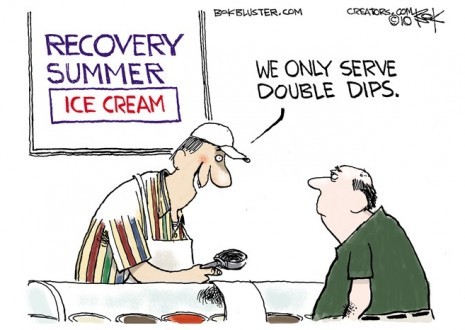
An end of summer Double Dip?

“Prediction is very difficult, especially if it’s about the future.” This quote is often incorrectly attributed to baseball legend Yogi Berra, but attribution should go to scientist Niels Bohr. This is my longwinded way of saying I am not making a prediction either way, the cartoon just struck my fancy.

Joe

{ 0 comments }