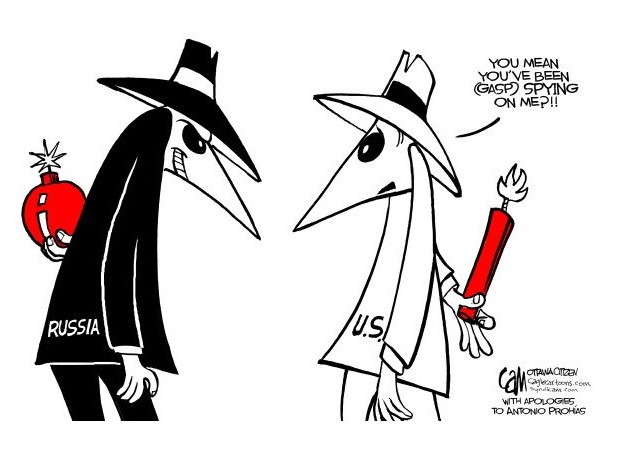
A good cartoon to share this week, non partisan, and something from my childhood. These two spies are from Mad Magazine and have been fighting it out since I was a young one. Some things don’t change, wonder what the spies found out.
Joe
A good cartoon to share this week, non partisan, and something from my childhood. These two spies are from Mad Magazine and have been fighting it out since I was a young one. Some things don’t change, wonder what the spies found out.
Joe
You just changed jobs. You’re excited about the new company, new opportunities ahead, etc. Did you decide what to do with your old 401(k)? Do you know what your choice are? You can withdraw the money and pay ordinary income tax along with penalties (bad choice). You can leave it in the old 401(k) and forget about it (it may be okay to leave it there, but for Pete’s sake, don’t forget about it).
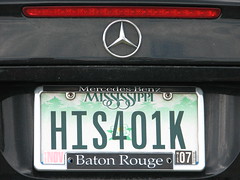
photo credit: Roger Smith
Today, I’d like to talk about the two better choices, rolling into the new 401(k) account, or rolling into an IRA.
Why would you want to put the money into the new 401(k)? A few good reasons come to mind. The expenses are so low, you can’t do better on your own. (disclosure – the expenses on my company’s S&P fund is .05%, less than Vanguard or the SPY ETF. I pay less over 20 years than some people pay for a managed fund in under a year.) On the flip side, high expenses may steer you toward just depositing enough to grab the match, if any, and invest in an IRA or taxable accounts.
A 401(k) may have a loan provision – this is a tricky one. It’s easy to make a huge mistake by taking a loan, losing your job, and having it treated as a early withdrawal. If used wisely, it can also be a cheap source for a loan, they usually run at prime or slightly over. You can’t borrow from your IRA, at best you can grab the money for 60 days while you move it between account, but this is playing with fire.
Age 55 retirement – If you separate from your company at age 55 or older, you can take 401(k) withdrawals with no penalty, just the taxes due. In theory, you can do the same with your IRA via what’s known as Section 72(t) withdrawal, but it’s a bit more cumbersome.
Last, say you have some IRA money already, some post tax (the rest pre-tax, deducted from income in the year deposited. If you intend to convert any of these IRA funds to a Roth, the amount is taxed in the same ratio as the ratio of pre-tax and post-tax funds in there. The 401(k) rollover into your IRA might swing that balance against you. As far as the IRS is concerned, you have one IRA (An Individual Retirement Arrangement) regardless of the number of accounts it resides in.
Now for the benefits of the IRA choice. As mentioned above, the fees may be high on the 401(k) and you view the rollover as a way of getting out from under these fees. If the 401(k) represents most of your retirement money, and you would like the ability to convert some funds to a Roth for whatever reason, this is your chance to do it through the the IRA. It’s not an all or none prospect, you can first convert the full amount to an IRA, and convert over the years, a small amount at a time.
An IRA also offers much greater flexibility of investment choices. You may invest in mutual funds, ETFs, individual stocks, etc. You can also break the funds up into multiple accounts, with different brokers or the same, and set up different beneficiaries as you wish. The beneficiary can stretch the withdrawals over their lifetime to maximize the IRA benefit. 401(k) withdrawals are at the mercy of the administrator’s plan documents, not all are so flexible.
Given how often people tend to change jobs nowadays, it makes little sense to leave a trail of 401(k) money behind you. As Thoreau said, “Simplify, simplify, simplify.” Good advice, I’d agree.
Joe
Let’s start with Wealth Pilgrim’s Neal Frankle who answers the question “How Much Can I Afford For A House?” This is one of those recurring questions, and one that seemed to get ignored as the real estate bubble formed.

(well, I used a Fireworks image for my tips for Financial Independence, so a barbecue seemed appropriate for today)
Staying on the topic of first time homeowners, Doug Warshauer discussed “30 vs 15 Year Mortgage. Which is Best For First Time Homebuyers?” I think this can’t be answered without knowing a lot more about the person doing the buying and choosing the mortgage. I’ll reserve my own further thoughts for a future post of my own.
Craig Ford at Money Help For Christians shares his thoughts on “When Do You Become Debt Free?” The question he raises – Are you still the slave of the lender if you have no debt other than a mortgage? Can you call yourself debt-free when you still don’t own your house outright, or does “I have a mortgage” mean “I am still in debt?”
I enjoyed New Versus Used: The Great Debate at the Millionaire Nurse Blog. An interesting list of things Dean would buy used, and then a shorter list he’d avoid. His ‘avoid’ list has “electronics” and I’ve had pretty good luck buying older electronics on eBay, but as always, your mileage may vary.
Another new-to-me blog I found this week was “eventual Millionaire” and Jaime’s post Compare Yourself to a Millionaire in which she offers some statistics from Dr Thomas Stanley’s The Millionaie Next Door. A good read from someone who seems to be taking the right steps as well.
And last this week, a nice post from Jeff at Deliver Away Debt, The Debt Destroyer System. Take a read there, sounds like Jeff’s financial independence isn’t too far away.
Enjoy a safe and happy holiday.
Joe
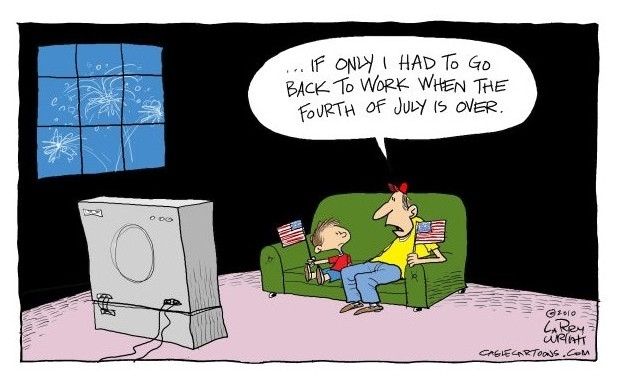 Hopefully this political cartoon is non-partisan. Last week’s caused a bit of a stir. This week I tried to avoid the sensitive issues and continue the holiday theme. Back tomorrow with my best fellow blogger reading this past week.
Joe
With the July Fourth Holiday (Independence Day in the US) coming up, my friends at TurboTax asked me to guest post on financial independence, I liked the idea and got moving.

My guest post is titled Twelve Tips Toward Financial Independence, and I invite you take a read and drop a comment. I hope you all have a safe and Happy July 4th.
Joe