≡ Menu

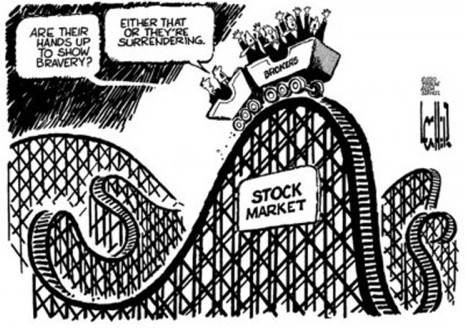
The Dow Jones Rollercoaster


The Dow and market in general had some wild swings recently,yet another thing for the SEC to look into if they can take some away from (how do I say this delicately?) their other endeavors. Not sure if they got to the bottom of this yet, it was likely a sell order that had an extra two zeros at the end, selling 100 times what you intend can never be a good thing.

Joe

{ 3 comments }

Under Water?

I’m not asking if you owe more on your house than it’s currently worth. With all the recent flooding in the US, I mean it literally, are you a victim of flooding or other casualty losses this year?

If so, you might be able to get some relief on your taxes when you file next April. I wrote a guest post Flood Victims: Casualty Loss Deductions Might Be for You on the TurboTax blog. Take a look, and let my friends at TurboTax know if this helped you.

(FTC disclaimer – I received nothing of monetary value for this post. In exchange, I have a resume line “Guest Blogger at TurboTax,” as well as the friendship of my contacts there. Thanks for asking.)

Joe

{ 1 comment }

A Yakezie Mother’s Day Roundup

This week’s roundup includes posts from my fellow bloggers participating in the Yakezie challenge.

Young and Thrifty offered a brief review of Malcolm Gladwell’s Outliers-The Story of Success, a book I enjoyed as well.

The Amateur Financier asks Does Success Skew Your Perception? This one really got me thinking, which of course is what I find best about reading others’ blogs. Roger starts with a discussion of Trent’s success at The Simple Dollar, and how he feels Trent implies that others can duplicate his own success blogging. He goes on to offer other examples such as “easy as riding a bike,” and since Roger never leaned to do so, that expression is an oxymoron. (uh, please pass me another jumbo shrimp.) I understand Roger’s point perfectly. For me, some things are simple. Years ago, I had my five year old daughter change a broken light dimmer. I walked her through every step, but touched nothing. The response I got from most adults was (a) they wouldn’t even do such a thing themself, and (b) that what I did was dangerous. I offer this anecdote to tell Roger that I do get it, and I wish him success in whatever he pursues.

Cool to be Frugal offered her own link post with Friday Link Love: Home Ownership Edition, Mrs Frugal included the Money Mavens Network posts and others who all discussed aspects of home ownership costs. Thank you for the shout out.

Beating Broke posted an update, My Wife Quit Her Job: One Year Later, an ongoing series about how his wife quit her day job to start her own business with with two of her friends. A risk, of course, but glad to see it’s doing well so far.

Aaroan at Clarifinancial asked If Death is Simple, Why is Life Insurance Complicated? A discussion of a pretty straightforward question I’ve often asked myself as well. Henry David Thoreau once said “Simplify, simplify.” (Yes, that’s the whole quote, sorry) I believe that most people who buy policies other than term don’t actually understand the product they were sold. Simplify, my friend.

My Financial Objectives introduces the story of One Red Paperclip in which we find a fellow (claims) to have started with that paperclip and after 14 trades, had a house. Of course, he wrote a book about it, which I’ve not run across just yet. My reading schedule is pretty full, but I’ll keep it in mind.

And last, A guest post by Kathryn Katz at Single Money Guy asks Are Your Friends Enabling Poor Spending Habits? I don’t doubt that we are influenced by those around us, this post will help you look at your own spending habits and how your friends help or hurt your finances. An interesting read.

{ 2 comments }

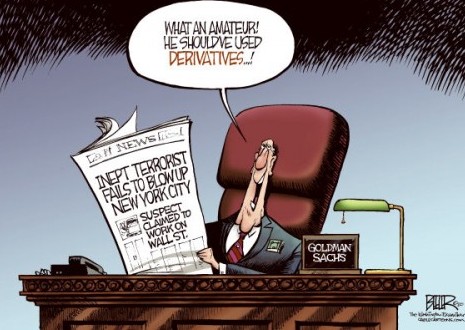
The Derivative Bomb?

I’ve followed the derivatives issue for some time, and have a very tough time feeling that the derivatives themselves were to blame for anything. Puts and calls on traded stocks and commodities are priced by supply and demand, but the Black–Scholes model offers a convenient equation to calculate a ‘fair’ price. On the other hand, when the rating of a product is severely flawed, any derivatives based on that product will be flawed as well.

Joe

{ 3 comments }

Pay the Mortgage Early or Save?

For some people, getting rid of their mortgage is their top priority. After all, it’s by far the largest personal debt one is likely to ever owe, and having no mortgage will free up a nice chunk of that monthly income. That’s why we don’t just pay it off, we burn the mortgage paperwork when it’s paid off.

Is it in your best interest to take your extra money or use it to pay the mortgage off early? This isn’t such a clear cut issue, let explore what might impact your decision.

First, and most important, are you taking advantage of any matched 401(k) your employer may offer? A dollar for dollar match should be grabbed regardless of the rest of your situation. Even ahead of paying off any other debt. Companies usually limit the match to 5-10% of the employees’ gross income, so if you make $50,000, the first $2500-$3000 is matched, and that’s it. Don’t miss this.

Do you have any revolving debt? Credit cards? Store cards? Common sense tells you it’s silly to pay 12-18% interest on this debt, yet make extra payment on a 6% mortgage.

Do you have a proper emergency fund? The real concern at the bottom of this question is can you survive the loss of your job and still keep your home until you find new work? Remember, when you send extra money to your mortgage, it’s a one-way street, you can’t easily borrow it back. Of course you can arrange for a HELOC (home equity line of credit) but not after you are out of work. I view the HELOC as a bit of a slippery slope. It can be responsibly used as a secondary emergency account, but should not be your only source of funds to cover unexpected expenses. Your hot water heater fails, you should be able to pay for it.

In the final analysis, it comes down to one question – Do you feel lucky, punk? I ask this in all sincerity, as in most situations it will requite luck to choose the best outcome. We can look at all the data we wish, time periods when stocks returned over 19% on average (the ’90s) or a decade of less than 1% growth per year (the recent ’00s). You can play with the numbers all you wish, but unless Treasuries are yielding more than your mortgage (adjusted for tax implications) then Dirty Harry’s question will come back to haunt us.

Consider, in the big picture there is little difference between a dollar used to pay down a 5% mortgage or one sitting in a 5% CD. Of course, the big difference is liquidity, but I am talking instead about the return on your money. So, as you get older and look at your portfolio, when you look at your stocks and cash allocation, it may make sense to accelerate those mortgage payments and enjoy the savings of 5-6% vs the 1% you might currently get in CDs. For our situation, we decided that it was wise to refinance in 2004 to a 15 yr, aligning our mortgage payoff more closely to when our daughter would start college.

In the end, you might read some very insightful analysis showing that 5% after taxes is really 3.75% if you are in the 25% bracket, and if cap gain rates stay at 15% (they might) that a fund yielding 4.4% will break even. DVY (The Dow Dividend stock ETF) yields 3.6%, the underlying stock need to grow just 8% over the next decade to let you break even. This is total growth, not each year. But the question remains, are you willing to bet on the markets return over the next ten years? Do you feel lucky?

This was a Money Maven Network wide posting, my fellow mavens discussed this topic as well:
Green Panda Treehouse – Pay Off Your Mortgage or Invest Your Money?
Wealth Pilgrim – Pay Off Your Mortgage or Invest
Money Help for Christians’ Pay Off Mortgage Sooner, Invest, Or Save? The Math Analysis
Len Penzo – 12 Good Reasons Why You Should and Should not Pay Off Your Mortgage Early
Enemy of Debt – Should You Grow Your Nest Egg Or Pay Off Your Mortgage?

Joe
{ 25 comments }