≡ Menu

A Mayday RoundUp

I know – Mayday was yesterday. So this is really a post-mayday roundup. Either way, some more great reading from my fellow PF bloggers.

Let start with Trent at the Simple Dollar asking What Does It Mean to Be Rich? His post doesn’t conclude with a number, but an emotion, a sense of having enough. No argument here.

Green Panda Treehouse touches on a similar topic with What is Financial Freedom? A brief post describing some of his happy older clients.

Get Rich Slowly’s JD Roth posted Money Myths and the Importance of Thinking for Yourself. I especially appreciated this post as it contained a paragraph Do People Spend More When Using Credit? Since I just discussed this earlier this week, I was glad to see my suspicion confirmed, there is no hard data backing up this claim.

Neal Frankle, the Wealth Pilgrim, offers some career help with Should I Change My Career? Three Questions To Help You Decide.  This one hit home for me. As I may have mentioned, my day job is completely unrelated to finance, and for the most part, my personal life is pretty well firewalled from my blogging persona. I often think about what my next career will be, and Neal really has me thinking after reading his post.

The Fiscal Geek gives us 8 Steps You Can Do Today to Protect Your Identity.Yes, the internet, mail, credit cards, etc, are all potential leaks of information that can lead to identity theft. Check out Paul’s article and protect yourself.

As a user and fan of Duct Tape I couldn’t help but read Lez Penzo’s tongue in cheek 4 Ways Duct Tape Can Fix Your Personal Finances. I knew that the uses for duct tape were pretty endless, but Len takes this to a new level.

Last this week, Jeff at Deliver Away Debt tells us how to Stop the Spiral of Debt (part 1). For those of you just getting started in this process, Jeff offers some good tips and great inspiration. If you recall, he has taken on a job delivering pizza and using that extra money to pay off his debt. He’s been tweeting and blogging on his progress.

I wish you a great week ahead.
Joe
{ 0 comments }

Floppy Disc RIP

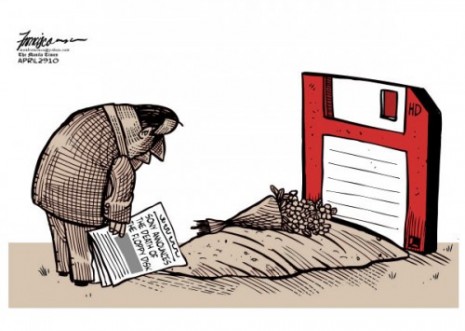
I’ll try not to get too sentimental about a piece of plastic, but Sony declaring the floppy disc dead is the end of an era for me.  The first floppy disc I’d seen was 5-1/4 inch before the 3 in was introduced. I remember the first Apple computer that dropped the floppy and the controversy that stirred. We are fast approaching the day VHS tapes will be declared dead, if that hasn’t occurred already. Technology moves on. Farewell, floppy.

Joe

{ 2 comments }

Ad Velorem Debit Card Fees

The topic of credit cards is a recurring theme. Are they bad, good, etc? Is debt a tool or is it evil? I think the jury is still out on a final conclusion as there are more than two sides to this debate. One of the suggestions made by many who are anti-CC is to use a debit card. As the card taps your checking account funds, no credit is extended to you and the risk and inconvenience of carrying cash is eliminated. But, (you knew there would be a ‘but’) what about from the merchant’s side?

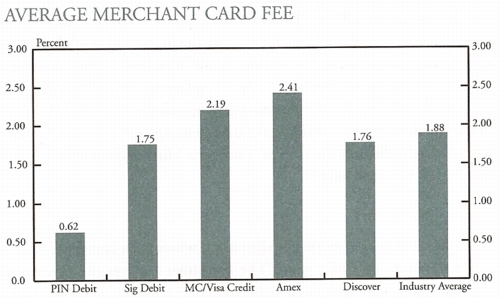
The title Ad Velorem simply mean measured in proportion to the value. In this case, I am pointing out that debit cards, despite having no aspect of credit involved, and therefore having a fixed cost per transaction regardless of the size of transaction, still has fees that are a percentage of the transaction involved. A signature debit transaction costs the merchant nearly as much as a Mastercard/Visa transaction. This seems to be a little known tidbit ignored in the discussions regarding purchases on plastic. If we are to believe that the card issuers are evil, debit cards carry that same brimstone smell as credit cards do. If we believe that credit cards fuel inflation as they take a slice of every merchant transaction and add to the cost of business, we then need to understand that debit cards are little different. If you wish to be one of the real men who pay with cash, I’d not talk you out it. On the other hand, if you are anti credit card, yet think debit cards are any better, for you, me, or the economy, you may wish to reconsider your position.

Joe

{ 3 comments }

Spend More With Plastic?

I recall a few years ago a bit of news came out that linked coffee with cancer. As a student of the scientific method, I immediately asked one question. Is this a false correlation? I have to say I nailed that one. A few months later, the claim was withdrawn. It turns out the population of coffee drinkers contains a higher percentage of smokers than non drinkers. This statistical difference was high enough that it was easy to understand (and predict) the conclusion that followed. Once this occurred to the researchers, it followed that they acknowledged their error and withdrew their anti-coffee remarks.
Another correlation – TV makes you fat. No doubt there are the proverbial couch potatoes who sit in front of the tube, drink soda, and eat snacks. Yet, TV has the opposite effect on me. I try to run 20 miles a week, all of which are on a treadmill, with a TV propped in front. I tried reading and that was a mistake. Books on tape? Great in the car, but on the treadmill, not so much. TV takes just enough of my attention so I can follow the story and keep a good pace. So, for me, another bad correlation.

What does all this have to do with credit card spending? Turns out, plenty. Studies show that people spend 12-18% more when using credit cards than when they spend with cash. I’ve read this and even though I’ve never seen any raw data to back it up or any details of the study, I’ll concede it may be true. But what is the cause and what is the effect? I’ll ignore the reasons to use cards, the rebates, extra warranty, etc, and instead focus on the claim itself. I charge all my gas purchases. Would I buy less gas if I paid cash? Groceries? I’ll be the first to admit I can spend $100 more at Costco than I plan, but is that money wasted or well spent? I’ll come home with the start of quite a few meals. The pack of baby back ribs for the BBQ, the shrimp that are just about half the price at my local supermarket, you get the idea. How is the spending an issue just because it wasn’t planned? Do these studies differentiate between spending on say, magazines, candy bars, and gum vs food that becomes a meal? If I buy bathroom tissue or Kleenex on sale saving both money and the gas of an extra supermarket visit, how does that purchase get characterized? If the unplanned purchases are truly wasteful wouldn’t I be throwing food away? If not, then what is the consequence of the spending more on the cards? If not gas, not food, then maybe clothes? I actually don’t remember the last clothing purchase I made for myself. My daughter, however, is still growing, so new sneakers and shoes every year. New clothes for her before school starts every September as well. But again, I can choose between going around with a wad of cash or just sticking to the cards. If you have a moral objection to credit card use, I understand, but if not, I think the idea of cards causing to to spend more is more hype than reality.

What do you think? Are you tempted by the plastic?

Joe

{ 17 comments }

An End of April Roundup

In Massachusetts, it was school vacation week, and I spent this past week in New York City. A busy week, but not too busy to read my fellow PF bloggers.

At beingfrugal.net we find Proof that Frugal People DO Have a Life. MD explains that being frugal isn’t a 24/7 thing, it’s just a minor aspect of life, a way of making conscious financial decisions. I like that view as I’m often kidded when I make some purchase that appears to be unfrugal, and I’m led to explain, again, how frugality is what helped me save for the purchases I wish to make.

Free Money Finance looks at What the Top 10% Have and Earn. It will take about $120K/yr in family income to get into the top 10%. Not bad, and it goes to show how very few people are really making the big bucks.

Lazy Man And money asks How Much Do You Really Spend? It seems we underestimate our outflow. He comes to the same conclusion I did years ago – the best way to understand your spending is to write down every dollar you spend for a good period of time. This will let you review your spending and help you decide how you can cut back.

Last, Kevin from OutofYourRut.com guest posted on Fiscal Geek Stop Obsessing on Your Credit Score! Kevin makes some excellent points about the score. It’s a moving target, changing monthly if not weekly. I think most people would be better off just be fiscally aware, paying bills on time, using debt wisely, etc, than to obsess over their ‘number.’ Good points, Kevin.

Joe

{ 0 comments }