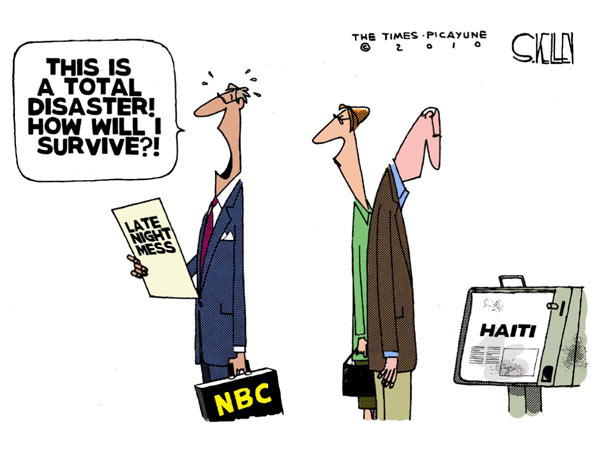
Sometimes, unfortunately, it takes a real disaster to put certain things in perspective. Our thoughts and prayers are with the people of Haiti, and those with friends and family there.
Sometimes, unfortunately, it takes a real disaster to put certain things in perspective. Our thoughts and prayers are with the people of Haiti, and those with friends and family there.
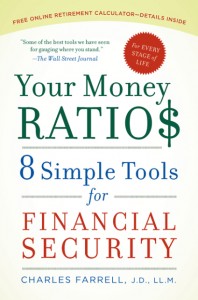
I recently read Your Money Ratios, 8 Simple Tools for Financial Security, by Charles Farrell.
The Disclaimer
I was asked to review this book in exchange for a copy, and chance to give a copy to one of my readers. This didn’t influence my thoughts on this book which are genuine and my own. I did however pick up this book with a bias. Charlie Farrell wrote an article on CBS Market Watch titled Don’t Rush Into Roth IRA Conversions. With all of the cheerleading surrounding the Roth IRA, this article echoed the warning that I’ve written about myself. I consider it serendipity to have read this article shortly before I began reading Your Money Ratios.
The Ratios
Capital to Income – Very simply, your current saved assets compared to your current annual income
Savings Ratio – The percent of your income you need to save each year
Mortgage to Income Ratio – How large your mortgage is compared to income
Education Debt – Amount owed compared to income
Investments – percent ratio of stocks and bonds
Disability Insurance – The monthly income you’d get as a percentage of current income
Life insurance – The number of years salary of the policy
Long Term Care Insurance – Insurance for this care, kicking in at age 55
Financial authors run a risk, too much detail and a reader will lose interest, too little, and the message may not get across. In this case, I think Charles Farrell did an excellent job straddling that line, staying on point, and keeping my attention throughout the book. To be honest, he had me at “when it comes to your money, and your future, you want to be Mr. Spock, not James T. Kirk.”
Charles offers a step by step process, so the reader isn’t left on his own to fill in the blanks. Starting with an 80% of income replacement target (where did that come from? Well, if you’re saving 12% and another 7.65% goes to payroll witholdings, you’re living on 80% now) we are walked through the percent of income to save at different ages and how to invest this savings in order to reach the target. I’d point out that the assumption is for Social Security to provide 20% of one’s working income. If you object, thinking this is too high, my Social Security Benefits post from last May should put your mind at ease. The benefit is regressive so a $90K earner may get $27K/yr (30%) but a $50K earner will get nearly $21K (42%) so Charles’ numbers are actually conservative.
Frequent reference is made to his Unifying Theory of Personal Finance:
“All decisions you make should help move you from being a laborer to being a capitalist”
This is not a poke at people who work with their hands. It’s an encouragement to save enough wealth so your money’s return has a significant impact. Consider, the first few years of savings, the interest or growth on your account doesn’t feel like much. But once your savings are equal to a year’s pay, a 10% increase is nearly as much as the 12% you add to the account, and it’s grown by 22% in that year.
I think that this book would benefit people at any stage of their life (hmm, maybe the blurb on the cover stating “for every stage of life” really sunk in). Someone just starting out can get a good understanding of how to start on a good financial path, knowing in their 20’s what their goal is 30 some years hence. An older reader can get an understanding of whether or not they’re on target and perhaps better calculate what their goals are. More than anything, the writing style and tone of the book was something that put me at ease. We are offered targets but not made to fell that these number are rigid, carved in stone. Even the replace ratios are offered as targets, 80% at age 65, but a fallback position of 70% at age 65 or 70 is also discussed if one either can’t reach the 80%/65 or doesn’t need that sum.
There is also an invitation to go to Your Money Ratios website and check out how you rate, your Money Mass Index.
I’d do a disservice to not be clear about what you won’t find in this book. The investing method is simple, a mix of stocks and bonds with a brief reference to diversifying with international stocks. Some might object that this section might have been expanded upon. For a comprehensive overview of asset, I’d suggest a book such as William Bernstein’s The Intelligent Asset Allocator. From a practical standpoint, the mix of stocks and bonds suggested will have a far greater impact than the further diversification within the groups is likely to provide. In the end, an enjoyable and educational read.
The Giveaway
To help promote the book, the publisher has offered me a copy to give away to one lucky reader. If you wish to be entered for the drawing please sign up for my RSS email subscription and I will chose a winner on January 31. Yes, you can unsubscribe after the drawing, but you wouldn’t want to, right? (Note – this giveaway is valid only for my readers in the US and Canada, they cannot ship elsewhere.) Good luck!
Joe
As I often do, I was surfing through some fellow blogger posts. I came across a question posed on Debt Free Adventure
Should one pay off their 20 year remaining student loan, fixed rate below 3%, or use the money to aggressively pay a higher interest mortgage? There is no correct answer, just more questions. That’s about the cheapest fixed rate money one will even see, and with inflation likely to return in the next few years, I’d bet that one could do better than 3% on average over the next 20 years. One could buy a mix of stocks or corporate bonds with a higher dividend than 3% and take any increase in price as a profit.
The turn that caught me by surprise was one comment suggesting that the borrower should have never taken on a mortgage while the student loan was still outstanding. That God’s word says we should avoid debt and therefore not have both those debts at the same time. Specifically, the comment said “Christians have an obligation to repay debts, and to be debt free.” I am curious about the mix of religion and money. The more I blog and read others, the more I run into this. Not that I’m uncomfortable with God or religion, I’ve just never viewed God and finance as being related at all let alone as closely related as others are suggesting. I recently read a book review in which the reviewer discussed the book in a positive light, but commented that he felt the author should has injected some discussion of God or faith in the review. No, I don’t think the reviewer was at all crazy, I’m just trying to keep an open mind. When I see Star Wars (The original, 1977 release) I see good and evil, the Force and the Dark Side. A discussion of God might naturally follow. When I am talking about debt, money, mortgages, etc, I just don’t see where the injection of religion adds to the dialog.
It happens that both the book reviewer and the debt discussion were referencing Christian views of money. Are Christians more debt adverse than other religions? Is is all Christians or just certain denominations? Do blog authors lose their non-Christian readers by tailoring their discussions to that approach to money? Am I a bad person for really liking the 2% cash back credit card I use? Just my thought for the day.
Joe
Last week, in my New Year Goals post, I mentioned how in ’10 I wanted to get more exposure by guest posting among other approaches. I’m proud to tell you that I was invited to be a regular guest poster on the TurboTax blog, and my first guest post Estate Planning 101 was published this past Saturday. It offers an overview of three sub-categories, Will, Designated Beneficiaries, and Trusts. A good read to help you understand this process and give you the first steps to get your own plan in order.

I look forward to being a regular there as it seems a comfortable fit. Taxes play a major role in our finances, and by coincidence, it was TurboTax (then MacIntax) that I chose to use when I first filed my own return in 1985. I’ll continue to post a note here to let my readers know of any guest posts I author, as I hope you’ll read and comment.
Joe
Last week, I found I had such a great selection of New Year Resolution blog posts, that I was unable to narrow it down to a list short enough to share in one post here. So let’s get going with the rest….

Jim Wang at Bargaineering plans to invest half of his emergency fund account into the stock market. At present, his EF is a full year’s expenses, a pretty healthy sum.
Matthew at Mint.com posted Financial New Years Resolutions You Can Keep, a top ten list of his resolutions of concrete, tangible goals. No “save more” or “spend less” on this list. Among the goals: (10) Make or update your will (amen!) (6) simulate bad news, a dry run to understand how to survive a financial disaster, and (1) don’t buy a house. Visit and read the full post to understand why Matt’s not buying this year.
Mark Miller at Retirement Revised offers a Resolution for a new decade: Work with meaning. This single resolution introduces this thought with “The Greatest Generation. . . the Silent Generation . . . And now, the Over-indulgent, Self-Centered Generation? It doesn’t sound too good–and it’s an unfairly harsh judgment, from my perspective.” A thought provoking post on the generational changes we are witnessing as boomers age.
On Gen X finance Charissa wrote Five Foolproof Financial Strategies That Will Ensure You a Better 2010. More a list of suggestions of strategies to adopt than resolutions, if you’ve not set up your own goals for the year, here’s a few thoughts to get you going.
Single Money Guy has five great New Year’s Money Resolutions focused on credit and debt. Among them, getting rid of the little extras that add up over time, such as that $4 latte that keeps you $1200 a year to the poorer.
Last post I’ll share in this resolution roundup is Free From Broke’s New Year’s Resolutions Are Bulls@%t! If only to provide a bit of a different view, a discussion of how resolutions are quickly broken and soon forgotten. FFB also offers suggestions on how to move from potentially unachieved resolutions to meaningful goal. A nice end to our two part resolution discussion.
What are your goals this year? Leave a comment, please, and let me know.
Joe