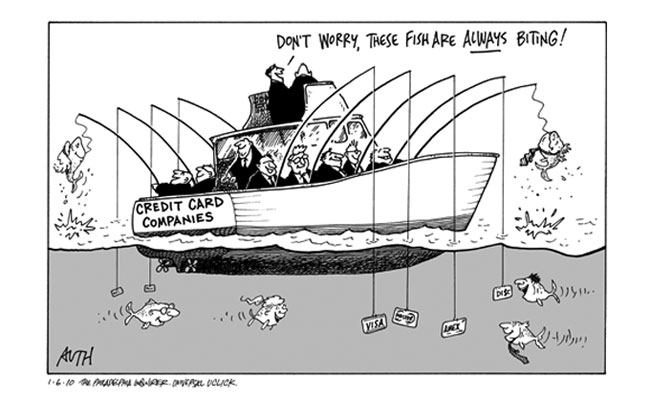
 I view this relationship more as guppies and sharks but either way, the credit card industry survived the CARD act, and is happily reeling in new customers.
Joe
I view this relationship more as guppies and sharks but either way, the credit card industry survived the CARD act, and is happily reeling in new customers.
Joe
I’ve spoken here about shopping for sales and the use of coupons to stretch your shopping budget. I thought it would be an interesting experiment to track my own savings here reporting on the last Friday of each month. I’ll count sales that I use to stock up on items as well as coupons/rebates. I won’t count things bought with a coupon that weren’t really needed in the first place (like the extra hard drive I just bought with a $25 coupon to Staples.) Let’s see how much these efforts actually return over a year’s time.
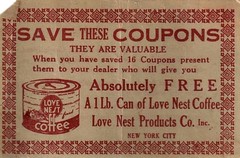
photo credit: HA! Designs – Artbyheather
Please leave a comment and let me know what you’re doing to save on your every day expenses.
Joe
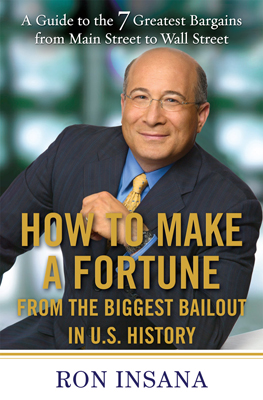
How To Make a Fortune From the Biggest Bailout in U.S. History is former CNBC anchor Ron Insana’s latest book. Its subtitle A Guide to the 7 Greatest Bargains from Main Street to Wall Street offers a glimpse into the book’s intent, how one can identify and profit from, recent events in the financial markets.
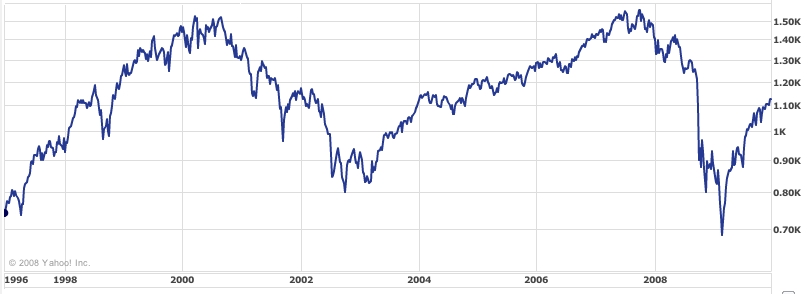
Ron (forgive my lack of formality, but as someone I’ve seen on TV for 25 years, ‘Mr. Insana’ seems a bit too formal) first offers a bit of historical perspective, discussing how there are times post-crash when the markets are on sale, at bargain basement prices. “Imagine buying the 1932 Dow at 1896 prices.” Indeed, today’s stock market as measured by the S&P is where it was in early 1998. Click on the chart if you wish to enlarge it.
In a twenty first century variation of “follow the money,” we have examples of how the pros have been navigating recent events and coming out winners, big time. Sam Zell, real estate magnate, sold all of his commercial properties to Blackstone for $39 billion in 2007, just as the market was about to take its turn. Bill Gross, founder and CEO of PIMCO, has been able to achieve returns in the bond market that have managed to exceed the long term stock market returns. His advice now is to put your money where Uncle Sam does. With the ability to adopt a ‘too big to fail’ approach, the government is able to prop up and bring to health the institutions they choose. Warren Buffet, with some very high profile (e.g. Goldman Sachs) purchases during the latter part of 2008 was a bit ahead of the market bottom, to be sure, but is now profiting handsomely from his investments.
While the book is upbeat about the future for the economy moving forward, Ron does share the concerns he has which could either slow or stall such a recovery. Among these concerns are the ballooning deficit nearly two trillion dollars this year and projected to exceed one trillion dollars in 2010. The flip side of this is that all of this stimulus will still not be enough to boost the economy back to health. Energy costs are also a wild card as a jump in gas and heating oil can quickly tap the brakes on an otherwise accelerating economy. Last, there are still concerns regarding the politically unstable regions of the world, North Korea, Iran, and Afghanistan among them.
Through the book we are offered examples of the government’s efforts to keep the recession from worsening, and how this will impact different segments of the economy. This, combined with very large cash holdings as compared to the value stocks, sets the stage for a continued recovery in the stock market.
Specific to stocks, the market is not homogeneous, the declines have hit some sectors far worse than others. Among the sectors that have hit badly are financials, home builders, and technology. Instead of choosing individual companies, Ron suggests using ETF (exchange traded funds) or mutual funds to lower the risk involved. For these industries just mentioned, XLF is the symbol for the S&P select Financial Sector, XLK for Techs, ITB for iShares Dow Jones US Home Construction. (Note: I offer these as a starting point for you to do your own research, the book does not specifically mention these, and I offer them only as examples of what is suggested.) Choose one company in any industry and there’s a risk that for whatever reason, that company fails. By using ETFs, you reduce that risk, as the chance of an entire industry failing is unlikely.
Next, Ron discusses REITs, Real Estate Investment Trusts. These investments trade like a stock, but are invested in Real Estate, focusing on residential, commercial or in the case of Mortgage REITs, the mortgages on these properties. A case is made for the fact that once the economy begins to recover, REITs’ returns will (likely) surpass the market averages for superior returns. Just as Real Estate was in the midst of a bubble two years ago, we are now experiencing a period of over shooting on the downside. For those who are considering purchasing a home for their own occupancy or as a rental property, these same factors make it a favorable time to do the research and move on the decision.
From stocks, let’s now move on to bonds. Bonds were not immune to the financial crisis, in fact, they were at the very center of it. That said, there was still the same overselling going on in the bond market that occurred in both stocks and real estate. Ron specifically makes a case for municipal bonds citing the fact that no state has gone bankrupt in the history of the US. He warns to stick to General Obligation bonds as opposed to project specific, given that the General Obligation maintain a senior position.
In closing, let me say this – This is not a book to buy and put on your bookshelf to read some day. The opportunities spelled out in its pages are not going to be around for ever. Given the timing between the editing process and getting a book to the stores, some of the potential gains have already occurred. As with any investment, make sure you understand the risks involved. I have no doubt that there will be people who read this book and profit handsomely, as well as those who think they are following the book’s advice yet somehow misapply the lessons learned. My own disclaimer – FTC regulation require that I disclose I received a review copy of this book as compensation in full for providing a review. This did not impact the content of this post in any way.
Please let me know what you think of this book after you read it.
Joe
Update – I was fortunate to catch an interview with Ron on CNBC discussing his book you can watch the video I loaded on You Tube)
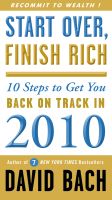
The book Start Over Finish Rich by David Back, is now available (one day only) as a free ebook download at WalletPop. Note: this is not a pirated copy, I received a mailing from David today announcing this promotion. A good way to start a Monday.
This was good for the one day, I’ve removed the link, hope you enjoyed the free eBook!
Joe
Yesterday, I posted my own goals for the year 2010. Pronounced ‘twenty-ten’, or better still just ‘ten,’ not like someone will ask what century you’re talking about. Today, I’d like to share some goals or resolutions, if you must, of some of my fellow PF bloggers.

(This dollar is not photoshopped. I got it while in NYC last weekend, and believe it’s the Big Guy’s ™ way of telling me to call this decade simply ’10’)
Let’s start with Kelly at The Centsible Life who declares with conviction 2010 is gonna rock! Kelly has two groups of goals, first those for her website, and then goals for herself and family. Even if you are not a blogger yourself, her personal goals are worth a look, she really has her priorities in order.
Next, Trent at The Simple Dollar had four goals spread out over as many posts. He plans to lose 40 pounds (makes the 10-15 I need to lose a bit more manageable), pay cash for a replacement truck, learn to play the piano, and reduce entertainment and hobby spending by 50%. I know quite a few people who’ve mention the need to drop a few pounds, maybe we can all compare notes and specific goals for the year.
At Don’t Mess With Taxes, Kay Bell has a short list, ‘Get Organized.’ I’m good with that. For me, the first step was to keep the clutter from growing. I’m in the midst of my own ongoing organization battle. Let’s see how we all get organized this year.
Flexo at Consumerism Commentary offers a nice mix of income goals, investing goals, and personal. There’s the desire to get in shape and to keep the place clean enough to have company on short notice. We’ll all be buff and neat by ’11.
Kelly at Almost Frugal posted her New Years Goals and Resolutions, and a recap of her ’09. In a minimalist approach, she has just three; sticking to a zero balanced budget (i.e. tracking every penny. An excellent way to understand where it all goes), to give something, every week, and to keep stress from affecting her personal life. Good luck, Kelly, sounds great to me.
New Year’s Financial Resolutions: Resolve to Take Baby Steps by Amanda at My Dollar Plan is a focused finance-centric list of how to get your finances in order over the next year. She addresses debt, saving, income, and investing in one’s own future. Not sure if it’s polite to ask her if she’s in great shape or just decided to stick to finance for the goals.
Another excellent 8 Financial Resolution Ideas for 2010 in an article by Kathryn at Million Dollar Journey. She includes some of the usual suspects, tracking spending, max out your pretax accounts, etc, but also includes two easily overlooked goals; Write or re-write your will, and save up for something fun. Great advice. I’d add that while your reviewing your will, you should also check the beneficiaries listed on your retirement plans.
Too many great lists to call it quits, I’ll complete the round up next week.
Joe