≡ Menu

Two Good Roth Moves

I’m afraid that my recent posts (and tweets for that matter) have given the impression that I am, for whatever reason, anti-Roth. Nothing could be further than the truth. I seek to keep an open mind, understand the numbers, and help others to better use the right account at different stages of their lives. Tonight I worked on some year end planning for two people, and I’d like to share these as examples of when the use of a Roth conversion is ideal.

First, a woman now in her early 50’s. She is on disability, with non-taxed workers’ comp payments providing much of her income. When the Roth IRA was first available she had an IRA, all pretax, as well as enough post tax money to last her more than ten years. In 2009, her personal exemption is $3,650 and her standard deduction, $5,700. This totals $9,350 which she can have in income before any taxes become due. So a conversion of this amount from her Traditional IRA to the Roth is what I suggest. In fact, we’ve made an annual Roth conversion each year since the Roth started, and her Roth account is now worth over $75,000. Keep in mind, there are those who would have suggested she maintain a mix of accounts even while working, of course no one can foresee a disability for a woman in her 40’s. Fortunately for her, the Roth wasn’t available back then, but it is now and is an important tool in her long term planning.

Next, I counsel a woman in her 80’s. With pension income and RMD (required minimum distribution from her IRA), her taxable income calculates to be in the mid-$20Ks. This puts her in the 15% bracket. Keep in mind, RMDs continue to rise as a percent of your account balance, and in theory, the market rising should increase the value of your IRA year on year. As she gets older, there is a risk that the RMDs will force her into the 25% bracket. To help avoid this, I suggest that she convert just enough money from her traditional IRA to a Roth IRA to “top off” that 15% bracket. In other words, in 2009 we are aiming to end the year with a taxable income of exactly $33,950. Next year, the standard deduction and exemptions remain the same as in 2009, but the bracket shifts up $50 to $34,000 even. Over time, this strategy will help shift quite a bit of money into her Roth at 15%, and avoid the potential 25% bracket. It also helps her beneficiaries, as if they inherit the Roth account, no further taxes will be due. Withdrawals from the traditional IRA are taxed at the beneficiary’s margin rate.

I hope these two examples help provide a balance to my other posts. There are more examples I plan to offer for the best use of the Roth IRA account in future posts.

Joe
{ 4 comments }

Retirement Savings Ratio

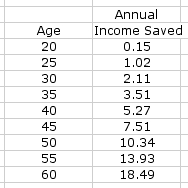
If you haven’t learned by now, I am a spreadsheet tinkerer by nature. One thing I’ve been thinking about lately is the retirement savings one should have at different ages. A spreadsheet I’d written some time back came in handy to revisit this idea.

savingratio

This snippet shows hows many year’s annual income one would have saved for retirement if they save a total 15% of their income each year and get an 8% annual return. In the spreadsheet, I make the assumption that 10% is their deposit and 5% is a company 401(k) match, but either way, it’s 15% of their gross income saved. Of course, one doesn’t save so linearly, it’s tough to get a twenty year old thinking about saving for a retirement that’s decades away. Nor will the investment return be so steady. My post titled A Change of Plans offers a somber warning about what can happen when you just continue to project ‘more of the same.’

Let’s look at these numbers for a moment. Two things that I’d call to your attention; First, there are no dollars shown. While that might seem a bit counter intuitive, it makes perfect sense. When people discuss retirement needs, the conversation often boils down to a replacement ratio, how much of your pretax income do you need to continue in your current lifestyle? The number is up for discussion, but 80% is the common answer. With a 4% withdrawal rate at retirement a savings equal to twenty times your final year’s earnings is about what you’d need to accomplish this. The second thing to note here is that the saving numbers are not linear, but exponential. At 8% return, your money will double every 9 years. So you need about half your retirement goal saved not halfway through your working career, but by about 10 years before you retire. Note also that the numbers I show take into account a rising income, for example, at 35, I show that one would have saved 3.5 of their current income. This process builds in the inflation adjustment by assuming your income will rise over time. You can see from these numbers that any rule suggesting that you have say 1/10 your age times your annual salary saved can’t possibly be accurate, and will only be valid at one particular pint in time, here at age 35. At 20, it would be impossible for a new worker to have 2 years salary saved up, yet for a 60 year old, 6 years salary won’t be enough to survive, not without relying on other sources of income.

Just something to think about, replacement rates will make a good topic for a future post.

Joe

{ 8 comments }

The Weekly PF Roundup

Let’s start this week with Dr. Thomas J. Stanley’s $1 Million: Something or Nothing? If you’re not a frequent reader of financial books, you may not know that Dr. Stanley is the author of the Millionaire Next Door series and his latest installment, Stop Acting Rich, which continues to analyze the backgrounds of the rich and how they got that way. This post isn’t just a rhetorical question, the real answer is, of course, it depends.

Michele of Money Ning offers 10 Reasons to Have a Library Card. Sorry, I’m still a sucker for a good list, and I bet that once you get past the obvious (uh, borrow a book, anyone?) you get to some things that can really save you the bucks. Sorry, no spoiler here, go take a quick read there.

Once again, Kay at Don’t Mess With Taxes breaks the news on Tax Breaks Which are Extended into 2010. Among the extensions are the choice between state income tax or sales tax if you itemize (great for people who live in a no state tax state) and the “donate from your IA if you are 70-1/2 or older.” This helps those who are taking RMDs and make nice donations, but don’t itemize. Good news from Kay.

This week I offer the first round up mention to Deliver Away Debt. I’ve read too many question posted about how to pay down debt when one has no extra money, and I find it curious that the writer seeking advice will also reject the best advice we all have to offer about how to raise extra cash. Jeff, on the other hand, is a great example of a guy who takes action. Delivering pizza on the weekends to earn some extra money to pay offer his debts. We follow his adventures via Twitter, and his blog. This past week, Jeff posts about how to Build Relationships While Eliminating Debt. Jeff discusses balance in one’s life and how to stay engaged with others while still getting ahead in your finances. Even if you are debt-free, this makes for good reading if you want to be a good parent and spouse. I tip my hat to you, Jeff.

Redeeming Riches wrote about Why You’re Off Track for Your Retirement (And What to Do About It). A thought provoking piece that reminds us to stop, take a step back, and review where we are and what our goals are. We’re reminded that without a plan, there is no success.

Peter at Bible Money Matters helps to talk some of the consumerism out of the holiday season with 50 Frugal Gifts You Can Give This Christmas. This is a list I’ve bookmarked as it can be a great source of inspiration for any occasion, not just Christmas.

{ 1 comment }

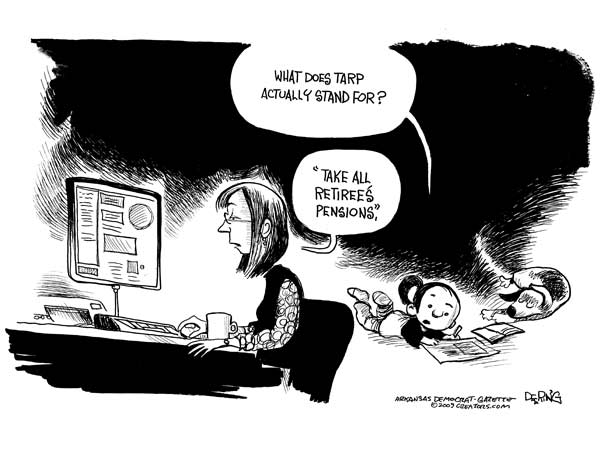
TARP explained

tarpNow we know what it really means……

{ 0 comments }

Year End Tax Tips

2009 is almost over, and if you believe that the decade started in ’00, then your decade is ending as well.

It’s time to consider the last minute things you can do to save on your taxes. With just three weeks left until the new year, take advantage of what you can.

  • If you have an FSA (flexible spending account) and have any balance remaining, there are some easy ways to spend on items you can submit for reimbursement. Visit the eye doctor, and get new glasses. Review the list of reimbursable drugstore items and stock up. Bandaids, Ace Bandages, aspirin, cold medicine, birth control, there are quite a few things you can buy that are covered by FSAs. Don’t lose the chance to get your money back.
  • It may already be too late to adjust your 401(k) withholding for 2009, but it’s the right time to consider bumping your percent for 2010.
  • If you are right on the edge of the standard deduction or the ability to itemize (for single, it’s $5,700 married filing joint, $11,400) consider this strategy; In odd years, make two year’s worth of donation, half in January , half in December. In December, make the January mortgage payment, and take the interest for 13 months worth of payments. Also in December, make the next property tax payment. In simple terms, cluster all itemized deductions you can into the one year, and take advantage of itemizing. In the even years, make just the 11 months mortgage payments, no charitable donation, and only the property tax due. This strategy works best if you were very close to the numbers mentioned.
  • If you are 70-1/2 or older and don’t itemize, donating to a charity directly from your IRA can have the same effect as the deduction as the withdrawal is not considered income.
  • If you are in the 10 or 15% tax bracket, consider selling appreciated stocks and take advantage of a 0% cap gain rate.
  • If you are already retired, try to forecast your taxable income for the year and convert just enough IRA money to a Roth to “top off” your present bracket.
  • Any change in family status, marriage, divorce, having a child, etc, and you should check that all you beneficiary designations are still how you want them.
  • As always, if you have losses in any non-IRA stocks or mutual funds, you can use up to $3000 of that to offset ordinary income. If you still want to hold the position, you can but it back after 30 days to avoid running afoul of the 30-day “wash rule.”

Any other ideas I may have overlooked? Pass them along!

Enjoy the weekend,

Joe

{ 2 comments }