
≡ Menu

Trade-Off

I recently read Trade-Off, Why Some Things Catch On and Others Don’t, by Kevin Maney.
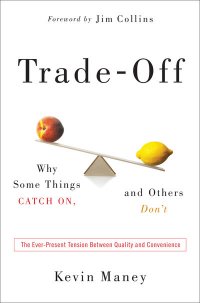
tradeoff

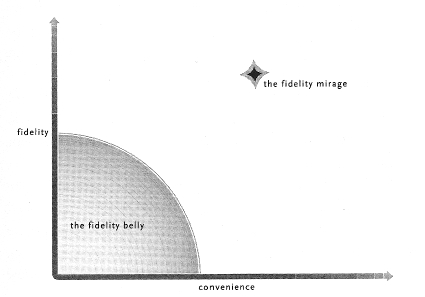
This book surrounds one premise, that for a product to succeed against its competitors, it needs to excel in either Quality (fidelity) or Convenience. In a montage of one example after the next we are given pairs of products as examples of this concept. The fidelity (literally) of MP3 audio is lower that that of a CD, but the convenience is much higher, a dollar or so (assuming you’re not stealing it) and a few seconds download time, and it’s yours. A CD, at best, is a walk or car ride away, or a few days if ordered on line.
tradeoff2

The author goes on to discuss how where a product lies on the fidelity/convenience curve will shift over time. Not just to say that it can shift, but that it will. A simple case in point, the iPod. The first models came on the scene as a high priced, high fidelity purchase. Over time, the iTunes store took off but the unique aura surrounding the iPod faded a bit as everyone seemed to have one. As the iPod shifted its position on the curve, Apple introduced the iPhone and gained incredible market acceptance for this new product, again hitting the high point on the fidelity curve as its older products shifted toward convenience.

This book is fast reading, and enjoyable despite its tight focus. Take a read and see if you don’t start to view certain products in a different light.

FTC disclosure – The copy of this book I read was from my public library. No one paid me to read it or write about it. Most links in the sidebars left or right are advertisements, and not personal endorsements.

Joe
{ 2 comments }

My Financial Weekly Roundup

This week I’ll start with Don’t Mess With Taxes’ post ‘Accidental mortgage interest deduction.’ In this article, Kay Bell, author of The Truth about Paying Fewer Taxes, explains how the deduction for mortgage interest sort of snuck into the tax code some years back. I like her writing and how she continues to offer unique finds such as this one.

At The Simple Dollar, Trent had two articles that caught my attention, and I’ll mention them both. First is sure to become a classic, Personal Finance 101: How Averages Lie. In this article, Trent talks about a few examples of averages not telling the whole story. “The average household has $8,000 in credit card debt.” Well, ok. But we’re given an example, say 3 families have none, one has $10,000 and one has $30,000. That still averages to $8,000, doesn’t it? It’s less that they lie and more that the numbers are pretty meaningless as they don’t tell the whole story. I have my own draft of a similar concept and it talks about home pricing. “As reflected by sales numbers, median home pricing fell X% in some location.” Meaningless. Perhaps the higher priced homes happen to have families less likely to move. Maybe new condos are being built on the other side of town, in phases, and the price happens to be lower than the majority of homes in most of the town. All sales will drag down the average, won’t they? Yet existing home values may not be dropping at all.

The next Simple Dollar article is Consumption Smoothing and Why It Doesn’t Work. The concept is similar to the “Life-Cycle” Hypothesis introduced over 60 years ago by Franco Modigliani, as well as the Permanent Income Hypothesis introduced by Milton Friedman. I come to the same conclusion as Trent, there are some nice theories out there, but the reality is a bit different.

Not a blog, Morningstar had a must read article by Nouriel Roubini, 10 Reasons the Recovery Will Be U-Shaped. In the end, a slower recovery will set a better stage for long term growth than would the V shape others are calling for.

Len Penzo offers a nice list of 23 Creative and Sure-Fire Ways to Easily Earn Extra Money. In these times, a few hundred dollars a month can help knock off a debt or save for an otherwise unaffordable event. Keep an open mind and decide what you’re willing to do to get ahead.

Free Money Finance discusses why Americans Still Not Ready for Retirement. Despite the article recently quoted which suggests that it’s possible to save too much, FMF offers data suggesting that 60% are not saving enough and those who are ahead of plans can choose to retire early if they wish.

Why You’re Wrong If You Think Gold at $2000/oz Is Unlikely… or Worse, Just a Bubble by Money Energy makes the case for a continued rise in the price of gold. John Maynard Keynes referred to gold as a barbarous relic, and over the longer term, I tend to agree. In the short run, anything is possibe, I suppose.

Joe

{ 1 comment }

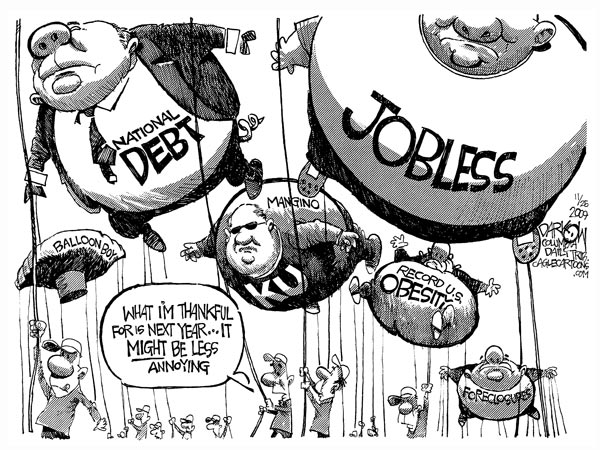
The Thanksgiving Floats

thanksgivingballoons

Next year we’ll have other annoying thing to ponder, I’m sure. But for now, I remain thankful for what I do have.

Joe

{ 1 comment }

Frugal Friday Week 27

We survived another Thanksgiving. Good food, good company, and my Turkey Gravy was perfect. Gravy is one of those odd things that I don’t made often enough to feel comfortable with, so I has a jar at the ready just in case.

Today, Black Friday.

In sticking with my theme of Frugal Friday, I’d like to go back to one of my earliest frugal bits of advice, to stop buying magazines on the newsstand. Typically, you can get a year long subscription for the cover price of just a few issues. For the next two weeks, Cooking Light magazine has a “Friends and Family Program” and the subscription savings are huge. One example – Entertainment Weekly, I believe has a $3 cover price. For $10, you can get a year’s subscription, how crazy is that? Why would anyone buy it at the supermarket? Take your $140 saved and go make an extra payment to a credit card.

Note – this is not an affiliate link, the link is to CookingLight.com/FAF and it immediately changes to a Time Warner page. I will always disclose any interest in a referral I discuss in a post.

Enjoy the weekend, don’t spend too much today!

Joe

{ 0 comments }

Happy Thanksgiving

I wish all my readers a happy and healthy Thanksgiving.

Today is the day to reflect on what we are thankful for, and for me, my family, and friends are at the top of the list. Thanks to the internet and my blogging efforts, I feel that the ‘friend’ list has grown a hundred fold over the last few years. Comments from my readers and visiting other finance blogs has taught me a lot and helped me gain an expanded perspective. I appreciate all of you, and hope I can continue to share my thoughts with you another year.

Thank you for reading JoeTaxpayer

Joe

{ 1 comment }