≡ Menu

Can the Market Make You Rich?

This was the question posed on a Morningstar article a couple weeks back. It begins by offering the fact that the bull market of the eighties set the stage for high expectations, specifically that the market would make you rich even with a small sum invested. It closes with this punchline; “Here’s the reality: Your contributions matter much more than investment returns.” Within the article appears the following chart. It assumes an annual deposit of $10,000 invested monthly over the stated time horizons and given rates of return.
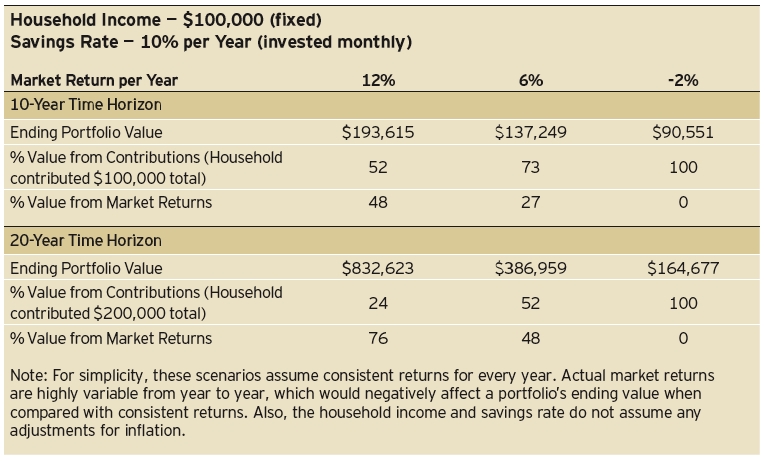
savingvsmarketThe logic behind the article centers around the ratios calculated above. With an annual return of 6%, (I’ll ignore the 12, as I don’t expect to see 12 long term) you can see that over a ten year period, the value of the account is 73% from deposits, and 27% from growth, the market’s return. Over a 20 year period, with the initial deposits having longer to grow, the ratio is now 48% from gr0wth. This is where the article stops and concludes with the “control what you can” advice. I am 47 years old, and have been working since I’m out of college, 25 years now. Even if I retire early, my money is still invested, so at 62, I’ll have a 40 year investing history, and after retirement a couple more decades, I’d hope. So, why not extend this chart a bit?
savingvsmarket2

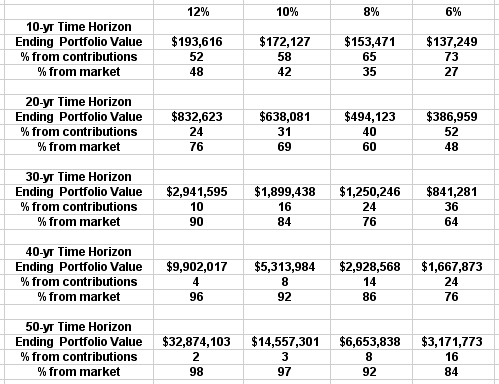
Note, I took out the potential 2%/yr loss. It stands to reason that with zero or less return, all of your return is from deposits. I did add a column for 8% and 10% as the long term stock returns fall closer to this range. A thirty year time horizon really starts to change things, doesn’t it? At 30 years you can see that 64% or nearly 2/3 of the ending account value is from growth, and only 1/3 from deposits. The numbers are even more skewed at higher returns or longer time horizons.

What to conclude from this? First, whenever you read anything regarding a long time span, take it with a grain of salt. Second, even a small difference in returns, just 2%, will dramatically affect your returns over a sufficiently long period. Last, and most important, you need to understand your own risk tolerance, I included the 12% column as it was part of the original article, but with reward comes risk, don’t count on that kind or return when you plan your retirement 30 or 40 years hence.

(If the link to Morningstar doesn’t function, the article is available from Invesco Aim)

Joe
{ 8 comments }

This Week’s Roundup

I must say, I enjoy the Sunday round-up posts. It keeps me open to new ideas and on the lookout for fresh blogs. I try to bookmark one or two articles each day and then on Saturday review my collection. Right until now I don’t know how many will past final edit. Let’s get started and see my weekly finds.

Benjamin Clark posted at Christian PF, What are Charitable Gift Annuities and how do they work? It turn out they offer a way to get a tax deduction, immediately, then get a steady income while also do good (donating to a charity.) The downside, if there is one, is that upon your death, the charity picks up the remaining value of the funds, no money is left for your heirs.

The Psychology of Bubbles: Using Hindsight to Examine Why We Bought into the Hype is an excellent, in depth, discussion of bubbles and their cause posted at Steadfast Finances. He includes a chart of the stages of a forming and then crashing bubble, as well as discussions of the bubbles of the most recent ten years, tech, oil, and housing. Excellent post, worth your time.

Similar to the oft repeated message we hear about achieving prosperity, but worth reading is 5 reasons you are not wealthy. One day, these behaviors will be obvious enough that we’ll learn to avoid them, and get on track. Maybe.

Investopedia’s Amy Bell posted Overcoming 5 Major retirement Risks. One Risk is that you might outlive your cash. Amy offers suggestion on how to overcome this risk and four others in this article.

For some time I’ve been trying to get the word out that the Roth conversion will benefit a select few at any time. Now, Susan Tompor of Freep.com agrees that Roth IRA conversion isn’t for everyone. Of course there are many factors to consider, but Susan reminds us that if you don’t have the cash handy to pay the tax upon conversion, it’s never a good idea. The rules kick in in just about 6 weeks, what are your plans?

And to close out this week’s reading – The oblivious investor again shows us he’s anything but, his Efficient Market Hypothesis: Strong, Semi-Strong, and Weak is a great paper on a topic we usually run into in a college level finance class. This theory basically states that the current price of a stock represents all know data available on that stock at that given point in time. Theory vs reality, I suppose.

Another good week. Four days till turkey.
Joe

{ 3 comments }

Happy Aniversary Sesame Street

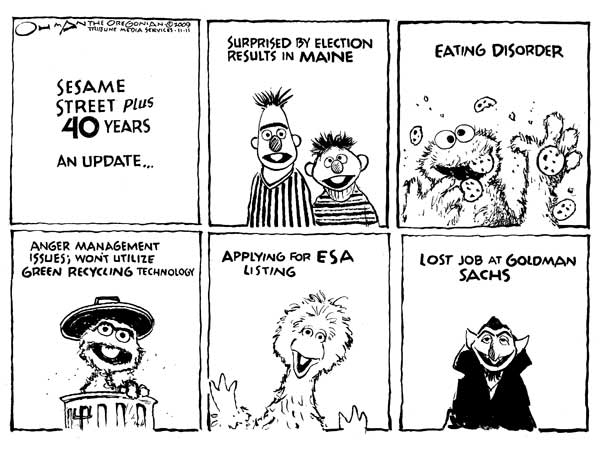
sesamest40 years? Bert and Ernie haven’t aged a bit.

Joe

{ 0 comments }

Frugal Friday Week 26

Time is Money

The_Persistence_of_Memory

How often do we here this? And is it something that we toss aside or do we take this cliche to heart? If the date on the milk is far out enough and I buy an extra container, Jane (my wife, as in Joe and Jane Taxpayer) warns me it may spoil before it’s finished. I remark back that having to go out just for that item, not as part of a regular trip to the supermarket, would cost over 30 minutes of time and nearly $1.50 in gas. So I take the risk. I know how far we live from the supermarket but how do I value that half hour? If you make $50,000 per year, it’s equal to about $25 per hour. On the other hand, as I clip coupons from the Sunday paper, and Jane asks how that’s different, I tell her that I discovered the fallacy of my ‘time is money’ rationalizing. One can’t always convert their time to their day job’s hourly rate. Sure, some people can put in overtime, but that’s another story. When I am sitting with the Sunday paper, drinking my first cup of coffee, enjoying the silence, I may not be ready for the news. Cutting coupons while listening to NPR is relaxing to me.

Remember though, a dollar saved isn’t a dollar earned, it’s quite more. Anywhere from $1.50 to $2.00 depending on your tax rate. Reading elsewhere last week I ran into an even more extreme result. The saving rate in the US is now back up to the 5% range. This means that of every $20 one makes, on average, they are saving just $1. So you might think of the dollar saved by cutting a few coupons as $20 you’d otherwise have to earn to save that buck. If that doesn’t get you rethinking the couponing game, why not try this? Think of something you wish to buy, maybe a big TV, or iPod, whatever. When you use a coupon at the store, you get to drop the saved money in a jar toward that wanted item. Last I did this, I tracked all my deals for a year and found the savings to exceed $2000. I may do this again as a monthly installment of this Frugal Friday series.

Enjoy the weekend.
Joe

{ 0 comments }

Choosing between a 15 or 30 year mortgage

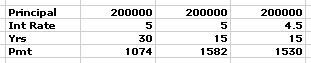
With mortgage rates at or near all time lows again, it’s time to consider the ongoing question, do you choose a 15 or 30 year term? The 15 can be the way to go, especially if you are in your late 30’s or older and have a goal of having no mortgage at retirement. More than that, you’ll get a rate about a half percent lower which can save you some money as I show in this example:

mortgage

As you can see, the payment required to cut the term of your mortgage in half jumps by just over 40%, all of this extra money going to principal. Another approach you can consider is to take the 30 year term, at the slightly higher rate, and make payments for a 15 year payoff. You need to look closely at your finances and your own risk tolerance to make this decision:

  • Is there room in your budget for the higher payment?
  • Do you have any credit card debt you carry month to month?
  • Are you paying any other installment debt (car, boat, etc.)?
  • Are you depositing to your 401(k) at least to capture the full match, if available?
  • Do you have 6 months or more of emergency money set aside?
  • Are you and your spouse secure in your jobs (as if such a thing is possible these days)?
  • Are you expecting a child in the next few years and will lose some income during that time?

For many who are just moving into a house, it’s a better choice to take the thirty year, beef up your financial position, and then begin accelerating your payments. This isn’t rocket science, no complex math, just make extra payment each month to principal, and make sure the back is crediting it that way. For those who are paid bi-weekly, when you see that third check in a month (this occurs twice a year) you may use that money to pay down the mortgage. Another approach, if your retirement savings is on track, is to take half your raise and use that as your pay down money. The idea of having no mortgage is very appealing, but there’s one risk to consider. So long as you have a payment to make, that expense is still there. If I lost my job before the mortgage is paid in full I’d still prefer to have a well funded emergency account vs a mortgage that’s five years from being paid off.

One goal to consider is to pay at a rate that will have your mortgage paid off before you retire. My personal goal is ten years, so with that payment gone, we can reevaluate our retirement savings and increase to a higher level if needed. Or if we feel comfortable retiring early, at least that monthly payment will be long behind us.

Joe

{ 11 comments }