≡ Menu

Will Gold Break $1250 by 2011?

I am not a fan of gold. For those who are, are you putting your money where your mouth is? Do you think gold will be over $1250 by the end of 2010? That’s ‘only’ 21% higher than it is today. I’ll pass along a secret, odds are 4 to 1 against it happening. If you feel otherwise, that it’s a sure thing, I’ll share with you how to collect that payoff. First a disclaimer: The following involves the use of exchange traded options. I’ve not discussed these instruments before, and will be providing only a brief overview to explain a specific strategy. Don’t do it unless you understand it. Even if you do, don’t do it.
goldoptions

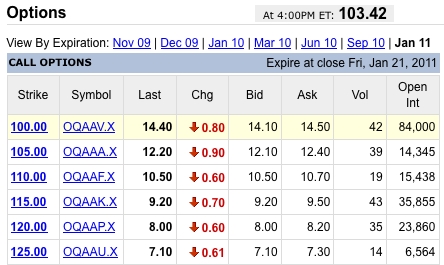
This is a clip of the option quotes for the GLD ETF which trades at 1/10 the price of gold. An option gives you the right but not the obligation to buy the underlying stock at the strike price you choose. For example, $1450 gives you the right to buy 100 shares (options are priced per share but trade 100 at a time) of GLD until Jan 21, 2011 for $100/share. If gold rose to $1200, your $1450 would rise to $2000. Make sense?

Now for the 4 to 1 bet: if you bought 1 option at the strike price of $115 for $950, and sold the $125 option for $710, you would be out of pocket $240. If gold closed at $1250 on Jan 21, 2011, the $115 option would be worth $1000, and the $125 option is worthless, and you’ve gotten 4 times your money. Note, if it closes any higher, the difference between the two strikes is still $1000 no matter how high it closes. Below $1150, and you’ve lost your bet. In between and you’ll get something back, $100 for every $10 dollars gold is over $1150. As I said, I don’t recommend this, it’s just a thought experiment for me. Given the choice between actually buying gold or taking a fraction of that money and placing this bet, I’ll take the bet. You can lose it all, but gold can also crash to less than half its current value. Any questions on this gamble (I don’t call this investing) please comment.

Joe
{ 28 comments }

The Dow 10,000 means nothing

Last week as the Dow crossed 10,000 again, I saw some serious chatter about this milestone, the press celebrating and even the traders on Wall Street wearing Dow 10,000 2.0 caps on their heads. A number of people pointed out that this number gets far more attention than it deserves. Will you do anything different now that Dow broke 10,000? Will you buy more stock, sell your stock? Remember, the Dow peaked at over 14,000 in October, 2007. So what does 10,000 really mean? Nothing at all.

What I really want to discuss is the odd nature of the index itself. It completely ignores the dividends of the underlying stocks. In real life, you just can’t ignore those dividends. By going to Yahoo Finance and looking at pricing on DIA (the Dow Jones ETF), we find that 10 years ago, on Oct 15, 1999 the closing price was 100.00. (equal to a Dow 10,000), but you can see the adjusted close of 82.14 tells a slightly different story. This means that over these 10 years, the Dow stocks are not exactly flat, but have gained 21.74% over this period. Before you dismiss this as trivial, consider that on a million dollar retirement portfolio, this is nearly $20,000 per year on average from these dividends. $20,000 you don’t need to draw from your original principal. If you are still working and in the ‘saving for retirement mode,’ you gain from the benefit of dollar cost averaging, as well as from reinvesting these dividends.

What I’ve ignored in this discussion is the benefit that you’d see from rebalancing your portfolio each year, keeping the stock/bond ratio in a certain proportion in line with your risk tolerance. The subject of a future post.

Joe

{ 5 comments }

Another Fellow Blogger Roundup

The credit card issue is continuing to get analyzed five ways till Tuesday. If you didn’t read my roundup last week, please read Baker’s Reward This first and you’ll understand this remark. This week Matt Jabs at Debt Free Adventure wrote Credit Card Rewards? Rethink Your Returns. Matt starts by putting people into two camps, Camp Rewards and Camp Avoid. I’d suggest there’s a third camp, Camp Convenience. But I understand he wanted to keep it simple, and just name the Pro and Con groups. As with Baker’s post, I can respectfully disagree and at the same time complement a writer on his the excellent way he gets his point across.

In a post taking the opposite view, How To Use A Credit Card For Protection, MLR of My Life ROI mentions rewards, but also discusses two other important perks, extended warranty and chargeback protection. Whatever side you are on, be aware of what you gain or lose by choosing as you do.

On a lighter note, Green Panda Treehouse answers How Much Life Insurance Should You Have? A good start to understanding your needs. Better to read this and do the math before it’s too late, and you leave your family unprotected.

Financial Samurai offers a cleverly titled Party Like It’s 1999! 10 Takeaways From This Recession, a very thoughtful post on what he learned not just in the past 18 months but over the decade for the fact that the Dow is where it was exactly ten years ago. I did leave a comment pointing out that the Dow index does not include dividends, so 10,000 today is not quite flat to 10,000 ten years ago, but there does seem to be a psychological impact looking as this number.

Trent at The Simple Dollar sets us straight with Passing the Blame: Some Thoughts on the 401(k) Crisis. There has been much talk about how 401(k)s have failed investors. Trent offers a different take, the 401(k) is not an investment to be labeled good or bad, it’s only a shell to hold one’s investments. Those who haven’t learned to manage their own money (or sought advice if this is beyond them) need to accept responsibility for themselves. The contents of one’s retirment portfolio should reflect their own needs and risk tolerance.

On Good Financial Cents, Jeff Rose hosts a guest post from Peter Montoya, Why You Should Keep Contributing to Your 401k. This article is a great overview of the benefits you’d miss out on if you choose to walk away from this retirement account option. Good advice, don’t miss out.

Last today, Baker’s Stop Timing Markets was excellent viewing, yes viewing, he’s trying to offer a video post every so often, it may settle to one video per week. The title itself was misleading, it was more of a discussion of the obsession over Dow 10,000 and how the number itself is pretty meaningless. I agree with his conclusion, and no, there’s no trade or reallocation I plan to do based on this meaningless milestone.

I continue to enjoy the analysis of so many people. It’s a refreshing break from the pros on TV, magazines, or web, and they frequently offer insight the pros simply miss. A great week, it was.

Joe

{ 4 comments }

The Recovery

recovery

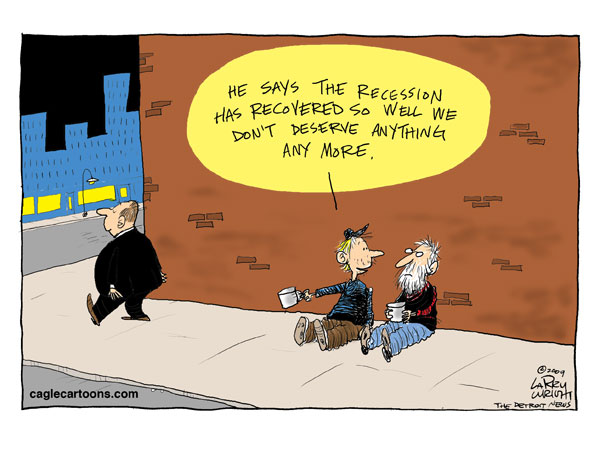
The recovery certainly won’t impact all of us at once. Even at 4% unemployment, if you are one of the unemployed, a good economy doesn’t mean too much. Enjoy the weekend.

Joe

{ 0 comments }

Frugal Friday Week 21

The Frugal Tweeps’ Edition.

This past week, I asked my Tweeps (those I talk to on Twitter) to give me their best frugal tip for today’s post. Here we are:

@deliverawaydebt – Sentence “hands off that new purse woman” Now that’s savings.

@taxtweet – Adjust withholding so you don’t get a huge tax refund and put the extra paycheck cash into a savings account or other specific fund.

@RetSav – Wachovia’s Way to Save program – every debit card transaction, $1 is moved from checking to your savings account.

@ncheapskate – Easiest way to save? Think before you spend any money!

@stephonee – Get a cast iron skillet and learn to clean it correctly – never buy another skillet in your life!

@frugalhousewife – If you find sirloin steak on sale, have the butcher grind some up into ground sirloin.

@MyLifeROI – I think of my money as liquid effort. “Do I REALLY want to spend 2 hours [of my labor] on this ?”

@Matt_SF – Don’t allow a high price to sway your frugality. If you get X uses out of your purchase, the cost/use shrinks over time.

@nleader – do you need all the movie channels? @ $19 per channel, can save ~$100 per month and watch the series online for free.

@freefrombroke – Take enough out of your ATM so u don’t get hit with ATM charges at a machine from another bank.

Not bad, ten new tips to save some bucks, many of which hadn’t occurred to me. Thanks to all who contributed!

Joe

{ 1 comment }