≡ Menu

Roth Mania!

I read quite a few financial magazines, and follow the financial writing of countless finance bloggers. Recently, there seems to be a growing mania surrounding the Roth IRA (and the Roth 401(k) for that matter) as well as the chance to convert money to a Roth with no income restriction next year. I wrote about this last year in two posts titled Loving That Roth and More Roth Lovin’. It’s time to refine and repeat the message regarding this flavor of retirement account. We need to start with one understanding. Your Marginal Tax Rate, what is it, and how do you figure it out?

Next, what is the source of the Roth Mania? The idea that you’ll be in a higher tax rate at retirement, right? With no other income (e.g. pension) how much can you have in pretax accounts and still pay no tax at all, zero? In 2009, a married couple had a standard deduction of $11,400, and two exemptions $3650 each. This totals $18,700. So far, it’s just adding three numbers. Now, some patience, please. Most planners suggest you only withdraw 4% of your retirement balance each year as a safe number. More and you run the risk of depleting the account. So, 4% of $467,500 is our $18,700. You can have nearly $500,000 and still be in the zero bracket! The next $16,700 would be taxed at 10%, and it would take $417,500 to produce that $16,700. I’m going to stop right there. Too many numbers and my readers lose interest, I know.

Let me sum up the above paragraph: You can have as much as $885,000 in pretax accounts, and the withdrawals will not even put you into the 15% bracket. These are today’s dollars, the numbers continue to shift up with inflation. To illustrate the impact of the shift over time, in 2004, the standard deduction and exemptions added to $15,900, which would be supported by $397,500. The 10% bracket was taxable income of $14,300 supported by $357,500. So, just five years ago the total was $755,000. Can you know today what this number will be in five more years, or twenty? Nope, you sure can’t. But you know today’s number, and whether you are anywhere near it now.

When does it make sense to convert? If you were making deposits to your IRA but earned too much to be able to take a deduction, you can convert and only pay tax on the appreciation within the account. You need to review the numbers to see if this makes sense for you.
It can also make sense to convert some IRA money to Roth once you are retired and understand where you fall within your bracket. For example, if you are married filing joint your taxable income from $16,700 to $67,900 is taxed at 15%. Say you see that you’ll be at $40,000, you should consider paying the tax and converting $27,900. I call this “topping off your bracket,” and it’s a great way to reduce your future RMDs (required minimum distributions) so the increasing amount you are forced to withdraw doesn’t bump you to a higher bracket.

Who should deposit into a Roth? Young people working part time or just starting a job, likely in a low bracket and not a bad idea to just pay the 10% or even 15% and put that money away. The other exception is truly an exception in these times, those who have an excellent defined benefit pension plan. The old fashioned plans were structured to replace a large portion of your income, 80% wasn’t unheard of. So, my remarks above aside, if you are well into your working career and will enjoy such a pension, and still are saving in a retirement account, the Roth is something you should really consider.

In the end, the decision is yours to make. Don’t get caught up in the hype, a conversion for working people may be right for a very few people, not the majority. I’d hate to see people jumping on the conversion bandwagon, paying 25% or 28% to convert only to discover they retire and are in the 10% or 15% bracket. That would hurt.

Joe
{ 17 comments }

Free; The Future of a Radical Price

I recently read a book titled Free, The Future of a Radical Price. In it, the author, Chris Anderson, shares with us a series of anecdotes to get his point across how free can actually be profitable for companies that support it as a business model.

Let’s start with Monty Python. A few years ago, some of the existing members of the group Monty Python found that their video clips were being screened on YouTube. To counter this, Monty Python launched their own YouTube channel and started streaming high-quality video, also for free. What did they gain from this? Three months later sales of their DVDs had climbed to No. 2 on the Amazon movie list with revenue increasing 23,000 percent.

Chris event takes us back a couple generations to when Gillette handed out razor handles as a loss leader to sell blades to happy customers at a profit. In another example of clever marketing strategy, we find that Jell-O wasn’t always the popular dessert treat that it is today. It took some hard work and giving away tens of thousands of Jell-O cookbooks to gain market acceptance. If it weren’t for this marketing genius the Jell-O shots that we enjoyed in college may never have been.

Back to today. We find companies such as Google and Yahoo providing a valuable service but never sending us a bill; both companies basing their business models on advertising revenue. Chris also discusses how some companies may provide a free service as well as a premium service with more options. So long as some fraction of customers to pay for premium service, the company might sustain a profit. While he doesn’t mention it in the book, Evernote is one such company, their free service providing enough value that the founders are comfortable talking publicly about the percentage that sign up for their premium service.

There is also a lengthy discussion of recording artists who accept the fact that their music is pirated on the Internet but their gain in revenue and sales of concert tickets and older CDs makes up for this. I find this hypothesis interesting although I’m not personally comfortable declaring that the ends justifies the means. If a band wishes to choose to distribute their music freely, and make up for it elsewhere, that should be their decision and not a business model to force upon them. Still it’s an interesting discussion to observe how a product with no incremental costs can lead to a different marketing path. Before the price of hard drive memory came down so dramatically, it would make little sense to photocopy every page of a 300-page book. Today that book may very well be available online for the downloading. And the business model of free will struggle with the distinction between the bits and atoms.

Chris offers and interesting insight on this concept and this book deserves a space on your shelf right next to other recent books such as Blink, Freakonomics, and The Tipping Point.

{ 3 comments }

Term vs Whole Life Insurance

Today I have another guest post up at Bible Money Matters titled Term, Whole And Variable Life Insurance. Which Type Of Life Insurance Should I Buy? The choice is complex and the decision, not so black and white. Take a read and let me know how you’ve made your decision.

Joe

{ 18 comments }

Weekly Roundup – The Credit Card Edition

If only for the blunt title, Bend Over… I’ll Show You Where You Can Stick Your ‘Rewards’ was my first pick for the week. Baker takes a strong stand against the credit card industry, so strong that he’d like to avoid doing business with them altogether. My own view is different, but I respect Baker and even when we disagree, he makes me stop and think about my values.

On Wise Bread I read 9 Things That Are Worth Buying at Costco. On a good visit to Costco I can find a couple dozen items we buy there on a regular basis, this post was just the tip of the iceberg offered from a Costco member. Some favor BJs or Sam’s Club, for me Costco is the big winner for savings.

On Realm of Prosperity I saw an interesting take on the ‘time is money’ concept, Changing The Price From Dollars to Work Hours When Shopping. Simon touches on this idea by comparing his hourly wage to the money he’ll spend on his lunch hour meal. I commented on this post that I think the concept is brilliant. As time goes on, looking at how much a meal costs, or a new car, or man’s suit, not in dollars, but in hours, helps put and interesting spin on your spending habits.

At Financial Highway was a neat collection of Investing and Money Rules of Thumb. Some traditional rules such as the Rule of 72 and the 4%/yr withdrawal rule for retirement, but also new ones Ray’s fellow tweeps sent in.

Next, The Debt Gazette shares that Statistics Reflect a Consumer Shift Away from Credit Cards.I don’t doubt that, but I do fear that we have a very short memory. When the economy turns up again, I can’t be sure the same excesses won’t return and lay the path to a repeat of the same mistakes we just made.

The Finance Buff offers a clever way to Uncover The Hidden Fees In Your 401(k) Plan. The issue for these accounts is that while the funds themselves may have a low fee, there may be a management fee that difficult to uncover. The disclosure isn’t always so easy to understand. Using this method is a great start to getting a grip on your retirement account expenses.

David at My Two Dollars passes on this declaration from Time Magazine, Own A Home? You’re On Welfare. This view sees the government giving me money to subsidize my mortgage and property tax. Me, I see it from the opposite view, that I work hard for my money, and our tax structure has rules that certain items ‘come off the top.’ So I’m spending my money before the government gets their hands on it. Time seems to feel that all money within the system belongs to the government and whatever I’m permitted to take home is my welfare. An interesting read even if I disagree 100%.

Last, I tip my hat to Kay Bell of Don’t Mess With Taxes who had Obama’s Nobel Prize tax implications the day he won the award. She suggested that if he’d donate the entire award to charity, directly, there’s be no tax consequence. I think he’s a fan, too, and took her advice.

As you can see, another great week of reading.
Joe

{ 3 comments }

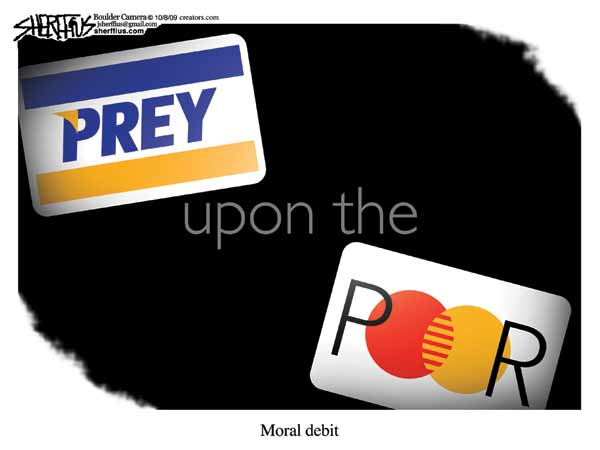
Credit Cards Preying upon the Poor

creditcards2

It seemed fitting after my Evil Credit Card post on Thursday that I find this cartoon in time for my weekly cartoon find of the week. I’m sure Man vs Debt’s Baker will enjoy it as well.

Joe

{ 0 comments }