
≡ Menu

Mad Money, Watch TV, Get Rich

First, Jim Cramer’s book persona is far more level headed than he appears on TV. Say what you will about the mad man on CNBC, but the author has an intelligent story to tell. He does not recommend individual stock picking for one’s investment portfolio’s bulk. He starts by suggesting that one have the rest of their finances in order and start with individual stocks only after they are on the path to a properly funded retirement, IRA, 401(k), etc. And then, with the $10,000 minimum “extra money” diversify so that five chosen stocks are in different sectors.
He also advises that one needs an hour’s worth of homework per week for each stock one owns. That seems like a conservative, not cowboy, approach. It also limits how many stocks someone with a day job should own.
The book also contains a stock worksheet which contains question one should answer before choosing a stock. It’s listed here, along with his 25 rules of investing.
If you put aside your notion of the TV pitchman (and he’s self deprecating about that persona in the book) he comes off as level headed, rational, and worth the few hours it takes to get through the book. The real question is this – have I learned something from this book I will use? Maybe. My stock picks are minimal, I’m mostly in index funds and ETFs depending on the account. My last individual stock pick was MO (Philip Morris before the name change) and the misses vetoed the purchase.

If you are at the point in your investing life where individual stocks are planned for your portfolio (and there are many sucessful investors who have never owned an individual stock) then this book is certainly worth the three or so hours of your time it will take to read.

JOE
{ 2 comments }

Today’s discussion of how to decide between the Traditional IRA or the Roth IRA appears as a guest post at Moolanomy Personal Finance. There, I offer an analysis to help you decide which one would benefit you most at each stage of your life. Please visit, and let me know what you decide.

Joe

{ 2 comments }

This Week’s Financial Blog Reading

Let’s start this week’s reading with Wise Bread’s 51 Unusual Money-Saving Tips from Readers. The key word here is “unusual” as some of these tips boarder on the dishonest (claiming the paint you bought is the wrong color so you can buy it back at a markdown) to the illegal (keeping cups from fast food places so on next visit it’s just a refill), to the downright bizarre (go get what the supermarket is throwing out each night, good food they hear. Yea, right.)

Fiscal Geek wrote about Sinking Funds: taking Budgeting to the Next Level. An interesting way to view how you budget and prepare for certain expenses. When my wife and I bought our cars, I put them down on our balance sheet so the ‘current value’ is calculated from the date. I set it up so the cars would zero out after 5 years and beyond that the spreadsheet automatically is calculating funds to buy the next car. I just never realized that was the name for such a concept.

On Consumerism Commentary, Flexo gets out his red Sharpie to offer A Report Card for Financial Rules of Thumb. In the end, one size does not fit all, 10% not the magic percent to save from your income and 80% of your pre-retirement income can be too much or too little. In all Flexo looks at 5 different rules, and invites his readers to add their own to the list. Nice analysis.

Something about lists that draws me in every time. B Simple’s Signs you may need to simplify your personal finances is a pretty comprehensive list to keep your financial life simple. I must say, I follow most of what the list suggests, automating bill payments, combining accounts so you don’t have similar assets all over the place, etc, but it took me decades of learning to get there. Hoping some younger readers will take this advive now and save years of unneeded effort.

One day this week, I came across a few recurring questions, namely, Should I Invest While Still In Debt, How much do we need to retire, and When to pay off your mortgage. All good questions to ponder no matter what stage of life you’re in.

There are a number of topics that always seem to be of interest to those interested in personal finance. De-cluttering, organizing, time management are all among these related topics. Along these lines I offer Dragos Roua’s 33 Ways To Get And Keep Yourself Motivated. This list comes with a brief paragraph expanding on each item, but I have the feeling a full blown eBook may be born from this, and I’m looking forward to reading it.

Looking forward to another great week of reading.
Joe

{ 4 comments }

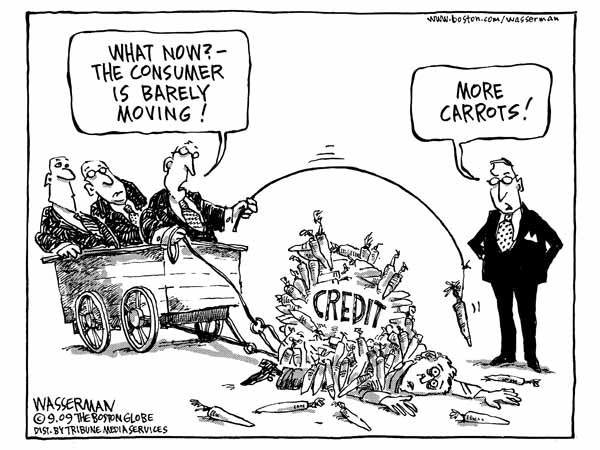
The Economic Carrot and Stick

carot

He has to start moving, eventually. No?

{ 0 comments }

Frugal Friday Week 19

Today, I’d like to offer some more frugal tips, random ideas to help you save some bucks.

The Entertainment Book retails for $35, but is often available for half price. It’s a book full of coupons, regionally focused, targeting restaurants, entertainment and travel. You can easily save ten time the purchase cost by using this book on your next vacation.

Get a grip on your (grocery) shopping habits. There are a few aspects to this. The usual “make a list and stick to it” is a great start, as is “don’t shop when you’re hungry.” To these I’ll add, if you have a number of supermarkets nearby, plan your trips on the way to or from someplace else, this will help you save time and gas. My closest ones are close to each other, but nearly 5 miles away, so a round trip visit from my house is 10 miles and about 20 minutes. Stopping as I pass on the way home saves me both time and money. Tie this strategy to stocking up on the non-perishable sale items are there’s a lot of savings to be had.

Avoid the soda machine. I’d like to suggest you avoid soda altogether, but short of that, are you putting $1.25-$1.50 into the machine for every soda? Buy it in 12 packs (brand names, not even store brand) and you’ll pay about 30 cents a can. Do the math, just one soda per day and you just found $250/yr to save or use to pay off some debt.

More than just a tiny change to find a few dollars a roommate can make a huge difference in your budget. You may have a spare bedroom in your house or apartment, and whether it’s to help you pay the rent or mortgage, a roommate can be the difference between just getting by and really getting ahead. Of course this isn’t for everyone, and you’ll want to screen the roommate even more than you would a tenant as this will be a guest in your home. They will not only pay half your rent or a nice chunk of the mortgage, but also half the utilities, if that’s the deal you offer.

Many financial contracts have a three day “right of recision.” Sort of a three day cooling off period, in case you change your mind. How about you pick a level, maybe $100 or less, depending on your income, and decide that when you want to buy something, you’ll write it down, and wait three full days to see if you still really want it. You’d be surprised at how even after a couple days, the urge to buy often fades enough that you start to temper your impulses.

Five ideas today to help you save.
Joe

{ 0 comments }