≡ Menu

Frugal Friday Week 16

I’ve been thinking about Frugal vs Cheap lately, and on that topic read a Quiz on Moolanomy. I guess I don’t have too much to worry about as I didn’t even pass as frugal on the quiz, perhaps it was the big tv purchase that threw me over, until then I had a 10 year plus TV.

So maybe the quiz is just a start. I’d suggest that part of drawing that line is to understand the impact your decisions are having on your life and those around you.

Years ago, I found myself at a dinner, a dozen people who had just all met and decided to head over to dinner together. The waitress comes by and one person asks for separate checks. Twelve of them. I though the waitress was going to cry. I spoke up and said I really didn’t care if I paid for an extra drink or two, that just splitting the bill evenly was fine by me. Well, I was out voted, and the waitress had to juggle 12 tabs for one table. I’d call the avoidance of a couple extra dollars cheap, and it made for a pretty frustrated waitress.

Buying the store brand of generic soap when my wife or daughter has a preference for a particular brand – cheap. So, instead, I follow the sales and stock up when the bargains present themselves. Fortunately, we have enough closet space to handle the inventory of soap, shampoo, toothpaste, TP, etc. The stocking up also helps avoid the emergency trips for an item that’s run out, wasting both time and money.

This past week, the local supermarket had my favorite soup (Progresso) on a sale that if you bought 15 can for $20, you’d get a $5 coupon good for your next supermarket trip. Jane (as in JaneTaxpayer, my wife) was heading in that direction and I asked her to pick up the soup since she was passing by anyway. Later that day, I asked for the $5 coupon, and she told me that two cans were dented and she left them with the cashier, so no coupon. That’s when I needed to ask myself if it would be worth criticizing Jane, or, as I decided to do, let it go, as no good would come of it. That’s the risk I take by asking someone else to do me a favor, and even without the coupon rebate, the sale was ok. The sale was frugal, making Jane feel she let me down would be plain stupid.

Just my thought this week.

Joe
{ 5 comments }

Is Your House an Investment?

Recently, Jim at Bargaineering authored an article titled Your Home is Not an Investment. Looking at data gathered by Michael Bluejay, we find that the price of new homes increased by 5.4% annually from 1963 to 2008, on average. During that same period, inflation averaged 4.4%, so housing rose faster, no? Well, not so fast, the size of new houses also grew during that time, from 983 sq ft to 2349 sq ft, or 1.6%/yr on average. On a same size comparison, this means housing has lagged inflation by about .6%/yr.
When was the last time you heard of someone buying a house and leaving it unoccupied, hoping for a positive return? Me neither. What’s missing from Jim’s post is the rent saved by an owner occupied house, or the rent received by the landlord of a rental unit.
Where does that leave us? I’ll suggest that you not count on rising real estate values as part of your long term plans. On the other hand, as retirement approaches, a plan to either downsize or move to a less expensive area (or both, of course) can free up some needed money.

Joe

{ 1 comment }

Fun With Statistics

Sounds like an oxymoron, I know. But ever since grad school, a lifetime ago, when I read a book called “How to Lie With Statistics,” I’ve seen some fun in it. I recently read Thomas J. Stanley’s blog where he posted an article titled Average Rich or Median Poor? In it, he discusses that median (the middle number of all observed) household wealth is but a fraction of average household wealth, about 1/5 or so. This goes to illustrate the concentration of wealth in this country.

On a different note, today I wanted to talk about median home prices.

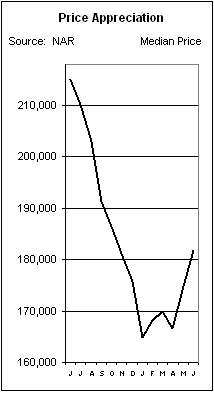
medianprice

Let’s look at this chart, the 12 months ending June 2009. On the news they’ll tell you home prices are down 15% from a year ago. But does that really mean anything? Think about this. Does the drop you see from June until January even mean anything? Not much to me, anyway. The number graphed here is the median sale price for home sales in the given month. In an economic crisis, the kind we are in the midst of, it would stand to reason that higher end homes would not be enjoying the turnover the lower priced ones would see. See where I’m going with this? The numbers charted do not discuss same home value, only the value of observed transactions. Say there’s a town of mostly $500K homes, with little turnover, everyone there is pretty happy and the houses are not for sale. A builder comes in and with everyone’s approval builds nice homes, a bit smaller, and they sell for $400K each. Even though the $500K houses lose no value, and may very well start to sell for $550 or more, the transactions at $400K are the ones that hit the data and the median sale is that $400K. This is just one way the numbers get distorted and the facts presented by the media, while true, still don’t tell the whole story.

Joe

{ 0 comments }

Good Financial Reading This Week

Mike at Gather Little by Little posted 7 Quick Numbers To Fix Your Personal Financial Situation a list of 7 rules of thumb regarding your finances. They included my favorite, the Rule of 72, as well as some I might disagree with, such as the 100 minus your age should be your stock percentage in your portfolio.

MSN money blog’s article Frugal or dishonest? You decide referenced stories from my fellow PF bloggers, Penelope Pince, FMF, and Smithee. A combination of MSN struggling a bit to come up with new material, and the blogging world’s quality really improving. A good selection of frugality gone too far.

John Chevreau discussed Jim Otar’s book Unveiling the Retirement Myth. In his soon to published book, Jim warns that most baby boomers have not saved enough for retirement and fall into the “red zone.” He feels that the concepts we take for granted, asset allocation, frequent rebalancing, asset dedication, diversification and the notion of stocks for the long run are all myths and need rethinking. A video interview with the author appears on the site as well.

Wise Bread offers Save Money: Take the Boring Challenge, a brief list of frugal ways to save that may get a bit, well, boring. I don’t find the list there boring enough. The suggestion to drop the Starbucks habit and make your own coffee? I’ve been doing that for years. Take a look, and see what ideas you can use to start saving.

Thomas J. Stanley, author of The Millionaire Next Door, a classic, has his own blog, and posts some very interesting articles. His recent Average Rich or Median Poor? offers us two data points, an average net household worth of $434,782, and a median net worth of $91,304. Median is the halfway point, half of families have more, half less. This disparity points toward a growing concentration of wealth. On average we may be a rich country, but the average person isn’t wealthy. An article that gets you thinking about how the numbers are offered to us and what happens when you a bit more closely.

Thank you, fellow bloggers for some good reading this week.
Joe

{ 3 comments }

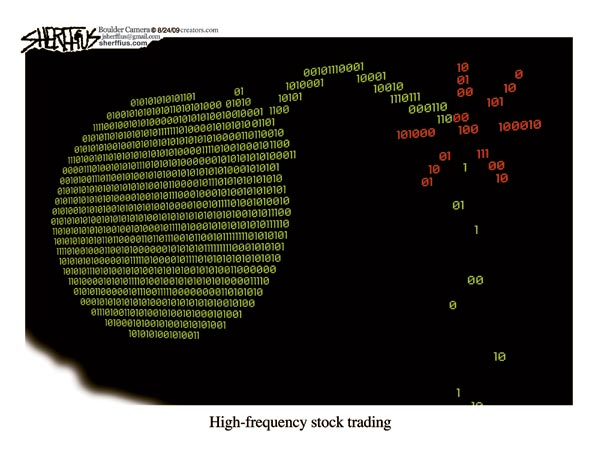
High Frequency Stock Trading

stocktrading

I’ve always been a believer in “Buy and Hold” and “Stocks For the Long Term.”
Enjoy the weekend,
Joe

{ 3 comments }