
≡ Menu

Frugal Friday Week 15

The Netflix vs Redbox Edition.

One of the ways people have been trying to save without sacrificing too much is to cut back on entertainment a bit. On cable, either eliminating premium channels or going to a basic lineup from extended. Also cutting back on the movie nights out, whether as a couple, or a family, it really can add up.

One alternative for your movie addition is Netflix. They offer a number of plans ranging from $4.99/mo for the “1 DVD at a time, 2 per month” to $8.99/mo for “1 DVD at a time, exchange as often as you wish”, up to the $16.99 three at a time plan. All but the cheapest plan offers unlimited streaming to your Mac, PC, or TiVo of a limited selection of older movies (typically not the new releases.) You choose your titles on line and as soon as you return one the next one in queue is sent to. Most areas are in a one business day turnaround, which is very convenient.

Another alternative is the Redbox. These DVD dispensers look like a soda vending machine and are starting to appear in supermarkets, drug stores and other shopping areas. The deal is pretty simple, you rent a movie for $1 per day. Rent today and the DVD is due back tomorrow by 9pm. If you don’t return it, it’s an extra $1 per day until the total is $25 at which point you bought it for good. If you don’t wish to browse the selections at the store, you can go online, choose a video, and see the closest box to you that has it. You then can reserve it online and are charged from that time. The DVD can be returned to any location, so maybe you picked it up on the way home from work Friday and on Saturday return it at the supermarket box.

This choice is personal, it really depends on your lifestyle, number of family members, etc. The break even on the $8.99 plan is 9 rentals per month, but the ease of dropping the DVD in a mailbox vs the Redbox location shouldn’t be overlooked. While I might pick up the movie at a regular supermarket visit, it may still need to go back on a special trip. Round trip to the supermarket for me is nearly a half gallon of gas, so my math should include that expense somewhere. So there’s no clear winner, although Redbox favors the casual viewer and Netflix the Movie fan.

I’d be negligent if I didn’t remind readers that most local public libraries also lend DVDs. Our system has 35 libraries which allow you to reserve a DVD or book online and it will transfer to your local branch when it becomes available. Not bad for free.

If you’re not looking movies but just TV, Tom Drake wrote an article How to watch free TV and cheap TV in Canada. His advice makes sense in the states as well.
Happy viewing,
Joe
{ 4 comments }

More Innumeracy

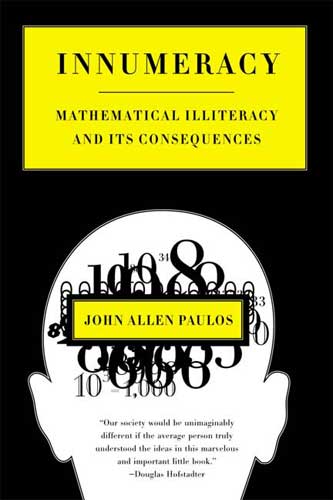
I’ve used the word Innumeracy in a number of posts here to describe how people seem less and less able to grasp simple mathematical concepts. Today, I’d like to share what I view as a new low in my innumerate observations.

innumeracy

I went into a store (doesn’t mater which, and I don’t wish to insult other employees of that chain) which honored its competitor’s coupons. In this case, a particular brand of soup, priced at $3.19, but on the coupon they were 4/$5. I offer the cashier the coupon in advance of her starting to ring anything up, hoping that will save her having to re-ring or void anything out. She looks at the coupon quizzically, and reaches for a calculator. “$7.76” I tell her. Huh? I ask if she’s looking for the difference between full price and the coupon price. Nope, she was trying to calculate how much each can would be. The calculator had .80 in its display, as she had entered 4/5 which of course is .80. So, not only could this cashier not divide $5 by 4 in her head, but even using a calculator to help was beyond her. Are my expectations too high? Or have people stopped bothering to acquire skills that I consider to be needed to pass fourth grade? Is it me, or does this disturb you, too?

Joe

{ 3 comments }

Lottery Winners Going Bust

When you google Lottery Winners Stories, you find that 90% of winners go bankrupt within 10 years of winning. At first blush, that sounds pretty crazy, bankruptcies aren’t that widespread, why would winners be so much more inclined to have such financial difficulty? Like any general numbers, we don’t really know enough of the details to pass judgment, but I do have my suspicions. People in the top 10% (family income above $125K or so) are far less likely to play the lottery, so most winners are from the lower income levels, spending money on tickets that should instead go toward savings or debt payment. They are more likely to take their windfall and blow it on cars, jewelry, and trips they have been envying from seeing such spending on TV. In their case, money not only doesn’t buy happiness, it brings trouble.
One thing they don’t realize is that if they take a lump sum, a 10 million dollar prize is usually awarded as half that sum immediately. After taxes, they are left with $3 million or so. Who has that kind of money in their hands and doesn’t hop in the car and go shopping? But this money now needs to last forever. On a 4% withdrawal rate, they should be limiting their withdrawals to a gross $120K/yr. Depending on what they are invested in, taxes will be due each year, so they won’t quite have even that to spend.
On the other side, you have the annual payout, but keep in mind, after 20 years, the payments stop and you had better saved and properly invested enough to keep up the new lifestyle.
All in all, it’s unfortunate that this dream turns into a nightmare for so many. But, as they say, you got to be in it to win it.
Joe

{ 5 comments }

This Week in the PF Blogosphere

When Baker’s not writing outstanding posts, he attracts others to guest post them on his site. 25 Essentials That Are Better and Cheaper to Make at Home written by Miranda Marquit makes my list of good reading. The combination of the list format, the frugal ideas, and the further links, one of which send us to homemade candies, makes this a post I’ll refer to quite a few more times, I’m sure.

Jim at Bargaineering plays devil’s advocate and suggests that Your Home is Not an Investment. Another interesting spin on this topic, and one I’ll likely work on to offer my own view later this week. Do you treat your home as an investment? Do you even include it when thinking about your net worth?

The Financial Buff offers his latest Little Book review (to be clear, these are the books whose titles start The Little Book, the reviews themselves are comprehensive) on The Little Book That Builds Wealth. FB’s reviews on more than a dozen books on personal finance give a great glimpse into the book’s specific topics and let you decide whether you wish to read for yourself.

Rent vs Mortgage: Calculating Tangible and Intangible Costs by Frugal Dad reviews the cost of owning with an eye towards all the costs that renters don’t face. I agree with FD that the decision (to buy) is very personal and that one must consider all aspects very carefully.

Everyday Finance’s post Why Credit Card Companies are Evil: Because they Can Be (note: this blog is no longer) caught my eye, for the title, and for the fact that I’ve felt this way myself for some time.

Last, Pants in a Can talks about how he’s a Confident Consumer with Low Risk Tolerance. He finds himself with friends all considering some sizable homes with mortgages to match. Well, PIAC, confidence doesn’t mean wreckless. You may be one of the many confident conservatives, financially, anyway.

Back next week with more good reading to share.
Joe

{ 2 comments }

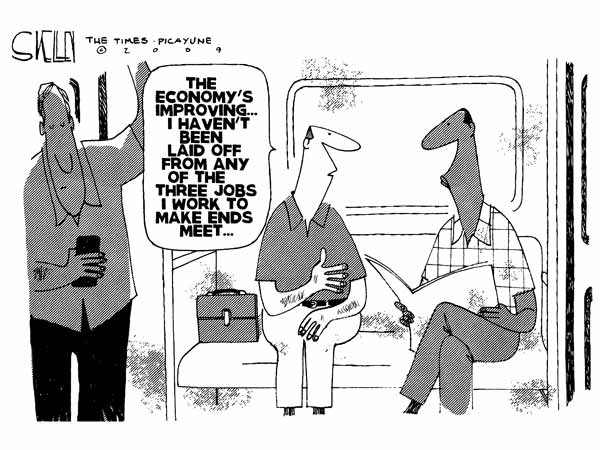
Our Recovering Economy

employmentEnjoy the weekend, summer’s almost over!

Joe

{ 0 comments }