by Joe
on February 20, 2009
From Wikipedia;
Moral hazard is the prospect that a party insulated from risk may behave differently from the way it would behave if it were fully exposed to the risk. Moral hazard arises because an individual or institution does not bear the full consequences of its actions, and therefore has a tendency to act less carefully than it otherwise would, leaving another party to bear some responsibility for the consequences of those actions.
This past Monday’s Barrons had a cover story suggesting that $200B would be well spent buying down all subprime mortgages by 25% (total subprime loans are estimated at just over $800B), i.e. simply reducing the principal owed, therefore reducing the payments. Presumably, this would put the mortgage back to a level below the current value of the house in most cases. When I hear such suggestions, I ask myself, “who loses and who gains by this”? It would seems that this idea protects both the bank who will receive a cash infusion as well as the homeowner who got in over his head. The taxpayer will eventually have to pay up, as this is a zero sum game, wealth is not created out of thin air, and even if the treasury simply prints this money, inflation results which devalues our dollar.
Why do we want to save the lenders? It was their own greed that caused them to write mortgages that made no sense at all. The option ARMs were an accident waiting to happen. Why save the homeowners? Many won’t be able to afford even a mortgage reduced by that 25%, and more foreclosures will follow.
I’d like to offer an alternative variation on the above suggestion. We the taxpayers only put up $120B, but the mortgages are all written down by 30%, the banks picking up that other 15%. Now the homeowner has a mortgage only 70% of what it was prior, at a rate that is fixed (5%) and recut to 30 years. But we don’t walk away from our $120B, all homes will carry a first lean equal to the 15% we put up. Money collect on subsequent sale of the property. The banks still get a cash infusion, and only need to write their loans down by 15%, and the homeowner stands a better chance to make those payments, a much lower percent expected to default.
Joe
{ }
by Joe
on February 19, 2009
Today, I’d like to share with you the MMA dashboard, a snapshot taken from an official demo video.
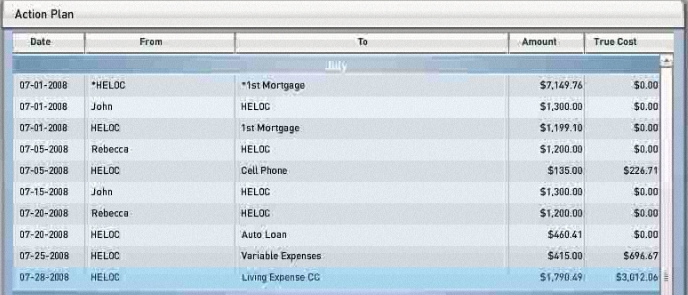
Note: You may click on it to see a larger image.
First, I’d note that it’s pretty convenient that the living expenses credit card has a due date right at month’s end. The main card I use happens to cut a bill toward the end of the month with a mid-month due date. That’s okay, it’s their example, I understand they wish to put the system in the best light possible. Let’s look more closely at the first month, July. There are a total of 10 transactions, 4 pay checks coming in, and six payments made from the HELOC. Seems pretty simple to me that for all the “sophisticated algorithms”, MMA can be summed up in two rules; (1) Pay all your bills with the HELOC and (2) deposit your paychecks directly to the HELOC. Is this the best they can come up with? What we don’t know, however, is the internal workings of MMA, specifically how it calculated that first mortgage paydown of $7149.76. A very precise number, why not $7000 even or one month’s income of the sample clients ($5000)? Funny, when you add up the HELOC withdrawals and payments, the July ending balance is $6149.76, and average daily balance which is used to calculate interest, $5542. Here’s where it gets interesting. In the classic example, the mortgage rate is 6% and the HELOC rate is 9%. The interest saved in one month by making that prepayment on July 1 is $7149.76 * .06 = $428.99 per year or $35.75 in the first month. But – the interest on the HELOC is $5542 * .09= $498.85 /yr or $41.57 that same month. In this example, it’s clear that MMA cannot even calculate the best first prepayment/HELOC withdrawal. As I’ve stated in other posts, I agree it’s possible for the HELOC shuffle to provide some benefit, but not enough even to pay off the cost of the MMA program. If this is MMA watching every last penny at every moment, I’ll be sure to watch my dollars myself, and I’d suggest you do the same. (Any agents care to comment on this?)
Joe
Back next week for more MMA discussion.
{ }
by Joe
on February 18, 2009
The American Recovery and Reinvestment Act of 2009 contains a number of tax breaks, which seem well intentioned, but none of the details I saw will have less than a token effect on one’s wallet.
A few highlights:
‘Making Work Pay’ Tax Credit. – For 2009 and 2010, the bill would provide a refundable tax credit of up to $400 for working individuals and $800 for working families (with incomes up to $150,000).
‘American Opportunity’ Education Tax Credit. – For 2009 and 2010, the bill would provide taxpayers with a new ‘American Opportunity’ tax credit of up to $2,500 of the cost of tuition and related expenses paid during the taxable year.
Computers as Qualified Education Expenses in 529 Education Plans. – The bill provides that computers and computer technology qualify as qualified education expenses.
Sales Tax Deduction for Vehicle Purchases. – The bill provides all taxpayers with a deduction for State and local sales and excise taxes paid on the purchase of new cars, light truck, recreational vehicles, and motorcycles through 2009.
Temporary Suspension of Taxation of Unemployment Benefits. – The proposal temporarily suspends federal income tax on the first $2,400 of unemployment benefits per recipient.
Extension of AMT Relief for 2009. – The bill would provide more than 26 million families with tax relief in 2009 by extending AMT relief for nonrefundable personal credits and increasing the AMT exemption amount to $70,950 for joint filers and $46,700 for individuals.
Joe
{ }
by Joe
on February 14, 2009
Enjoy the weekend.
Happy Valentine’s Day.
Joe
{ }
by Joe
on February 13, 2009
Sometimes there’s a phrase out there, repeated over and over in the business news, but rarely explained, “mark to market” being the latest. In a course I took as part of an MBA curriculum, I learned what this meant as it pertained to futures contracts. Say you buy a contract for 100oz of gold (I’ll use $900/oz to keep the numbers simple) and for the current value of $90,000 you must put up a margin, say 10% or $9,000. At the end of each trading day the broker will mark the contracts contain in the trading account to the closing prices and either credit the account if there’s a gain or require more funds be required if the balance has fallen.
Now, this is certainly a simple task for a contract that trades on multiple exchanges at a volume that indicates willing buyers and sellers. A single mortgage is less straightforward. It requires knowing the principal (easy) current home value (not really easy) and financial condition of the borrower (which of course can change in an instant.) In theory, when one creates a pool of mortgages written according to my Mortgage 101 rules, with enough mortgages combined into one simple pool, the value of that pool should be easy to calculate. It’s a bond that starts with a 30 yr life, but whose curve is shaped a bit different as many (actually most, in normal times) will be paid off early due to refinances or sales of the property.
We now find that Mortgage 101 was ignored completely, and default rates have skyrocketed. The result of this is that the value of groups of these mortgages cannot be determined, or at least not quickly. Therefore, the concept of ‘mark to market’ becomes difficult if not impossible to implement. These mortgage pools have some value, to be sure, but the credit markets are frozen and no one seems willing to provide a market in these toxic assets. Consider, so long as a house is in decent shape, as would be most homes still occupied, the value of its underlying mortgage should be no less than the value of the house, not the 10 to 15 cents on the dollar that some investors are offering to buy these mortgages. In the end, there is simply no market for these securities to to be marked to.
Joe
{ }