So I’ve looked a bit at the budget that came out last week. First, let’s look at the summary:
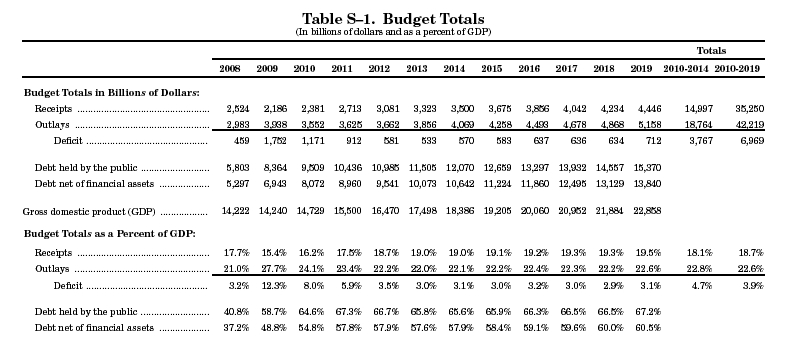
(As always, click to open in larger window) The first scary thing I noticed was that deficits continue, right out to 2019. Wasn’t it yesterday that we had a surplus?
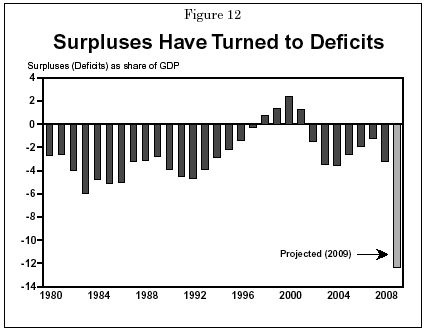
Oh right, that was before Bush took office. I remember the concern was that with no need to float more debt, that the government would have no place to ‘invest’ the social security trust fund, and that other instruments tied to T-Bills or bonds would have to find other indexes. Well those days are long gone.
So far, I have no conclusion, these numbers are large and frightening, but the impact of the budget needs to be felt quickly to be part of the solution and not send us into a more severe downturn.
Joe
{ }
by Joe
on February 27, 2009
And it has a cool title, “A New Era of Responsibility.” Which is bit Orwellian to me, as it starts with a 1.75 Trillion Dollar deficit in 2009. At 142 pages I have a bit of reading ahead of me this weekend, and I’ll comment if I discover anything worth bringing to your attention.
Enjoy the weekend.
Joe
{ }
by Joe
on February 26, 2009
Last week I shared a view of the MMA dashboard. As Greg commented, we should be able to calculate the optimum initial transfer from HELOC to mortgage, using the sample numbers given. Well, a bit more simple arithmetic, and I have it. From the example cash flow, we simply strike a running balance showing the amount owed on the HELOC (now, why don’t they show that right on the dashboard?). The lowest HELOC balance is -3483.86 if we use the order of flow shown, but there are multiple transactions on the same day, and for HELOC calculations we should only look at end of day balances. For the month of July, I calculate the lowest balance (owed) to be -4359.27. So the conclusion is that the initial withdrawal be 4359.27 less than suggested, or only $2790.49.
Again, in the example from the UFirst video, the HELOC shuffle has you spend $41.57 (HELOC interest) to save $35.75 on the mortgage, for a net loss of $5.82 per month. A bit of real intelligence to this process, targeting a HELOC monthly low balance closer to zero, and you will actually save about $5, net. (Pause on this fact alone for a moment. Using UFF example numbers, adjusted to their benefit, you still only gain $5 per month. $60 per year saved for your $3500 “investment”)
What remains most remarkable to me is not that people so want to believe in some magic solution that they’ll pay $3500 for such trash, but that what is so obvious to me after a bit of simple arithmetic, is even open to discussion. No agent can go head to head with me and prove the value of this program as there is none. What’s worse though, is that the most basic aspect of their system, the first transaction to start the process, is incorrect. But, if you view the whole video, you’ll find that when over $7000 is sent to the mortgage, the “interest paid” (or on my spreadsheet “interest saved”) jumps a huge amount, over $30,000. They conveniently kip the fact that you are now paying off $7000 at 9% instead of 6%, pulling out a BS explanation of how that $7000 gets paid off in 7 months vs 30 years. Well, of course it does, it’s your money. Why not just borrow the $2700 and optimize your results? Why not ask the next agent trying to extract $3500 from you while not adding a penny to your net worth? As always, comments welcome.
Joe
{ }
by Joe
on February 24, 2009
I recently saw a story in USA Today “Chase Adds fee for low-rate credit cards“. It appears that Chase is planning to start charging hundreds of thousands of customers a $10 per month fee for their card. They are also raising minimum payments to 5% from 2%. Let’s look at what this means in real dollars. A customer owing $10,000, not untypical, just went from a minimum payment of $200, to $510. For some people, this is the difference between making the payment and the beginning of late payments, which starts the spiral of late fees, punitively higher interest rates, and impact to one’s credit score.
Shame on you, Chase.
Joe
{ }
by Joe
on February 21, 2009
After yesterday’s post, this cartoon seemed appropriate:

Joe
{ }