by Joe
on December 5, 2008
I just posted on Wednesday that we have been in recession a year already, and also noted that we’ve not seen two quarters of negative growth. The determination of whether we are in recession is a bit more complex than this simple two quarter rule, and this Q&A by the National Bureau of Economic Research (the agency responsible for dating the peaks and troughs of the business cycle) offers a glimpse into their rationale:
Q: The financial press often states the definition of a recession as two consecutive quarters of decline in real GDP. How does that relate to the NBER?s recession dating procedure?
A: Most of the recessions identified by our procedures do consist of two or more quarters of declining real GDP, but not all of them.? As an example, the last recession, in 2001, did not include two consecutive quarters of decline. As of the date of the committee?s meeting, the economy had not yet experienced two consecutive quarters of decline.
Their report titled Determination of the December 2007 Peak in Economic Activity makes for some interesting reading.
Joe
{ }
by Joe
on December 4, 2008
(Note: I am pleased to make available a Money Merge Analysis Compilation, a PDF containing all of my MMA posts, so you can view them easily. Please advise if you find any typos or errors. The current revision shows R11 indicating it includes up to my Part 11 posting.)
A reader sent me this analysis. He asked that I remove both his name as well as that of the agent who generated this.
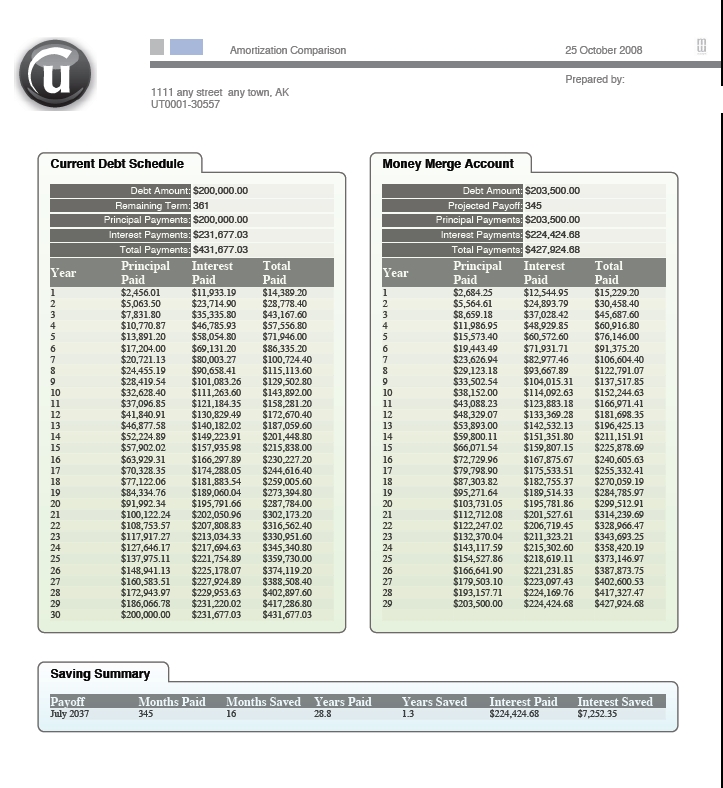
Note: you may right-click the image to open it in to a larger size for easy viewing.
The potential client asked the agent to run the standard scenario ($200K, 6%, 30yr fixed) but with no extra payments. She (the agent) insisted that the software would not go that low, and said she put in $25/mo extra. OK, do the math. Total paid = $427,924. Months paid = 345. Well, that divides to $1240.36 which is $41.26 more than the $1199.10 required payment, and not the $25 she claimed to enter. Further, in her example, she claims to have saved $7252 in interest which may be, but at a cost of $3500. When I enter $25 into my own excel sheet (or any mortgage calculator) as an extra payment I find the mortgage over in month 341, and total interest saved to be $14966. This is with no HELOC shuffle, no sophisticated algorithms, or factorial math for that matter. The most important question you must ask is where did all the claimed savings go? MMA saves you $7252 (since I can’t see the calculations behind it, I’ll take her number at face value) vs straight prepayment saving you $14966. So as I hope to get close to the end of this series, I again state how I fail to see any value at all in the MMA process. The numbers here show that if it were free, it would still bring you up short $7714. The month end prepayment takes no time at all, just add what you will to you mortgage check. MMA requires you to consult it daily so it can perform billions of calculations. All that math, and what do you get? You get to pay $3500 to come up short $7714. By the way, when the potential client asked the agent about the monthly extra payment looking higher, the agent replied to him “The $50 a month is technically only $25 because the program thinks you’re being charged $25 a month for a service that is now included. The analysis software is still showing this charge, which is why I added the extra discretionary income. However, it is canceled out by the $25 charge in the analysis, so it is really only working with $25 a month when it shows $50. Sorry that is so confusing. Have your friend run your numbers with $25 a month to compare apples to apples.” Huh? Ok, I used $25, and MMA lost. Badly. The agents like to say “it’s math, not magic.” Amen to that.
Joe
(I invite any agent to correct the analysis sent to me. In fact, I invite any agent to write a guest post which I will publish unedited, aside from obvious typos. I will not even comment on it until the next Thursday, if at all.)
{ }
by Joe
on December 3, 2008
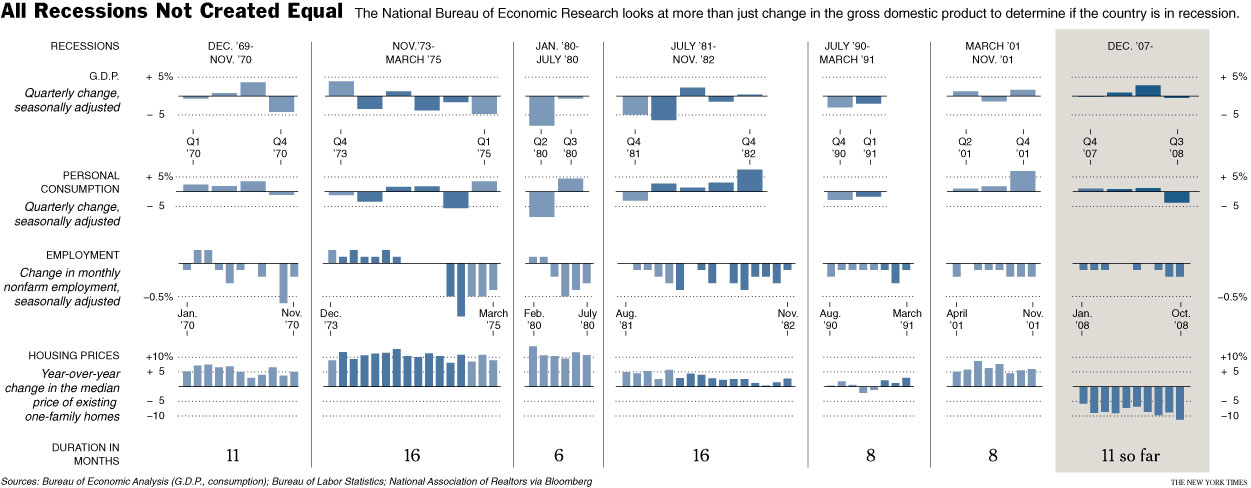
It would appear that the definition of recession is far more complex and more than “two quarters of negative GDP growth.” We found out last night that we are already 11 months into the current recession. This beautiful graphic (well hidden within the New York times website, so while I saw it easily on my iPod Touch last night it took quite some time to find it on the web today) illustrates some of the factors NBER (National Bureau of Economic Research) takes into account. Click on it to view full size. More on this story Friday.
Joe
{ }
by Joe
on December 1, 2008
As you know, this past Friday was Black Friday, and today is Cyber Monday, when the big online shopping deals start to sprout.
So, in keeping in the spirit, I offer this link to a great magazine deal. In one of my posts regarding how to find the extra money to save or pay down credit cards, I suggested that one of the first steps is to look at one’s magazine purchases. It’s easy to drop $10 each week without paying too much attention. One magazine offered is Entertainment Weekly. $3 per week in the supermarket, $10 for a year on this deal. If you only buy it once a month, that’s still $36, and you’ll still save $26 over the course of a year. This deal is scheduled to end on December 11.
Joe
{ }
by Joe
on November 29, 2008
As a lifelong Trek fan, I couldn’t pass this one up.
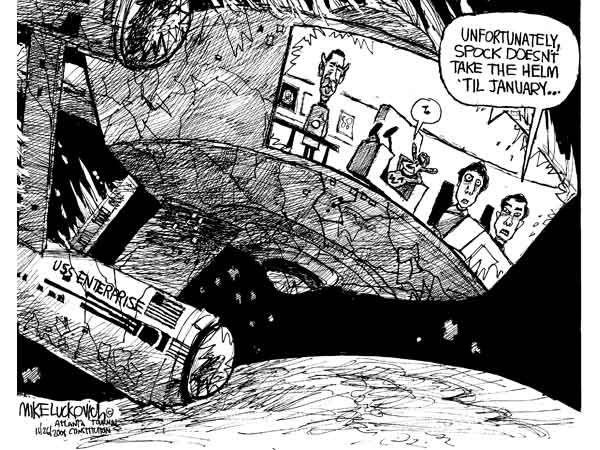
January 20th can’t come soon enough.
Joe
{ }