≡ Menu

And today, a guest post from Derek –

I once heard this statement at a business seminar and I have never forgotten it, “Put all of your eggs in one basket and watch that basket grow.” I know a few people that own multiple businesses and do not have the proper system that allows them to escape from any one of their businesses. They are constantly performing a juggling act with their businesses and seem to never get ahead. They just don’t understand it, but when I stand there on the outside looking it, I can see very clearly that they lack focus.

Without the proper focus, their businesses are all struggling. They fail to get traction because there is not a consistent focus on any certain business. Instead, the owner jumps from one emergency to another, never taking the time to do what is necessary to make their business grow. If they were to sell off all but one business, they could almost certainly increase sales and revenue of that business, perhaps to a size that would be greater than all of their businesses combined. Focus is a powerful thing, and if you put everything you’ve got into that one idea (or basket as it were), you can grow your business more rapidly than you ever thought possible.

Take This Principle Into Your Retirement Fund

We are often taught to diversify when it comes to investing, and this is most certainly a good idea, but no one ever said that you should have six or seven different investment firms handling your money. If this is your method for your retirement funds, you might actually go mad before you reach retirement age! Let’s say you are actually able to keep all of your funds straight. With all of these different brokerages, what are the odds that you will actually earn more money than anyone else? I am willing to bet that with all of that confusion you are putting on yourself, you will almost definitely do worse.

By putting all of your money into one super fund, you will allow yourself to do everything you dreamed of in retirement – skiing, hiking, traveling, cruises, and spoiling your grandkids. There are so many things that your retirement fund can do for you. Don’t waste it by trying to complicate your investments. Superannuation is the answer to all of your retirement needs. Click here to find out more about superannuation.

{ 0 comments }

Doing the Math on an Online Savings Account

I’ve frequently said to “do the math” and this guest post just helps drive home this point –

When you’re figuring out where to put your money, you have to do a lot of math and planning. The planning part is to help you figure out how to amortize your finances throughout your life, and the math part is to make sure you get the best possible return on your investment.

Today we’re going to look at online savings accounts, but first I want to focus just a bit on these two questions of math and planning, so you understand where I’m coming from.

How much money do you have, and when are you going to need it?

This is always the first set of questions you need to ask yourself before you put your money into any type of savings vehicle, from an online savings account to a Roth IRA. How much money do you have right now? Do you plan to earn more money that can be saved (vs. money that must be spent right away) in the future? Do you expect your earnings to grow over time, or do you expect your earnings to decrease soon? (A young person starting a career might expect earnings to grow; a couple planning a family might expect earnings to decrease if one partner quits a job to take care of the baby.)

When are you going to need your money? Are you planning to buy a house? Move to another state? Do you anticipate becoming the primary caretaker of young children or aging relatives? Do you want to go back to school?

Before you can start thinking about how to save and invest your money, you have to take some time to answer all of these questions.

Understanding money math

Once you’ve taken a look at the planning question, it’s time to start understanding all of the mathematical terms involved in saving money. Do you know what APY means, for example, and how to calculate it? Do you know whether a given interest rate is calculated daily, monthly, or yearly? Do you know how to effectively calculate the risk of any given investment?

If you’re not up on your money math, it’s time to take a refresher course. Joe Taxpayer has many great articles on how to calculate the true value of investments, savings accounts, and financial opportunities. Take some time to read through this site, and learn how to apply Joe’s tips to every new financial offer you encounter.

Online savings accounts: a good mathematical solution for short-term savings

There are a lot of solid, fixed-rate investments out there, including certificates of deposit (aka “CDs”) and goverment-backed Treasury bonds (not to be confused with Treasury bills — and read this if you want to learn all of the math behind Treasury securities).

However, one of the most solid investments out there, especially for new savers, is the good old-fashioned savings account. Compound interest is one of the first lessons we learn, financially, and it still applies. An online savings account is even better than a brick-and-mortar savings account because the money saved on overhead goes back to you. Online savings rates by Discover Bank, for example, are at 0.80% APY as of November 14. That means that if you put an initial $1,000 in the account, then add $200 every month, by the end of the year you’ll have $3,418.39 including interest.

Why are online savings accounts good mathematical solutions for short-term savings? Because any gains made by putting your money into a higher fixed-rate investment, such as a CD, are wiped out if you have to pull that money out early. Remember the questions we looked at earlier regarding when you think you’ll need your savings. If you put all of your money into a 24-month CD, and then you decide to get married/buy a house/have a baby, you have some problems to solve.

If you’re thinking short-term, the online savings account with a high interest rate is the way to go. Or, if you’re thinking medium- to long-term, combining an online savings account with some longer-term investments is a great way to have money when you need it as well as plan for the future.

If nothing else, your money should at least rest in an online savings account before you transfer it to your Roth IRA or 529 College Savings Plan. Every day you have extra money is a day it needs to be earning interest for you — and online savings accounts are set up to help you make that happen.

In conclusion: the next time you come into some savings, start thinking about math and planning. If you plan on spending your money soon, put it in an online savings account; if not, use what you know about money math to find the best possible long-term investment.

{ 1 comment }

A Quadradical Roundup

Anyone that starts their article with the Quadratic Equation certainly gets my attention. And I’m sure that was The Financial Buff, Harry Sit’s goal with his post How Many People Contribute The Max to Their IRA. This was a roundup in its own right, and Harry shared what he read the prior week.

At Generation X Finance, a Credit Karma Review. I’m a fan of this company and have written a number of articles on different components of the credit score with information supplied by Credit Karma. For a great overview and review, check out the article.

Food Stamp Reform: Unethical or Overdue? This was the question asked and answered by Jessica Sommerfield at MoneyNing. It’s easy to find examples of fraud wherever we look, and this social program is no different. For every 100 people who genuinely need some support, there are going to be some who are drawn into the spotlight as frauds, gaming the system. I think all programs should have proper oversight, but in the greatest country on earth (ok, I’m biased) there’s no excuse for us not to help keep our citizens from starving.

Next, Barbara Friedberg offered her book How to Get Rich; Wealth Building Guide for the Financially Illiterate for a special deal just until Tuesday Nov 19th, at $.99. I’ve not read it yet, but here’s my change to do it for less than a buck. As I’ve written recently, I’ve met Barbara a number of times, and had great discussions with her. I know her book will be a great read.

Clever Dude’s Brock wrote What Would You Do? Money Left Behind in the Self Checkout Lane. The story is simple, money left at the self check-out at a Walmart. Would you take the money? Turn it in? If instead of $20, it was a full wallet, more money plus a license, would your answer change?

We’ll wrap the week up with Roger Wohlner’s question – Do You Have a Back-Up Financial Plan? It’s pretty simple, like happens, jobs are lost, people get sick, have accidents, get divorced. Few people get through life with no bumps. What’s your back up plan?

{ 1 comment }

Black Friday, Too Early

blackturkeyday

The cartoon says it all, Black Friday is creeping right into Thanksgiving, and ruining the holiday for many who are forced to work on this day we should all be home.

{ 0 comments }

Frugal Friday Week 47

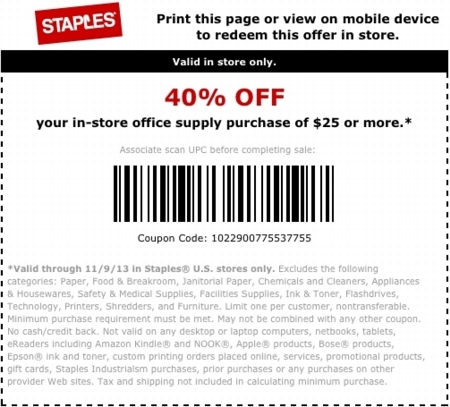
The week in which I mention my very odd interaction with Staples. It all started with this coupon. Wait. It all started with a new TI calculator. High School students I’ve been working with are using a pretty high end TI calculator, either the TI-84 Plus Graphing Calculator or the newer nSpire CX. These bad boys cost $120 or $150 respectively. My issue wasn’t that I need the calculator to solve any problems, after all, these things weren’t invented when I was a kid, but rather, knowing how to use them to help the students with questions they are solving on the calculators. So, a couple weeks back I decided I’d like to pick up the higher level model. It was just a matter of finding it on sale or a used one on eBay. Then this coupon appeared in my inbox.

staplescoupon

The question was, what is an “Office Supply”? The coupon listed things that weren’t permitted, no Apple or Bose products, for instance. No ‘technology’ either. Hmm. So I hop on to a chat with customer service. I write the coupon code and specifically ask what technology is, was a calculator excluded? No computers, laptops, netbooks, etc. The agent said ‘yes’ you can use this on a calculator, that’s not considered technology. Print that chat transcript. I then check for stock, and since there’s a Staples 5-6 miles away in every direction, I pick one and reserve a calculator. Nice process.

But. I get to the store, wait on line as there was one line for register and customer service/pickup. I get to the front and the cashier has to call the reservation guy. He says they had none in stock, despite what the web site told me, but he’ll order me one. He doesn’t like the coupon, but after seeing the chat transcript, he processes the paperwork to order it. But I have to go to the register to pay. Meaning I have to wait on line a second time. But when I say this out loud, the line parts like the Red Sea and says I should go ahead. Very nice of them, really. Now at the register, the coupon is still a problem, and I ask what items it was actually intended for? Even paper is excluded. I then show the cashier my chat transcript, and he overrides the system. $150 calculator is now $90. I like the idea of waiting at least a week for each $100 you plan to spend. So when I saw this calculator, I read the manual online, and thought about how much use I’d get from it, I then planned to wait 2 weeks to make the purchase.

I have to say, Staples made good on their mistake. That fine print is just a bit much.

{ 0 comments }