≡ Menu

You want to lend that couple how much?

I had an experience I was planning to share and after writing about Student Loans and Your First Mortgage, today is the day to do it. In that article, I wrote that a couple earning $100K could afford a house worth as much as $465K if they had a 20% down payment saved up. I actually think this is on the high side, but given how low rates are today, the numbers work.

If you’ve not read the article earlier this week, I used two ratios, 28% of monthly income to go towards housing cost, and 36% to total debt servicing. This is how responsible banks qualified borrowers before the mid-2000 bubble that nearly destroyed the economy.

On a personal note, I am taking the state mandated 40 hour class that will let me sit for the real estate salesperson exam. (Note – the word Realtor is trademarked, one has to have the license to become a Realtor, but not all real estate agents are Realtors.) That said, the class is offered over 4 consecutive Saturdays, a long day, 10 hours of stuff we’ll never use after taking the test. We were honored to have a guest speaker join us, a Mortgage Broker who talked a bit about her business. When she got to the qualifying ratios, it wasn’t 28/36, but 43/50. To compare to my numbers from the prior article, 43% is just about 1.5 times 28%, so this broker is saying this couple can borrow not the $372K I calculated, but rather, $558K. She was also pushing loans with as little as 3% down.

mortgagebroker

She was quick to point out that Real Estate Agents are not supposed to offer financial advice to clients, and that since she knew more than everyone in the room, we should just send our customers her way. (She literally said, “I know more about mortgages than any of you.” I decided it would be pointless to challenge her. We all just wanted her to leave so we could get through the material.)  It’s interesting for me to see that these mortgages are even available, the bubble and crash aren’t even 10 years behind us. I can understand the downpayment is tough, and if a buyer with good income can qualify for a mortgage with a decent debt to income ratio, that’s fine. But the thought of selling someone a mortgage that will put their debt service to 50% of their gross income should be criminal, in my opinion.

I’ll leave you with one final thought. Say this $100K couple gets in too deep, and for 30 years skips the 401(k) matched deposit of 5%. $10K each year for 30 years will grow to $1.1 million at an 8% rate of return. I know, it’s not that simple, but when people get in too deep, something has to give. Would you be comfortable if the Mortgage Broker told you not to worry about having half your gross pay going to service your debt? I don’t think I’ll ever refer anyone her way.

{ 2 comments }

Student Loans and Your First Mortgage

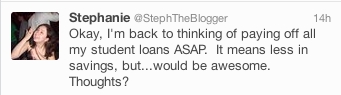
Is it wise to have no debt at all when you are planning a mortgage in the not-too-distant future? That’s what I was pondering after a blogger I follow was considering wiping out her student loan.

stephloan

If you’ve not read Stephanie’s blog, Graduated Learning, you might give it a try. The tag line is “I got my degree, I got a job…now what?” Not just any degree, Stephanie is an MIT graduate. Now, to her shared thought bubble above. Here’s what we know, she has a 2.75% student loan, enough cash to pay it off, and an engagement ring on her finger. No high interest debt, else that would surely be the priority for payment. Let’s look at how paying off the student loan might impact the size house she and her new hubby can buy.

We’ll make some assumptions, to offer a general idea of why you should or shouldn’t kill that last bit of debt before buying your first house. We’ll keep the math simple and start with a $100K salary. Engineering grads are starting higher than $50K, but $100K makes it easy for you to scale up or down to your our salary. When applying for a mortgage, the old ratios used to be 28/36. This means that monthly housing debt can be up to 28% of monthly income and total debt, 36%. In this example, 28% is $2333 per month. Let’s set aside $500 of this for property tax, and look at an $1833/mo mortgage payment. The 30 year fixed rate is just under 4.25% right now, so my trusty TI35 calculator tells me the new couple can afford a $372,600 mortgage. With 20% down, this is a house purchase of $465,750, and the down payment is $93,150. For most people, it’s not the mortgage that’s the deal breaker, it’s the down payment. The money she might wish to use to pay off the student loan will be very precious when she and Mr Blogger are house hunting.

Paying off the debt won’t put them in a better position, either. You recall that I mentioned that total debt service can be 36%? That 8% gap from 28 to 36 is $667/mo. Enough to support payment on a 10 year student loan of nearly $70K. You see how this works? The payment toward the loan isn’t impacting their ability to get a mortgage, and paying it off wont enable them to get a higher mortgage. But the ability to put 20% is pretty important. Imagine finding the right house, all is perfect, location, size, price, etc. But having paid off that student loan, they are a bit short on the down payment, and need to wait 6 months to save up again. Better to pay the 2.75% loan’s minimum payments, and in a year or two, after they are settled in the house, see if the emergency fund is topped off. And the retirement accounts are funded at least to the match. After that, if they wish to get rid of that low interest debt, no problem.

Last – the area we live in, not far from Boston, isn’t near the US average. Home prices can easily exceed $500K without living in a McMansion. And living too far from one’s job can result in 3 hours of daily commuting time. But again, these numbers are just an example to illustrate the need for that down payment and how the 28/36% gap can work to your benefit.


{ 3 comments }

Veterans’ Day 2013

It’s Veterans Day. In contrast to Memorial Day, when we remember those who were killed while serving in the armed forces, I feel that today is even more important, a time to show our gratitude to those who served and are still with us. Too many return and find themselves jobless and even worse, homeless. It’s awful for homelessness to be any issue in this country, but doubly so when we’re talking about those who risked their lives for the rest of us. One of the charities I list below to the right is the Center For Homeless Veterans. They are in Boston, and do a great job, not just giving a handout, but training Vets to find work and live independently. Consider donating to them or a Vets shelter closer to you.

iwojima

This is the iconic Raising the flag at Iwo Jima. It became a symbol of the end of World War II.

{ 0 comments }

Bringing in More Sales

A Guest Post From Crystal –

It’s no surprise that every business wants to bring in more sales – that is kind of the whole idea of running a company. However, few outlets, both large and small, utilize everything at their disposal to bring in these sales. Instead, the same old tactics and services get the nod and customers just don’t respond to boring advances. To counter this malaise, try to break the mold and reach out in different ways. Once the sales start rolling in, you won’t be disappointed with the time and effort you put in to try something new.

Connecting with Facebook and Twitter

At the heart of eCommerce is the social media explosion. Sure, your website is a big part of the picture, but if you can’t connect with your customers in a meaningful way, you can kiss their expendable income goodbye. To reel them in, try building a Facebook and/or Twitter account. With these tools at your disposal, you can offer content and information that draws in shoppers from across the Internet. An added bonus is that every time someone likes, retweets, or saves your posts in “favorites”, their social network is exposed to your product, creating a self-propagating campaign.

Build a Better In-store Experience

For the more traditional shoppers, the in-store experience still counts for quite a bit. To cater to these customers, consider adding in new point of sale machines and other comforts to the store. These machines, in conjunction with computer terminals that can access the online store, create a full-service approach that covers every need imaginable for those who visit your store. On your side of the equation, you can gather more information on the shopping habits and trends in the consumer base. But more on that later.

Offer Online Discounts

Getting back to the eCommerce initiative, spice things up with coupons and discounts that are only available to shoppers who make purchases on your official website. This action not only helps pump up sales, but also spurs overall sales numbers to higher levels. Consumers love a good deal, and if you give it to them, you can reap the rewards via enhanced volume over higher margins on individual sales. If you need to give your website a jolt after its initial launch, this approach can pump in traffic and get your page on the map.

Up Your Analytics

All of these tools, from pushing social media to building a better in-store experience, lead to a better, more viable business. However, this final result can be rather elusive if you don’t know how to interpret changes and trends that occur through these channels. To avert this issue, look into the analytics of the business process. This means reading into website and social media traffic, as well as pinpointing trends in the greater Internet realm. By knowing what shoppers like, before the fad or trend ends, you can match your products and services to these changes and maximize your profits. Combining these two factors is a clear and simple recipe for business success.

{ 0 comments }

A Muppet IPO Roundup

Another interesting week in the market and in the PF Blogosphere.

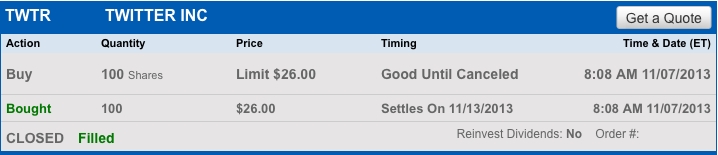
We start this week with a post from Bargaineering, Your take: Is investing in IPOs smart, or strictly for muppets? My own answer? It depends on whether one gets IPO shares at the IPO price or if the price is the elevated price at the open of trading. I was fortunate to get 100 shares at the IPO price, and will hold on to Twitter for a while. I wouldn’t have bought it at $46.

twtr

My friend J. Money is Obsessed With Rich Habits, because Tom Corley’s site Rich Habits offers some great reading. I hope Tom isn’t insulted when I say his work reminds me a bit of the work of Dr Thomas Stanley, author of many best sellers, The Millionaire Next Door and Stop Acting Rich among them. As long as we are a country of spenders vs savers there’s room for this message to be offered by many writers. Nice find, J.

Nerd’s Eye View’s Michael Kitces wrote about The Impact Of Taxes On The Safe Withdrawal Rate. We keep hearing about how 4% is the rate we can withdraw funds from our retirement accounts, but how do taxes affect this number? Michael explains.

Black Friday. Even the name sounds ominous. After all, Black Tuesday was bad. Very bad. You know what Black Friday is – the day after Thanksgiving, when stores offer prices to entice us to go save money on things we never needed in the first place. At Five Cent Nickel, Psychology of Black Friday: Motivation behind the pursuit of deals. If you miss reading this article, you will risk having your pocket picked on Black Friday.

Ask the Readers: High-deductible health insurance: yea or nay? A post at Get Rich Slowly that grabbed my attention. I’ve always felt that real insurance had a low premium, but a high deductible. In other words, I’m protected from the disastrous expense an accident might cost me, but would pay for routine doctor visits out of pocket. Ellen Cannon discusses her take on these plans.

Miranda Marquit guest posted at Investor Junkie, Is Your Company’s 401(k) a Good or Bad Plan? Miranda wrote “With many small businesses, you might pay between 1.5% and 2%.” 2%? I think there’s a special place in hell for those who run plans that charge 2%. If your 401(k) is 1% or over, deposit to the match, then run the other way. It’s that simple.

{ 1 comment }