by Joe
on September 11, 2008
As I posted in July, I feel some continued discussion of the Money Merge Account is in order, as many people seem to be getting caught up in the hyperbole. But I am committed to a more general readership, and toward that audience I will keep my MMA posts to appearing on Thursdays. As the dialog regarding this product continues in the blogosphere, I’ve spent quite a bit of time studying the numbers and writing a series I introduce today. If this topic is of no interest to you, forgive me and please move on, but again, this will be limited to a once per week series until I’ve exhausted the topic, and my patience.
Joe
I’ve posted in the past on the Money Merge Account and thought it was time to do a deeper dive into the pros and cons of this program and how it [claims] to work. The first question we need to ask is “do I really want to pay my mortgage down aggressively?” But that question just leads us to more questions;
- Have I studied my monthly budget? Do I have extra money at the end of each month?
- Am I maximizing my retirement plans? Especially a matched 401(k) with either my employer or spouse’s.
- Do I have any credit card debt or other revolving debt?
- Have I started saving for my child’s college education?
- What is my current after-tax interest cost of my current mortgage?
- Do I believe that the stock market will offer a higher return?
- If my mortgage interest rate is above 6% or so, have I looked to see what a bank will offer me on a refinance?
- If I do refinance, can I afford the payments of a 15 yr mortgage instead of refinancing to a new 30 yr fixed?
- Do I have an emergency fund? If not, am I able to borrow at low interest from an equity line should I have a short term emergency?
You see, the same emotions that would have you feeling so good that you will pay your mortgage down super fast will have you feeling miserable when the furnace goes, and you realize you have to pay for it off your equity line as you have no cash savings at all. Those who cite the current subprime crisis as a reason to pay your mortgage off so fast actually have it backwards. If you bought a house 5 years ago, and found you now live in a house worth far less than the mortgage, you’d have a decision to make whether or not to walk away. But if you paid so aggressively that your mortgage is already half paid off, you’ve just watched as you poured money down the drain and lived on a fraction of your income to do so. Note: I don’t recommend that anyone walk away from their house and mortgage obligations, I just want to make the point that the subprime situation is not a reason to pay one’s mortgage faster than they need to.
Next week – a closer look at the interest rates
Joe
{ }
by Joe
on September 11, 2008
I continue to post regularly, three times per week, minimum, usually more often. I’ve discovered that the feedburner system is a bit unreliable lately, my posts appearing to be three or more days stale. If you read my site thru an RSS reader, please be patient, as I expect they will fix this shortly. You can always visit the site directly for the latest posts.
Joe
{ }
by Joe
on September 10, 2008
The word schadenfreude means “taking pleasure at someone else’s misfortune”. I was seeking the opposite of this word and found the word “mudita”, which is “happiness in another’s good fortune.” Which leads me to the topic of today’s post.
Back in March, another blogger, whose blog is titled Unequivocal Notes said she was considering a gold fund, and I posted a brief comment to try to steer her away from that idea. In a follow on post she confirmed that she chose other funds and passed on the gold. So, I was recently thinking about this, and wanted to see how her choice is doing.
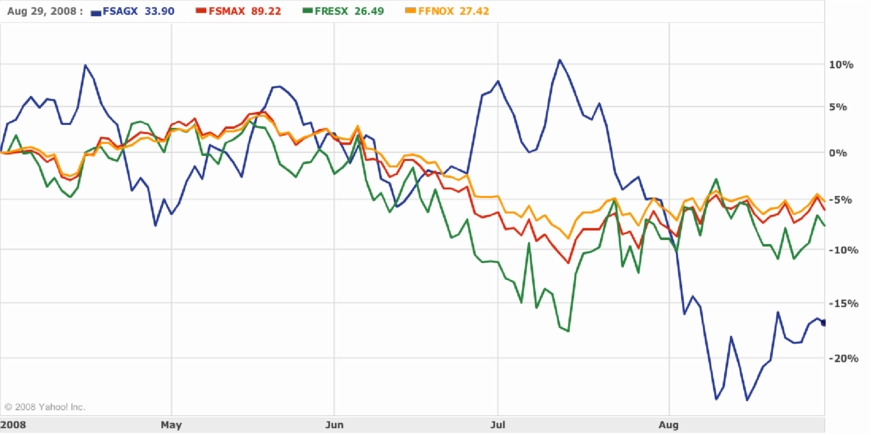
The good news for my blogging friend, is her choice of FFNOX is down just 5% compared to the gold fund’s near 17% drop, and actually was a bit ahead of the S&P index. When someone benefits from my advice, it’s mudita to me, as I hope that I can help others avoid the mistakes I’ve made, and share what I’ve learned.
Joe
{ }
by Joe
on September 8, 2008
Loaded up on your company stock? I hope not. You see, one of the basic mistakes I see in many clients’ investment portfolios is the (too) large amount of their own company stock, especially in their 401(k) accounts. You might think that you’re close enough to the business that you will get out before the stock would ever tank. If so, you are one of the select few. Your ongoing employment and stream of income is tied to your job, to protect yourself, you should consider limiting your company stock to no more than 5% of your portfolio’s value. Compare one blue chip company, Motorola, to the S&P since the beginning of the decade:
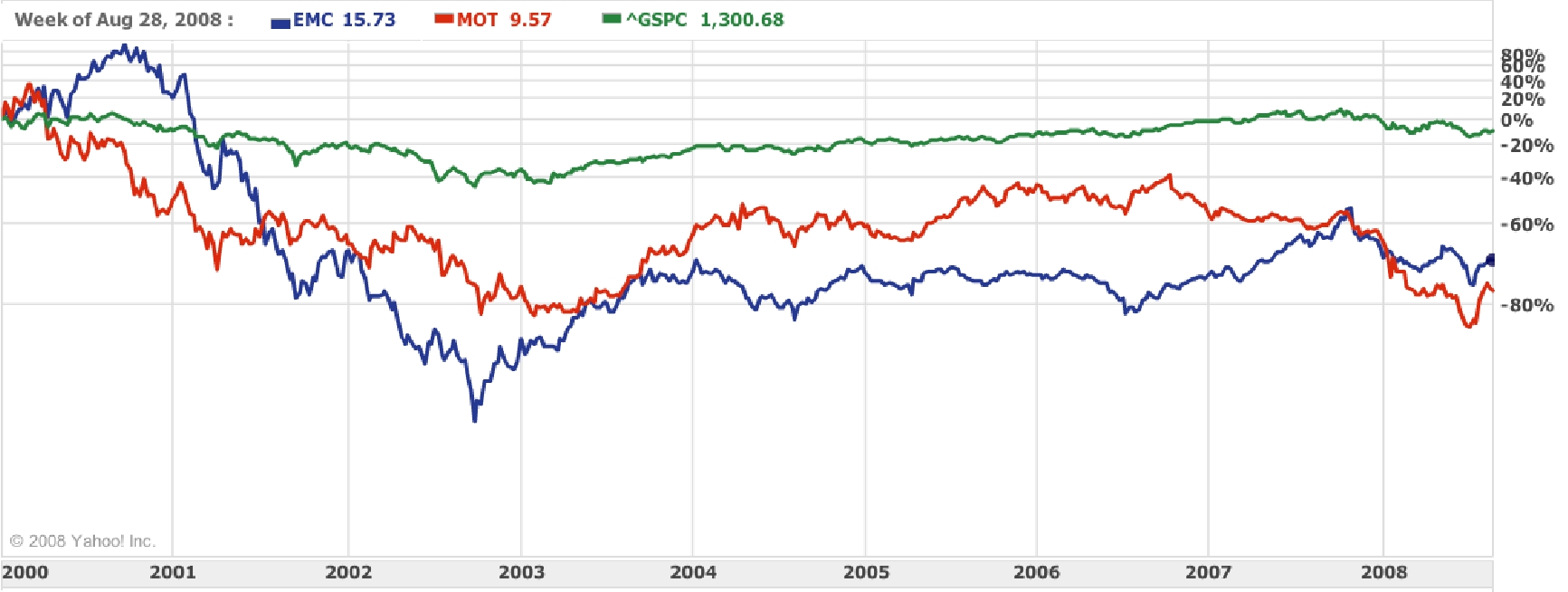
Now, to be fair, there are countless stocks that have kept up with or exceeded the S&P, but this is an example of one not so fortunate. S&P down about 10% (up, if you include dividends), but MOT down close to 80%. (Note, I added EMC as well, down 70% for the decade to offer another example.)
Joe
{ }
by Joe
on September 7, 2008
There’s a difference between blogging, writing on a specific topic, and being a software savvy person. This is why you see people using blog templates and the WordPress application. I was happy with my current design with two exceptions. The sidebox containing the PF blogs RSS feed did not list the original authors, and the search box just looked out of place. I tinkered a bit but was unsuccessful. I then found a fellow blogger with the skill that I lacked, by the name of Mrs. Micah, who has her own financial blog and is founder of The Finwikian, which I contribute to. A reasonable fee and a few days later, and I’m happy thrilled with the results. These were exactly the changes I was looking for. In a world where customer service always seems lacking, it’s such a pleasure to find a talented, knowledgeable person who gets the job done. Thanks, Mrs. Micah!
Joe
{ }