
From StateHouseReport.com
Enjoy the weekend
Joe
Back in July, I wrote a post “Loving That Roth” where I discussed why the Roth account was a great deal for a select portion of savers. I went on to discuss how few people could save their way into a higher tax bracket and that the use of a Roth 401(k) should be considered very carefully as it would ignore the lower rate most of us will retire into. A fellow blogger posting under the moniker jIM_Ohio shares my view, offering his own brief post last month, “The 15% tax retirement account“. As I look at Jim’s post, I realize its brevity is its strength. I tend to offer much data to support my views and often that obfuscates the issue at hand. To the other extreme, I offer the article, “Thinking About a Roth 401k Think Again” from the Journal of Financial Planning.
The JFP article closes with “Those properties [of Roth compared to traditional 401(k)] indicate that for most moderately affluent wage earners, today’s marginal tax rates and the associated government subsidy for retirement contributions are likely to markedly exceed effective tax rates tomorrow, when that subsidy must be cashed out.”
Anyone interested in the Roth vs Traditional 401(k) or IRA discussion should read the article from JFP, and decide how to approach their own situation. As I’ve stated prior, their are few absolutes in financial matters. When I shared my thoughts in one forum and suggested that Roth was appropriate for maybe 5% of people currently working, I was told that the particular forum only contained a selection of high income people who saved above average, that most of that group would benefit from Roth. It reminded me of surveys that showed that 10% of people believed they were in the top 1% of earners. And all of their children were above average.
Joe
Last week, the Q2 ’08 number was revised to 3.3% up from 1.9%. This may be attributed to the stimulus package, or an increase in exports due to the lower dollar, but it’s good news and far from the depression some were forecasting.
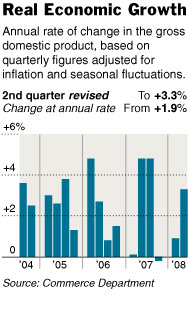
Perhaps we’ll avoid a recession altogether, and Q4 ’07 will be the only quarter of contraction. Time will tell.
Joe
Back in July I saw this telling graphic on the Times’ web site:

It would appear we are looking at a 30 year fixed rate nearly 1.5% higher than the low of 2003. Let’s compare the above to the 10 year Treasury chart below:
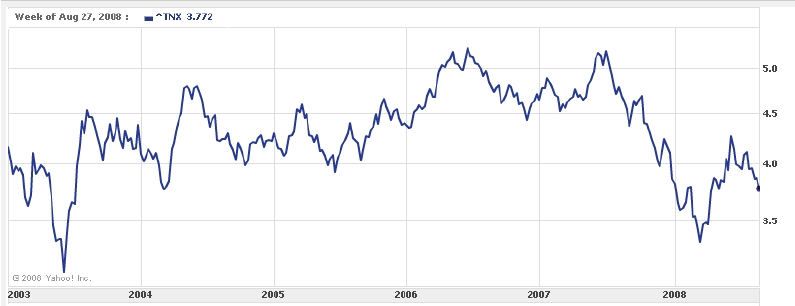
It’s clear that mortgage rates did not follow the Treasury’s recent rate decline due to the subprime issues. Looking at the impact on home purchases, I calculate that the $1380/mo payment that would finance a $250K loan at 5.25% will now only support a $213K loan at 6.71%. This is nearly 15% less purchasing power due to interest rates. I’ve remarked in the past that the rise in home prices (by that I meant median home prices) did not show any bubble forming. In two articles I wrote, aptly titled Housing Bubble and Housing Bubble Part 2, I offer charts showing wage and interest rate adjusted cost of home ownership, and from the late 80’s right to 2004 showed no decrease in affordability at all.
Joe
Regular readers of mine know that I am anti-Variable Annuity, one of my first articles on my main site JoeTaxpayer.com was titled “Variable Annuities are sold, not bought”. More recently, I quoted Suze Orman, who “hate[s] them with a passion”. That blog post received much response from readers challenging me to be more open minded. So I invited those readers to offer me a VA that they felt was worth a fresh look. In my August feature article titled “Another Look at Variable Annuities”, I analyzed the Fidelity Growth & Guaranteed Income Annuity. It’s a piece worth reading and as always, I invite any comment. In it, I conclude that the product doesn’t achieve what the typical buyer is seeking, inflation protected growth. I was challenged to suggest an alternate solution and in this month’s feature article, “Creating an Inflation-Adjusted Immediate Annuity”, I offer a strategy to create an inflation-adjusted stream of income from the purchase of a series of standard (non-adjusted) annuities. This is a strategy I am proud to present as I’ve not seen such a strategy presented elsewhere, and it offers both a high starting withdrawal rate (5%) along with conservative assumptions (4% inflation factor, yet just 3% return on savings). Please read it and share your thoughts.
Joe