≡ Menu

The Logic of Life

I recently read “Logic of Life” by Tim Harford, and found it to be interesting reading. The subtitle, “The Rational Economics of an Irrational World” was exemplified by most of the anecdotes shared by the author. Publishers Weekly review offers “this book will be of great interest to Freakonomics and Blink fans as well as anyone interested in the psychology of human behavior” and I’d concur. Similar to Freakonomics, Logic of Life is a series of short offerings, here, grouped into 9 chapters, each chapter expanding on a common theme.

For instance, the subject of racial segregation is discussed with an analysis using a chessboard. The board is filled with black and white pieces matching the colors of the squares, i.e. half white, half black, all interspersed. We see how after randomly removing some pieces (people moving out of the old neighborhood) and adding some more (people moving in), the board no longer looks evenly arranged, there are now clusters of one color which in real life attract more of that color. (This concept was conceived by Nobel Prize winner Thomas Shelling and referred to as “The Schelling Segregation Model.”)

Tim Harford touches upon such varied subjects as gambling, the mismatched availability of single men vs single women, and the process of ordering meals when you know the bill is split N ways among the guests. Books such as this offer a different way of looking at the world, one sliver at a time. Many of the issues brought up can certainly be expanded into volumes of research, especially where the issue of race and racism were discussed, the author opening the door to a spin on a variety of issues.

Joe
{ 0 comments }

A Recipe For Disaster

Sometimes I struggle to choose a title for my posts. You see, there are many times that a potential reader will glance at a title and read or skip the post based on those few words. Other titles I considered for todays were, “Did Congressman Hinchey cut class that day?”, “Stupid Congressional Tricks”, “Repealing the Law of Supply and Demand”, and “Hinchey is a @#$%’ing moron”. That last one was a bit harsh as I have no other experience with this Gentleman from New York, and this post is regarding this one story that came to my attention.

Straight from WBNG (Binghamton, NY) news comes this news soundbite; “In the short term, Hinchey will outline a variety of new legislative steps on which he is working, including a bill that would give the president the authority to cap gas prices at $2.49 per gallon.”

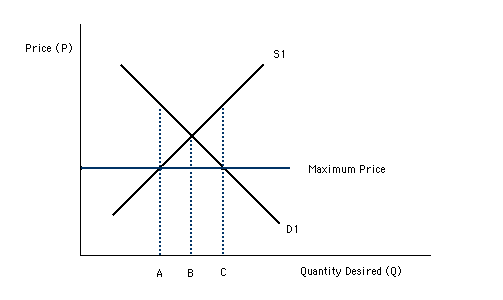
Let me offer a simple, but illustrative, image to help explain the absurdity of this proposal;

supply/demand curve

I first presented this last August in my post “Anti-Gouging sounds like price controls to me“. This chart is the classic supply and demand curve. The two lines intersect at point B, the point at which the amount demanded is the same as the amount supplied. If we were to lower the maximum price allowed, the demand of course would go up, yet at the same time the seller is less willing to offer as much product at that lower price. As an article on price control from The Concise Encyclopedia of Economics offers,”When the U.S. government set maximum prices for gasoline in 1973 and 1979, dealers sold gas on a first-come-first-served basis, and drivers got a little taste of what life was like for people in the Soviet Union: they had to wait in long lines to buy gas. The true price of gas, which included both the cash paid and the time spent waiting in line, was often higher than if prices were not controlled at all.” Short term, I don’t have the answer for the current problems we are facing. I do know that oil has limited supply at a given price. At a higher price, old wells can be reopened and deeper wells can be dug at a higher cost. I also know that not nearly enough has been done to improve the efficiency of alternative fuels, specifically, wind and solar. While Congressman Hinchey is at it, he may as well propose that President Bush repeal the law of gravity. That proposal is no more absurd than interfering with the law of supply and demand, and no more chaotic in whatever the results.

Joe

{ 2 comments }

Gold ready to crash?

Back in September, I wrote an article titled “All That Glitters“, and expressed my thoughts on gold as an investment. Recently, I’ve seen more charts that compare the price of oil and gold by forming a ratio, the number of barrels of oil that an ounce of gold will buy. First, on CNBC’s Kudlow and Company, and more recently in an Economist article borrowing my September story’s title. From that article, I offer this chart:

Oil to Gold ratio

What conclusion do we draw from this chart? Gold priced too low? Oil too high? I believe both are in bubble territory, each for its own reason. Only time will tell who is the right prognosticator.

Joe

{ 0 comments }

Emergency Funds

There is a ‘rule of thumb’ out there that one should save 3-6 months salary (net, I assume) and from the near 16,000 Google returns on “emergency fund” “rule of thumb”, it would seem this is a hot topic among financial concerns. At Master Your Card, Kristy on Monday discussed the importance of the emergency fund, and while I agree with her that you shouldn’t put those funds into stocks, which may or may not be down at the very time you need the funds, I am concerned about the priority most attribute to the fund.

You see, most financial rules, are just that, generalizations that may apply to many/most of the readers of such advice. It’s easy, however, to offer examples where the rule(s) need some modification once the rest of the situation is understood.

For emergency funds, first, does your company have, and do they provide any matching contributions, to a 401(k)? If so, this is my highest priority. Some companies match as much as the first 6% of an employees’ salary deposited into their 401(k). On $50,000/yr, that’s $3,000 the company will match against your $3,000 deposit. In the 25% tax bracket, your net cost is only $2,250. Let me spell this out carefully – you are out of pocket $2,250, but now have $6000 in your 401(k)! Do you see why this is my top priority? Should you fund an emergency fund first, or take $2,250 and turn it into $6,000? If you lost your job, and had to take it out next year, you will likely drop to the 15% bracket, and after the 10% penalty for withdrawal, you still take out $4500. A side benefit, also subject to dispute, is that with $6,000 in the 401(k), you now have the ability to borrow $3000 back out, at 7-8%, and use that loan to knock down the high interest credit card debt. Yes, there are those who advise against the 401(k) loan, but in this scenario, it can be part of a kick start to both your retirement savings and debt reduction plan.

From a completely different perspective is an article on MSN titled “The $0 emergency fund“. I think that may be taking it a bit too far. (The link is currently broken, MSN redecorating, it seems)
Joe

{ 4 comments }

Memorial Day

Have a healthy and happy holiday.

Unknown Soldier

You may click on the above image to be taken to US Memorial.Org to learn more about this holiday.
Joe

{ 0 comments }