Making the rounds on the internet, a friend sent me this piece;
Suppose that every day, ten men go out for beer and the bill for all ten comes to $100. If they paid their bill the way we pay our taxes, it would go something like this:
The first four men (the poorest) would pay nothing.
The fifth would pay $1.
The sixth would pay $3.
The seventh would pay $7.
The eighth would pay $12.
The ninth would pay $18.
The tenth man (the richest) would pay $59.
So, that’s what they decided to do. The ten men drank in the bar every day and seemed quite happy with the arrangement, until on e day, the owner threw them a curve. “Since you are all such good customers, he said, I’m going to reduce the cost of your daily beer by $20. Drinks for the ten now cost just $80.”
The group still wanted to pay their bill the way we pay our taxes so the first four men were unaffected. They would still drink for free But what about the other six men – the paying customers? How could they divide the $20 windfall so that everyone would get his ‘fair share’? They realized that $20 divided by six is $3.33. But if they subtracted that from everybody’s share, then the fifth man and the sixth man would each end up being paid to drink his beer. So, the bar owner suggested that it would be fair to reduce each man’s bill by roughly the same amount, and he proceeded to work out the amounts each should pay.
And so:
The fifth man, like the first four, now paid nothing (100% savings).
The sixth now paid $2 instead of $3 (33%savings).
The seventh now pay $5 instead of $7 (28%savings).
The eighth now paid $9 instead of $12 (25% savings).
The ninth now paid $14 instead of $18 (22% savings).
The tenth now paid $49 instead of $59 (16% savings).
Each of the six was better off than before. And the first four continued to drink for free. But once outside the restaurant, the men began to compare their savings.
‘I only got a dollar out of the $20,’declared the sixth man. He pointed to the tenth man,’ but he got $10!’
‘Yeah, that’s right,’ exclaimed the fifth man. ‘I only saved a dollar, too. It’s unfair that he got ten times more than I!’
‘That’s true!!’ shouted the seventh man. ‘Why should he get $10 back when I got only two? The wealthy get all the breaks!’
‘Wait a minute,’ yelled the first four men in unison. ‘We didn’t get anything at all. The system exploits the poor!’
The nine men surrounded the tenth and beat him up.
The next night the tenth man didn’t show up for drinks, so the nine sat down and had beers without him. But when it came time to pay the bill, they discovered something important. They didn’t have enough money between all of them for even half of the bill!
And that, boys and girls, journalists and college professors, is how our tax system works. The people who pay the highest taxes get the most benefit from a tax reduction. Tax them too much, attack them for being wealthy, and they just may not show up anymore. In fact, they might start drinking overseas where the atmosphere is somewhat friendlier.
For those who understand, no explanation is needed.
For those who do not understand, no explanation is possible.
It seems the original Author is not known.
JOE

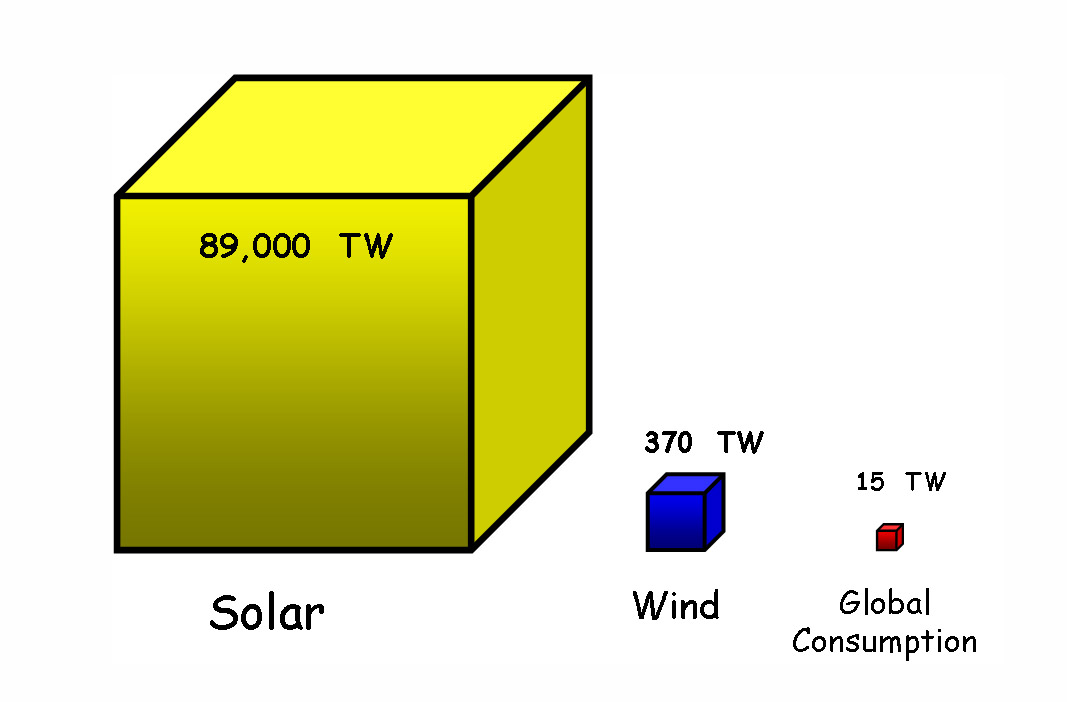 It would seem that there’s far more capacity than demand by a huge 6000X margin. You might object, thinking that this wouldn’t help the global warming crisis, but that’s not so. Energy is neither created or destroyed, in the case of oil, it’s locked up in the oil and released by combustion, heat is certainly created, along with much pollution. In the case of solar, the rays of the sun that would hit the earth are going to hit us anyway. Converting some to electricity to power your home doesn’t create more heat than it would have otherwise. think about this. (By the way, these panels will not take the place of farmland and impact the food supply, as I fear any